Apparently TSM has drawn a new reader. See #10 on my "Who's on Your Site" below:

Dude (or Dudette): Take a break. It'll all still be here tomorrow!
Returning briefly to England from France for a speaking engagement, I bought three of the major dailies to catch up on the latest developments in my native land. The impression they gave was of a country in the grip of a thoroughgoing moral frivolity. In a strange inversion of proper priorities, important matters are taken lightly and trivial ones taken seriously.Read. Every. Damned. Word.
This is not the charming or uplifting frivolity of Feydeau’s farces or Oscar Wilde’s comedies; it is the frivolity of real decadence, bespeaking a profound failure of nerve bound to have disastrous consequences for the country’s quality of life. The newspapers portrayed frivolity without gaiety and earnestness without seriousness—a most unattractive combination.
--
The newspapers confirmed what I had long perceived before I left Britain: that the zeitgeist of the country is now one of sentimental moralizing combined with the utmost cynicism, where the government's pretended concern for the public welfare coexists with the most elementary dereliction of duty. There is an absence of any kind of idealism that is a necessary precondition of probity, so that bad faith prevails almost everywhere. The government sees itself as an engineer of souls (to use the phrase so eloquently coined by Stalin with regard to writers who, of course, were expected to mold Homo Sovieticus by the power of their words). Government thus concerns itself with what people think, feel, and say—as well as with trying to change their freely chosen habits—rather than with performing its one inescapable duty: that of preserving the peace and ensuring that citizens may go about their lawful business in confidence and safety.
(W)e Americans can’t help but be horribly fascinated by what's happening to our British cousins.Dalrymple says much the same:I'm serious about this. The slight disturbances in the late 1770s and early 1810s notwithstanding, we Americans have always held our British cousins in the greatest esteem. No, that's not strong enough. We love Britain, as much for our shared heritage and language as for the fact that when we’re traveling, it’s an enormous relief not to have to struggle with a map and a language guide.
--
I could fill these pages with news of similar atrocities happening anywhere in the world—the British Disease is by no means confined to Britain, as witnessed by car-burning being the recreational favorite of French teenagers—but, if I may be frank, I don’t give a rat’s ass what happens to France, to the French, or to any other country in the world for that matter.But I care, deeply, about what’s happening in Britain nowadays, and if it seems any other way to my Brit Friends and Readers, then I humbly beg your forgiveness.
Therefore I have removed myself: not that I imagine things are much better, only slightly different, in France. But one does not feel the defects of a foreign country in quite the same lacerating way as the defects of one’s native land; they are more an object of amused, detached interest than of personal despair.


Publicola goes on to make his argument:In most things Kevin & I are in agreement. However there are a few differences.
I refer you to the following posts:
What is a "Right"?
It's Not All Faith
Rights, Revisited
History and Moral Philosophy
In these you'll find the main difference between Kevin & myself: He's a Contractualist whereas I'm an Absolutist. I think we both agree as to some of the problems society currently faces about Rights: namely that we are pretty damn apethetic in general about the most important ones.Where we differ is in the origin of those Rights.
A Contractualist believes that Rights are strictly a construct of the social contract. In other words Rights are dependent on society agreeing that they are in fact Rights.Please, read the whole post if you haven't already.
An Absolutist believes that Rights are inherent & exist independently of the social contract. Rights are an inherent thing not given to men by men, but bestowed upon us by Nature or Nature's God (depending upon your belief system).
Yes, I did state that "A 'right' is what the majority of a society believes it is," and I'll come back to that, but I am in agreement with Ayn Rand in her statement:I went on to argue that this right, the right to one's own life, is understood only if there is sufficient freedom both of time and thought to allow reflection on the topic. It's "self-evident" only if you have the time and the freedom to consider the question.
A 'right' is a moral principle defining and sanctioning a man's freedom of action in a social context. There is only one fundamental right (all others are its consequences or corollaries): a man's right to his own life.That right is, in my opinion, REAL, but it can be and has been trampled, folded, torn, spindled, mutilated, and - worst of all - unrealized, for the overwhelming majority of Man's existence upon the Earth.
The source of this right?
Reason.
Or Nature. Yaweh. Christ. Vishnu, Mother Gaia, Barney the Dinosaur. I don't know, nor do I care overly much, but reason works for me.
I believe that right is "real" because I believe that - given the chance - average specimens of humanity will conclude through reason that they are of value (to themselves if no one else), and that their physical selves and the product of their labor belongs to them and not another. However, it is difficult to build a society based on this belief alone. (The AnarchoCaptialists think it can - and should - be done, but admit that they don't know how.)
If a stone falls out of the sky & kills you that's just part of the game. It sucks, & in a bad way but those are the breaks. The rock was not acting with malice when it landed on you. It was behaving as rocks behave in gravity.Rights, according to Merriam Webster, and agreed to by Publicola are:
If a person walks up to you & for no justifiable reason drops a rock on you & kills you, then we have action with intent. We also have a good use of why Rights were communicated.
People. Be it a person acting singly or a group acting as a government, people are the reason it was necessary to define & articulate & communicate what exactly a “Right” is. They are, in essence, boundaries to prevent action from or by other people that would halt or slow you down in seeking or trying to achieve something that is necessary & proper for you to do.
something to which one has a just claim: as a: the power or privilege to which one is justly entitled b (1) : the interest that one has in a piece of property -- often used in plural (2) plural : the property interest possessed under law or custom and agreement in an intangible thing especially of a literary and artistic nature; something that one may properly claim as dueI've used that argument myself. But note the one commonality. Rights are, by Publicola's definition and mine only claimable against other people - that is, your society. You cannot claim the ocean violated your right to life if you drown in it because of an accident. Your family can, however, file claim in court if someone else was responsible for your being in the ocean in deadly peril.
Liberty is an inherently offensive lifestyle. Living in a free society guarantees that each one of us will see our most cherished principles and beliefs questioned and in some cases mocked. That psychic discomfort is the price we pay for basic civic peace. It's worth it.Rights exist when people are willing to defend them. Otherwise, they're just some damned fool's crackpot ideas.
It's a pragmatic principle. Defend everyone else's rights, because if you don't there is no one to defend yours.
[I]t would not only be useless, but dangerous, to enumerate a number of rights which are not intended to be given up; because it would be implying, in the strongest manner, that every right not included in the exception might be impaired by the government without usurpation; and it would be impossible to enumerate every one. Let any one make what collection or enumeration of rights he pleases, I will immediately mention twenty or thirty more rights not contained in it.(From Professor Randy Barnett's Restoring the Lost Constitution.) Irdell argues that the rights of humanity are, essentially, innumerable. Every single human being out there can come up with a "right" that they firmly believe in. Madison even tried to forstall this danger by writing the Ninth Amendment:
The enumeration in the Constitution, of certain rights, shall not be construed to deny or disparage others retained by the people.But the Ninth Amendment has become a meaningless inkblot, according to Robert Bork.
We Americans are a bundle of paradoxes. We are mixed in our origins, and yet we are one people. Nearly all of us support our Republican system, but we argue passionately (sometimes violently) among ourselves about its meaning. Most of us subscribe to what Gunnar Myrdal called the American Creed, but that idea is a paradox in political theory. As Myrdal observed in 1942, America is "conservative in fundamental principles . . . but the principles conserved are liberal, and some, indeed, are radical."I think we're witnessing a destabilization of our dynamic society. Of societies all over the world, in fact. What the Absolutists here proclaim to be Absolute Rights are, in fact, pretty radical compared to what history has shown us, and this is illustrated by MaxedOutMama's quote:
We live in an open society which is organized on the principle of voluntary action, but the determinants of that system are exceptionally constraining. Our society is dynamic, changing profoundly in every period of American history; but it is also remarkably stable.
Liberty is an inherently offensive lifestyle. Living in a free society guarantees that each one of us will see our most cherished principles and beliefs questioned and in some cases mocked.What other society has ever been founded on a principle that embraces the radical idea that cherished principles and beliefs should be subject to question and even mockery? Yet the right of freedom of speech is one of those absolutes, is it not?
Liberty is an inherently offensive lifestyle. Living in a free society guarantees that each one of us will see our most cherished principles and beliefs questioned and in some cases mocked. That psychic discomfort is the price we pay for basic civic peace. It's worth it.RTWT.
It's a pragmatic principle. Defend everyone else's rights, because if you don't there is no one to defend yours.
"I cringed as my young son recited the Pledge of Allegiance. But who was I to question his innocent trust in a nation I long ago lost faith in?"I read her piece, Country Boy, and my response to it was, almost literally, a RCOB.
Who, indeed? Reader Wagner James Au, who sent the link, writes: "My question is, why do anti-war liberals get so offended when people question their patriotism, when they spend so much time questioning it themselves?"
Country Boy"Metropolitan existences" apparently come, without question, with "weekend houses?"
I cringed as my young son recited the Pledge of Allegiance. But who was I to question his innocent trust in a nation I long ago lost faith in?
By Nina Burleigh
Apr. 17, 2006 | When people give directions to the upstate New York hamlet of Narrowsburg, they always refer to the big red brick schoolhouse at the stoplight. Narrowsburg Central Rural School has been on the hill on School Street since 1929, educating four generations of local children.
Hardly anybody in town remembers a time when the campus -- with its white doors, sloping green lawn, and Stars and Stripes snapping in the breeze -- was not there. But last year, bankrupted by local fiscal mismanagement and the woes of the post-9/11 New York state economy, the little school was shuttered. When the last student skipped out of its double doors in the summer of 2005, janitors moved in with packing tape and boxes from a nearby egg farm to empty the classrooms. Among the pupils left behind was my son, a member of the last kindergarten class.
Our family first arrived in Narrowsburg in 2000, as city people hunting for a cheap house. For barely $50,000 we were able to buy the "weekend house" we thought would complete our metropolitan existence.
But soon after we closed on the home, we moved to Paris, spurred by the serendipitous arrival of a book contract. When our European idyll ended after two years, and with tenants still subletting our city apartment, we moved into the Narrowsburg house. After growing accustomed to the French social system -- with its cheap medicine, generous welfare, short workweek and plentiful child care -- life back in depressed upstate New York felt especially harsh. We'd never planned to get involved in the life of the town, nor had it ever occurred to us that we might send our son to the Narrowsburg School. But suddenly we were upstate locals, with a real stake in the community.So, France is idyllic? I guess the Burleigh family (assuming they all use a common last name, which I find highly unlikely) left France prior to the, shall we say, recent unpleasantness the French have experienced. Cheap medicine and generous welfare? Paid for by those who actually work during that short workweek? France has an unemployment rate of between 9 and 10% (depending on your source), but its rate for the 26-and-under crowd is in excess of 22%. I guess Nina didn't have to go shopping for a job during her two-year idle, er idyll.
In the fall of 2004, we enrolled our son in kindergarten at the Narrowsburg School. The school's reputation among our friends, other "second-home owners," was not good. "Do they even have a curriculum?" sniffed one New York City professor who kept a weekend home nearby. Clearly, Narrowsburg School was not a traditional first step on the path to Harvard.Coming from a New York City professor, my first reaction is that he felt the hicks wouldn't introduce Marxism until the second grade.
As far as I could tell, though, no one besides us had ever set foot inside the building.No one in her circle that is.
When my husband and I investigated, we were pleasantly surprised. The school had just been renovated and was clean, airy, cheerful. The nurse and the principal knew every one of the 121 children by name. Our son would be one of just 12 little white children in a sunny kindergarten class taught by an enthusiastic woman with eighteen years' experience teaching five-year-olds.Isn't that special! "Twelve little white children!"
Still, for the first few months, we felt uneasy. Eighty of Narrowsburg's 319 adults are military veterans and at least 10 recent school graduates are serving in Iraq or on other bases overseas right now.In other words, "These people are not like us!"
The school's defining philosophy was traditional and conservative, starting with a sit-down-in-your-seat brand of discipline, leavened with a rafter-shaking reverence for country and flag.Imagine that! Requiring children to sit down in their seats! The Neaderthals!
Every day the students gathered in the gym for the "Morning Program," open to parents, which began with the Pledge of Allegiance, followed by a patriotic song, and then discussion of a "word of the week." During the first few weeks, the words of the week seemed suspiciously tied to a certain political persuasion: "Military," "tour," "nation" and "alliance" were among them.No, indeed. These people are NOT LIKE US!
But it wasn't until our boy came home with an invitation in his backpack to attend a "released time" Bible class that my husband and I panicked.PANICKED. Her word.
We called the ACLU and learned this was an entirely legal way for evangelicals to proselytize to children during school hours. What was against the law was sending the flier home in a kid's backpack, implying school support. After our inquiry, the ACLU formally called the principal to complain. She apologized and promised never to allow it again. While we were never identified as the people who dropped the dime to the ACLU, there was clearly no one else in the school community who would have done so -- and the principal never looked at us quite as warmly again.And why should she? The Burleighs contacted the ACLU (which probably doesn't have a Narrowsburg branch office) rather than the principal directly.
Shortly afterward, another parent casually told me that she wanted to bring her daughter's religious cartoon videos in to share with the class, but couldn't because "some people" might object.Here I'm not sure if the other parent was trying to pass a message, or hadn't been informed by the Great Christian Cabal that the Burleighs were Satan incarnate yet.
When we later learned that the cheery kindergarten teacher belonged to one of the most conservative evangelical churches in the community, we were careful not to challenge anyone or to express any opinion about politics or religion, out of fear our son would be singled out.You mean like Liberals do when they outnumber Conservatives?
Instead, to counteract any God-and-country indoctrination he received in school, we began our own informal in-home instruction about Bush, Iraq and Washington over the evening news.The kid is FIVE YEARS OLD.
Politically, Narrowsburg is red dot in a blue state.What planet is this woman from? According to this map (PDF) of the red vs. blue counties in the 2004 Presidential election, New York is well over half red.
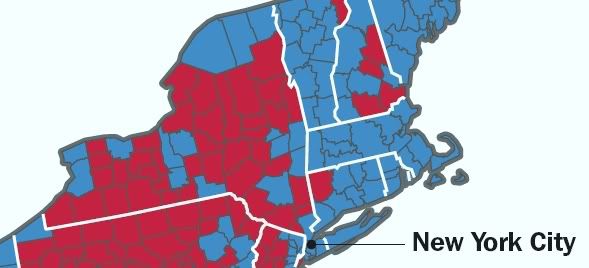
It is not named for any small-town frame of mind, but for the way the Delaware River narrows at the edge of town, then widens into a serene, lakelike eddy that at twilight mirrors the lights of town and the ranch-style houses on the flats. The towering pines along the river are nesting spots for bald eagles that soar year-round in pairs above Main Street and swoop down into the river to sink their talons into trout sighted from a hundred feet up. That year, driving to school every morning along the water, my son and I witnessed the wind gradually scrape away the bright foliage, snow fall, and the ground freeze. In the white, leafless months, we could see the entire span of the Delaware River valley from the car, a long arc of pastoral perfection."I never stopped resisting the urge to sit down in silent protest during the Pledge."
If you knew nothing else of the world, if you were just 5 or 6 or 10 years old, and this place was your only America, you wouldn't have any reason at all to question the Narrowsburg School's Morning Program routine. Hand over heart, my son belted out the Pledge with gusto every morning and memorized and sang "The Star-Spangled Banner." I never stopped resisting the urge to sit down in silent protest during the Pledge. But I also never failed to get choked up when they sang "America the Beautiful."
Listening to their little voices, I felt guilty for being a non-believer. When I was 5 years old, in 1965, did I understand what my lefty parents were saying about the Kennedy assassination, Watts and dead-soldier counts?Apparently not, but it was enough to warp you into the woman you are today!
Who was I to deprive my son, or his eleven kindergarten chums, of their faith in a nation capable of combining "good with brotherhood?" In a 5-year-old's perfect world, perhaps such places should exist.But you didn't let that stop you from counteracting any God-and-country indoctrination he received in school, by beginning your own informal in-home instruction about Bush, Iraq and Washington over the evening news!
That November, at the school's annual Veterans Day program, the children performed the trucker anthem "God Bless the USA" (one of the memorable lines is "Ain't no doubt I love this la-aand, God bless the USA-ay!"), as their parents sang along. About a dozen local veterans -- ancient men who had served in World War II, and men on the cusp of old age who had served in Korea and Vietnam -- settled into folding chairs arranged beneath the flag. When the students were finished singing, the principal asked the veterans to stand and identify themselves. Watching from the audience, I wondered if anyone would speak of the disaster unfolding in Iraq (which was never a word of the week).Wait for it...
No one did. The men rose and stated name, rank and theater. Finally, a burly, gray-bearded Vietnam veteran rose and said what no one else dared. After identifying himself, he choked out, "Kids, I just hope to God none of you ever have to experience what we went through." Then he sat down, leaving a small pocket of shocked silence. No one applauded his effort at honesty. On the contrary, the hot gym air thickened with a tension that implicitly ostracized the man, and by extension -- because we agreed with him -- me and my husband.No one repudiated the Iraq war. No one applauded the hope that these children be spared the need to go to war (or be spit on when they come back).
A month later, just before Christmas, my son and I drove together into New York City with bags of children's clothes and shoes that he and his sister had outgrown. The Harlem unit of the National Guard was putting on a Christmas clothing drive for Iraqi children. On the way into the city, I tried to explain to my son what we were doing, and -- as best I could -- why. As we crossed the George Washington Bridge and the Manhattan skyline spread out below us, I began to give him a variation on the "Africans don't have any food, finish your dinner" talk. I wanted him to understand how privileged he was to live in a place where bombs weren't raining from the sky. It was a talk I'd tried to have before, but not one he'd ever paid much attention to until that day, trapped in the back seat of our car.Out of the mouths of babes...
In simple language, I told my son that our president had started a war with a country called Iraq. I said that we were bombing cities and destroying buildings. And I explained that families just like ours now had no money or food because their parents didn't have offices to go to anymore or bosses to pay them. "America did this?" my son asked, incredulous. "Yes, America," I answered. He paused, a long silent pause, then burst out: "But Mommy, I love America! I want to hug America!"
A month after the Christmas outburst, the first rumors that all was not well with the school began circulating. Fiscal mismanagement, high fuel and retirement costs, and the depleted state economy had created a huge and unexpected cash shortfall for the tiny district. The parents at Narrowsburg School soon had a figure: It was going to cost just over $600,000 to keep their school open for another year. Chump change in Washington and New York City, but impossible to collect in a town where the median family income is barely $45,000.But NYC denizens can afford to come to the town and drop $50k on a "weekend home."
By late June 2005, the little school's fate was sealed. To my surprise I found I was deeply sorry about it.I'm sure it has a curriculum.
The patriot-ization of our son was thorough enough to survive the summer. He decorated his birthday cookies with red, white and blue sugar, and in his summer camp program, when doing arts and crafts, those were the colors of paint he favored. "I made the stars red, white and blue -- like the flag!" he exclaimed, holding a paper mobile he'd strung together.
Now it has been almost a year since my son scampered down the steps of Narrowsburg Central Rural School for the last time. We've since returned to the city, driven back to urban life more by adult boredom than our children's lack of educational opportunities. Our son is enrolled in a well-rated K-5 public school on Manhattan's Upper West Side;
not surprisingly, the Pledge of Allegiance is no longer part of his morning routine. Come to think of it, and I could be wrong, I've never seen a flag on the premises.Of course not. That would be provincial.
My husband and I realized, though, that Narrowsburg did more than mold our boy into a patriot. He can, it turns out -- despite the warnings of other city parents -- read at a level twice that of his new peers.Amazing how that "sit-down-in-your-seat brand of discipline" contributes to, you know, LEARNING.
Since we returned to the city, he has learned how to ride a bike, long for an Xbox, practiced a few new swear words and, somehow, learned the meaning of "sexy." He has pretty much stopped favoring red, white and blue.The kid is what, six? And she considers learning "a few new swear words" and understanding the meaning of "sexy" to be positive. So too, no longer "favoring red, white, and blue."
How soon childish national pride is shed, I sometimes think now, and not a little wistfully.Ah, yes. National pride is childish. No country is better than any other, and we mustn't make judgments. (But America is always wrong)
Only once it was gone did I realize that, after our initial discomfort, my husband and I had begun to see our son's patriotism as a badge of innocence. His faith was a reminder to us that the reason we are devastated by the war in Iraq and the Bush presidency is that we too love America. We too want to believe in its potential for good and brotherhood.BULLSHIT.
Our family now visits the Narrowsburg house only on weekends and holidays. Sometimes we pass the stately red brick school building, so recently renovated with thermal windows and elevators for the disabled, a town landmark for 75 years. The flag still flies there, but the doors are padlocked and the windows are black.But at least they don't hold Bible study there anymore.
When someone tries to use a strategy which is dictated by their ideology, and that strategy doesn't seem to work, then they are caught in something of a cognitive bind. If they acknowledge the failure of the strategy, then they would be forced to question their ideology. If questioning the ideology is unthinkable, then the only possible conclusion is that the strategy failed because it wasn't executed sufficiently well. They respond by turning up the power, rather than by considering alternatives. (This is sometimes referred to as "escalation of failure".) - Steven Den BesteToday's example comes from the City of Boston, as reported in today's Boston Glob, er Globe. To wit:
City plans a retooled buyback of gunsNote that, as I've mentioned before, violent crime fell everywhere. Gun "buybacks" had nothing to do with the decline.
Exchange may offer gift cards instead of cash
The City of Boston and community groups plan to launch a gun buyback program as early as next month that may offer gift cards instead of cash to people who turn in weapons, community leaders and a police spokeswoman said yesterday.
The buyback program, the first such effort in a decade, is being designed to avoid some of the problems a similar program faced in the mid-1990s.
From 1993 through 1996, the city collected 2,800 guns by offering $50 for each weapon. While there was some evidence that the program took some of the targeted weapons off the street, criminologists who studied the program found that many of the guns were older and not the guns typically used in crimes. The program was abandoned as violent crime fell and as police and critics raised questions about its effectiveness.
This time, said community leaders involved in the planning, they will try to recruit more grass-roots groups that work with young people involved in crime. Police want the new campaign to use gift cards instead of cash; criminologists found that some people used the buyback money to buy newer guns.You. Don't. Say.
Pending final approval from Mayor Thomas M. Menino, the city has made a preliminary pledge of about $25,000 for this year's campaign, said community leaders who have been planning the effort with City Hall. They hope the final amount will grow with private pledges from businesses, neighborhood groups, and others.I wonder if the drug/gun dealer on the corner will take the gift cards in exchange for his products? I mean, $100 is $100, right?
In addition, city officials plan to try to leverage the initial $25,000 by getting businesses to give significant discounts on gift cards to stores such as Target and Best Buy. Community leaders said the buyback program probably will offer gift cards of around $100 for each working gun.
The program is proposed as City Hall seeks answers to an alarming surge in firearm violence, in which 99 people were shot in Boston this year by April 6. The number of shootings has risen over last year, when there were the most shootings since 1995.I don't know about Boston, but I've driven Tucson's streets for years, and I have yet to find a gun laying on any of them.
At the same time, police believe there are more guns on the street than in at least six years. Last year, police seized 797 guns, a 35 percent increase over 2004, and the number of seizures through the middle of March was up over last year.
Menino's office declined to comment yesterday, but Police Department spokeswoman Elaine Driscoll confirmed that officials have been meeting with community leaders to plan for a probable buyback debut next month.With the glaring exception of allowing the law-abiding to carry a firearm for self-defense. "Every possible avenue" but that one. More "guns on the street," you understand.
"It's still in its conceptual phase," Driscoll said yesterday. "Although we are well aware of the historical perspective of this program, both in favor and opposed, we know it is our responsibility to explore every possible avenue in our efforts to decrease violent crime."
Driscoll said that officials are trying to design a buyback program that weds the best aspects of the effort of the mid-1990s with fixes to the worst. She said officials still believe that offering amnesty to people turning in illegal guns is a good idea, while offering cash incentives for turning in guns is a bad idea.Yup. Let them turn in guns used in crimes for destruction and give 'em $100 that they can use to get a newer "hot" gun. It doesn't matter if it's cash or a gift card. It all trades the same on the street.
"Cash awards were inappropriate," Driscoll said. She said officials are focusing on gift cards for guns as a "way to ensure that incentives are being used for proper reasons."And how, exactly are you going to do that?
Driscoll declined to discuss the $25,000 figure, saying, "We are still actively exploring potential funding options, as well as soliciting corporate donations."You know, the English have found that to be the case too. (But at least the Brits got a rocket launcher!)
The effectiveness of gun buyback programs, which became popular across the country during the 1990s, has been questioned by criminologists who have concluded that few guns used in crime are turned in.
Richard Rosenfeld, a criminologist at the University of Missouri at St. Louis, found that a buyback program there had little impact on violent crime. In addition, many people used the cash rewards for new guns and others turned in guns they no longer used while holding onto other, more favored firearms, he said.Like I said, if I could get a $100 gift card for a $65 Lorcin or Raven, I'd be down at the local gun shop like a shot (pun intended.)
"Gun buybacks don't have much of an impact on crime, because they tend not to attract guns from the segment of the population most likely to use them in crime," Rosenfeld said. "City officials know they are popular, they attract attention, and they can attract attention to the overall crime problem."Read that: "Uniform federal laws that restrict gun access to everybody BUT criminals." No matter what, the criminals will get all the guns they want. Notice how Rosenthal's comment echos that of Britain's shadow home affairs minister James Paice from that BBC link: "Nearly all gun crime involves illegally-held handguns, not legally-owned shotguns or rifles. The real problem is that illegal firearms are flooding into Britain because the government cannot secure our borders."
John Rosenthal, a close ally of the Boston police on efforts to fight violence and cofounder of the nonprofit Stop Handgun Violence, said he does not support buybacks because they don't work.
"I applaud the mayor's office and City Hall for trying to do anything and everything, (with the one, noted, exception) but the sad reality is Boston Police, among the best law enforcement agencies in the country . . . are never going to stop the flow of crime guns into Boston or any other city across the country until there are uniform federal laws that restrict gun access to criminals," Rosenthal said.
However, Rosenthal said he is pleased that the city will not be giving out cash. "In the past, kids would bring in cheap guns and would go out and buy a better gun," he said.I LOVE the fact that they keep repeating this. And where do kids buy guns? Not at the local federally licensed dealer!
But community leaders helping to organize the buyback and make it an annual event said that they believe it can make a difference and that taking even a few guns off the street is worth it.Yes, if it saves just one life! Except they've proved pretty conclusively that "buy-backs" don't.
"Even if we take off five, 10 guns that stopped a shooting that could be potentially fatal, I think that we've succeeded," said Jesús Gerena, director of community development and organizing for the Hyde Square Task Force, a nonprofit that works on youth development in Jamaica Plain and Roxbury.
Jorge Martinez -- director of Project RIGHT, a Roxbury community organization, said the buyback program will include public service announcements. He said the program aims to persuade friends and relatives of criminals to turn in guns, as well as residents who know or discover so-called community guns: shared weapons that are used for crimes and then returned to a hiding place.Excuse me, but I thought there was a program already in place for that. It's called a police department?
"We're not talking about the high-tech guns that criminals are going to be using," Martinez said. "We know we won't get those folks to turn in their guns. That would be foolish. We're talking about mothers who find guns, youths who know where guns are."
Kathie Mainzer, a Jamaica Plain restaurant owner who helped launch the first gun buyback program more than a decade ago after a shooting on the playground of her daughter's school, said that many guns that appeared to be active were turned in the last time.
Michael Patrick MacDonald, who answered the hot line for that campaign and whose well-known book "All Souls" chronicles life in South Boston, said he received calls asking where to turn in guns from street workers helping teenagers leave gangs and from former girlfriends of men in jail.
"It's really important to get the guns out of circulation, and it should be done every year," said Mainzer, who is helping city officials plan the new buyback. "We want people to have an opportunity to safely get rid of a gun without turning it over to another 15-year-old or selling it, which happens."


Instapundit links to an Opinion Journal piece on the Republican's failure to live up to their purported principles. Excerpts:It's the only power Congress really has. They're not going to give it up, short of being at gunpoint.
If Republicans lose control of Congress in November, they might want to look back at last Thursday as the day it was lost. That's when the big spenders among House Republicans blew up a deal between the leadership and rank-in-file to impose some modest spending discipline.I repeat myself: No reform unless it's at the Point. Of. A. Gun.
Unlike the collapse of the immigration bill, this fiasco can't be blamed on Senate Democrats. This one is all about Republicans and their refusal to give up their power to spend money at will and pass out "earmarks" like a bartender offering drinks on the house.
--
Jeff Flake of Arizona wanted each spending "earmark" to be identified along with the Member who requested it, so perhaps lawmakers might be shamed into using tax dollars more responsibly. He assumed, wrongly as it turned out, that a legislative body that has allowed these pork projects to quadruple in the past five years is still capable of being embarrassed.
The more you read and observe about this Politics thing, you got to admit that each party is worse than the other. The one that's out always looks the best. - Will RogersAnd, finally:
This country has come to feel the same when Congress is in session as when the baby gets hold of a hammer. - Will Rogers
The government consists of a gang of men exactly like you and me. They have, taking one with another, no special talent for the business of government; they have only a talent for getting and holding office. Their principal device to that end is to search out groups who pant and pine for something they can't get and to promise to give it to them. Nine times out of ten that promise is worth nothing. The tenth time is made good by looting A to satisfy B. In other words, government is a broker in pillage, and every election is sort of an advance auction sale of stolen goods. - H.L. Mencken
It is the invariable habit of bureaucracies, at all times and everywhere, to assume...that every citizen is a criminal. Their one apparent purpose, pursued with a relentless and furious diligence, is to convert the assumption into a fact. They hunt endlessly for proofs, and, when proofs are lacking, for mere suspicions. The moment they become aware of a definite citizen, John Doe, seeking what is his right under the law, they begin searching feverishly for an excuse for withholding it from him. - H.L. Mencken
The ideal Government of all reflective men, from Aristotle onward, is one which lets the individual alone—one which barely escapes being no government at all. This ideal, I believe, will be realized in the world twenty or thirty centuries after I have passed from these scenes and taken up my public duties in Hell. - H.L. MenckenI'm afraid his timeline might have been a little optimistic.
My blog is worth $96,536.34.
How much is your blog worth?
What I think the conflict boils down to is a struggle between the collectivists & the individualists. It's not a question of trust per se, it's a question of faith. It’s a belief that one system is better, more ideal than the other.Read the whole thing. He's exactly right. I wish I'd written it.
It is not possible to think clearly and be on the left. It is not possible. It is possible to think unclearly and be on the right. Not everybody on the right thinks clearly. But everyone on the left thinks unclearly. It is not possible to have a leftist view of the world, and think clearly. It is feeling and passion.And that, in short is the difference between, as I see it, individualists and collectivists. Collectivism comes from wishing things were not as they are, and refusing to see what is. Those on the right can be guilty of this as well, but it's a requirement for those on the Left.
A Drug Enforcement Administration agent who stars in a popular online video that shows him shooting himself in the foot during a weapons demonstration for Florida children is suing over the tape's release, claiming that his career has been crippled and he's become a laughingstock due to the embarrassing clip's distribution. Lee Paige, 45, blames the video's release on DEA officials in an April 7 federal lawsuit filed against the U.S. government.Crippled his career? What about his foot??
1. Childhood's End by Arthur C. Clarke *The link takes you to the list that's hyperlinked to short synopses of the actual works.
2. Foundation by Isaac Asimov *
3. Dune by Frank Herbert *
4. Man in the High Castle by Philip K. Dick
5. Starship Troopers by Robert A. Heinlein *!
6. Valis by Philip K. Dick
7. Frankenstein by Mary Wollstonecraft Shelley
8. Gateway by Frederick Pohl
9. Space Merchants by C.M. Kornbluth & Frederick Pohl
10. Earth Abides by George R. Stewart *
11. Cuckoo’s Egg by C.J. Cherryh
12. Star Surgeon by James White
13. The Three Stigmata of Palmer Eldritch by Philip K. Dick
14. Radix by A.A. Attanasio
15. 2001: A Space Odyssey by Arthur C. Clarke *!
16. Ringworld by Larry Niven *!
17. A Case of Conscience by James Blish *
18. Last and First Man by Olaf Stapledon
19. The Day of the Triffids by John Wyndham
20. Way Station by Clifford Simak
21. More Than Human by Theodore Sturgeon
22. Gray Lensman by E. E. “Doc” Smith *
23. The Gods Themselves by Isaac Asimov *
24. The Left Hand of Darkness by Ursula K. Le Guin
25. Behold the Man by Michael Moorcock
26. Star Maker by Olaf Stapledon
27. The War of the Worlds by H.G. Wells *
28. 20,000 Leagues Under the Sea by Jules Verne
29. Heritage of Hastur by Marion Zimmer Bradley
30. The Time Machine by H.G. Wells *
31. The Stars My Destination by Alfred Bester *
32. Slan by A.E. Van Vogt
33. Neuromancer by William Gibson *!
34. Ender’s Game by Orson Scott Card *!
35. In Conquest Born by C.S. Friedman *
36. Lord of Light by Roger Zelazny
37. Eon by Greg Bear *
38. Dragonflight by Anne McCaffrey *
39. Journey to the Center of the Earth by Jules Verne
40. Stranger in a Strange Land by Robert Heinlein *!
41. Cosm by Gregory Benford
42. The Voyage of the Space Beagle by A.E. Van Vogt
43. Blood Music by Greg Bear
44. Beggars in Spain by Nancy Kress
45. Omnivore by Piers Anthony *
46. I, Robot by Isaac Asimov *
47. Mission of Gravity by Hal Clement
48. To Your Scattered Bodies Go by Philip Jose Farmer
49. Brave New World by Aldous Huxley
50. The Man Who Folded Himself by David Gerrold
51. 1984 by George Orwell *!
52. The Strange Case of Dr. Jeckyl And Mr. Hyde by Robert Louis Stevenson
53. Snow Crash by Neal Stephenson *
54. Flesh by Philip Jose Farmer
55. Cities in Flight by James Blish *
56. Shadow of the Torturer by Gene Wolfe
57. Startide Rising by David Brin *
58. Triton by Samuel R. Delany
59. Stand on Zanzibar by John Brunner
60. A Clockwork Orange by Anthony Burgess
61. Fahrenheit 451 by Ray Bradbury *!
62. A Canticle for Leibowitz by Walter Miller *
63. Flowers for Algernon by Daniel Keyes *!
64. No Blade of Grass by John Christopher
65. The Postman by David Brin *
66. Dhalgren by Samuel Delany *
67. Berserker by Fred Saberhagen *!
68. Flatland by Edwin Abbot
69. Planiverse by A.K. Dewdney
70. Dragon’s Egg by Robert L. Forward *
71. Downbelow Station by C.J. Cherryh
72. Dawn by Octavia E. Butler
73. Puppet Masters by Robert Heinlein *
74. The Doomsday Book by Connie Willis *
75. Forever War by Joe Haldeman *!
76. Deathbird Stories by Harlan Ellison
77. Roadside Picnic by Boris Strugatsky & Arkady Strugatsky
78. The Snow Queen by Joan Vinge
79. The Martian Chronicles by Ray Bradbury *!
80. Drowned World by J.G. Ballard
81. Cat’s Cradle by Kurt Vonnegut
82. Red Mars by Kim Stanley Robinson *
83. Upanishads by Various
84. Alice in Wonderland by Lewis Carroll
85. Hitchhiker’s Guide to the Galaxy by Douglas Adams *!
86. The Lathe of Heaven by Ursula K. Le Guin *!
87. The Midwich Cuckoos by John Wyndham
88. Mutant by Henry Kuttner
89. Solaris by Stanislaw Lem
90. Ralph 124C41+ by Hugo Gernsback
91. I Am Legend by Richard Matheson
92. Timescape by Gregory Benford
93. The Demolished Man by Alfred Bester
94. War with the Newts by Karl Kapek
95. Mars by Ben Bova *
96. Brain Wave by Poul Anderson
97. Hyperion by Dan Simmons *
98. The Andromeda Strain by Michael Crichton *!
99. Camp Concentration by Thomas Disch
100. A Princess of Mars by Edgar Rice Burroughs
(* indicates that I've read it, ! indicates that I heartily recommend it.)


