Liberty is an inherently offensive lifestyle. Living in a free society guarantees that each one of us will see our most cherished principles and beliefs questioned and in some cases mocked. That psychic discomfort is the price we pay for basic civic peace. It's worth it. It's a pragmatic principle. Defend everyone else's rights, because if you don't there is no one to defend yours. -- MaxedOutMama

I don't just want gun rights... I want individual liberty, a culture of self-reliance....I want the whole bloody thing. -- Kim du Toit

The most glaring example of the cognitive dissonance on the left is the concept that human beings are inherently good, yet at the same time cannot be trusted with any kind of weapon, unless the magic fairy dust of government authority gets sprinkled upon them.-- Moshe Ben-David

The cult of the left believes that it is engaged in a great apocalyptic battle with corporations and industrialists for the ownership of the unthinking masses. Its acolytes see themselves as the individuals who have been "liberated" to think for themselves. They make choices. You however are just a member of the unthinking masses. You are not really a person, but only respond to the agendas of your corporate overlords. If you eat too much, it's because corporations make you eat. If you kill, it's because corporations encourage you to buy guns. You are not an individual. You are a social problem. -- Sultan Knish

All politics in this country now is just dress rehearsal for civil war. -- Billy Beck

Showing posts with label debate. Show all posts

Friday, May 29, 2020

More Quora Content

I posted a link to this story of a 70 year old man defending his wife from an attacker who broke through the front door of their home.  He retrieved a firearm and shot the attacker several times.  I received a comment on the piece, to which I responded.  Here's the thread so far:
Peter Collins: When are you going to post all of the stories of people shooting their kids, or their wives or husbands, or themselves.

You are 9 times more likely to be killed with a gun you own than to kill an intruder or mugger or other criminal.

So, this man killed an intruder - that means nine other gun owners were killed by their own guns.

The odds are against you, 9 to 1. Only a fool bets that longshot with his life.
KB: I don’t have to. ABCNNBCBS and all the other major news outlets already take care of that. What they DON’T typically report are successful defensive gun uses, leading to the illusion that they seldom happen. Even the CDC recently admitted, however, that they happen far more often than most people think.

That news was also not carried by the media beyond a very brief mention.

Now as to your 9:1 ratio assertion, do you have a citation for that, or do you “just know it’s true”? Because the last time I heard something like that, it was 43:1 from a thoroughly discredited “study” performed by a Dr. Arthur Kellerman many years ago.
PC: The media don’t cover so-called ‘defensive gun uses’ very much because they are relatively rare events. The only study, and it is on-going, of this, using actual evidence and verifying the events, finds that guns are used about 2000 times per year in the US to prevent, stop, or mitigate a violent crime. The group doing the study is not a gun-control group, and their definition of ‘defensive gun use’ is broader than I think is justified, but they follow a data-based approach and they are willing to do the hard work to find an accurate figure. If guns were used regularly to prevent or stop crimes, it would be all over the news - when it does happen, the “good guy with a gun” scenario gets huge coverage.

The figure you question came from the Miller study, a peer-reviewed and unassailable study published in one of the trauma journals.

The Kellerman study, far from being “thoroughly discredited,” is a model of excellent methodology combined with careful use of data. I am aware of no serious critique of the study from any qualified source. The conclusions from that study, though, do not really bear on the question at hand. Kellerman was studying intentional homicide only, and that doesn’t provide an answer to the question of whether gun ownership generally confers more or less safety than risk. If the results of a perfectly good study are applied to aquestion that the study did not ask, it is not likely to provide valid or valuable information.
KB: “The only study, and it is on-going, of this , using actual evidence and verifying the events, finds that guns are used about 2000 times per year in the US to prevent, stop, or mitigate a violent crime.” Which study is this? I noticed you didn’t provide a citation.

How about this one? Priorities for Research to Reduce the Threat of Firearm-Related Violence commissioned by the Centers for Disease Control that states:
“Defensive uses of guns by crime victims is a common occurrence, [my emphasis - ed.] although the exact number remains disputed (Cook and Ludwig, 1996; Kleck, 2001a). Almost all national survey estimates indicate that defensive gun uses by victims are at least as common as offensive uses by criminals, with estimates of annual uses ranging from about 500,000 to more than 3 million per year (Kleck, 2001a), in the context of about 300,000 violent crimes involving firearms in 2008 (BJS, 2010). On the other hand, some scholars point to radically lower estimate of only 108,000 annual defensive uses based on the National Crime Victimization Survey [my emphasis - ed.] (Cook et al., 1997). The variation in these numbers remains a controversy in the field. The estimate of 3 million defensive uses per year is based on an extrapolation from a small number of responses taken from more than 19 national surveys. The former estimate of 108,000 is difficult to interpret because respondents were not asked specifically about defensive gun use. [Again, my emphasis.]

“A different issue is whether defensive uses of guns, however numerous or rare they may be, are effective in preventing injury to the gunwielding crime victim. Studies that directly assessed the effect of actual defensive uses of guns (i.e., incidents in which a gun was ‘used’ by the crime victim in the sense of attacking or threatening an offender) have found consistently lower injury rates among gun-using crime victims compared with victims who used other self-protective strategies.” [Emphasis, well, you know.]
The LOWEST estimate of defensive gun use from a credible source that I’ve EVER seen was from the National Crime Victimization Survey at 80,000 DGU’s per year, 28,000 fewer than noted in the excerpt above. That’s still over 32 times your estimate. That’s on average 219 per day. What is a defensive gun use? Any time a person defends himself or someone else by so much as THREATENING to use a firearm to stop an attack. No shots need be fired, and in the overwhelming majority of these cases, none are. No blood, no news story. But tell the people who defended themselves that they didn’t need a gun. Go ahead, I’ll wait. But The Other Side™ seems to believe that if the defender did not shoot, or more accurately, kill the offender, then it doesn’t count.

Also, I noticed that you still haven’t cited your source for the 9:1 ratio from your first comment. Got a link to that “unassailable” Miller study? I think you misunderstand what “peer reviewed” actually means.

Oh, and Kellerman? He revised his own estimate down to 2.7 times more likely. Basically debunking himself.
PC: Your “study” is a piece of paid-for propaganda that relies on nothing that anyone could conceivably call evidence.

And your slur on Kellerman? No, he revised the application of his conclusion to a different set of circumstances.

If you actually read the study, rather than the claims made by gun fundy websites, you would know that.

And when you claim the number to be between 80,000 and 3 million, you lose all credibility. If you cannot even narrow it down within 2 orders of magnitude, your numbers are clearly phony.
KB: I really enjoy these discussions. So a piece produced by the National Academies of Science is “a piece of paid-for propaganda” because you say so. Interesting. But your uncited, “peer-reviewed” “Miller study” isn’t, because reasons. Kellerman’s 43:1 conclusion is gospel, but when he revised it to 2.1:1 it’s because he used a different set of circumstances - DUE TO THE FACT THAT HIS ORIGINAL CIRCUMSTANCES WERE LAUGHABLE. He’s already been proven unreliable. Why should I trust his revised numbers?

You object to the fact that the estimates between 80,000 and 3 million defensive gun uses means they’re not credible, but ignore the fact that the absolute low end, from United States Bureau of Justice surveys that DO NOT ASK EXPLICITLY ABOUT DEFENSIVE GUN USE still represent almost 220 defensive gun uses a DAY. You simply dismiss these as superfluous.

If you’d actually read the literature — all of it, not just the stuff you agree with — you would conclude that defensive gun usage is real, it’s effective, and it’s far more common than the general public is led to believe.

And that’s why I post these stories. The New York Times certainly won’t.
At this point I expect one or more of three things in descending order of likelihood:

1) He'll respond with more mouth-frothing
2) He'll report me for violating the "Be nice, be respectful" Quora policy
3) He'll go away
4) He'll delete his thread.

That didn't take long:

Kellerman revised the conclusion when the model for the study was revised - that’s akin to revising the number when you revise from mph to kph. If the ratio remained identical under different parameters, that would be questionable. Sorry you don’t understand how statistics work.

Your claim that the “absolute low end” is 70,000 ignores so many studies that show much, much lower numbers. I specifically cited the on-going GVA study which showed around 2000 verifiable cases per year. That’s lower than you claim is the “absolute low end.” Now, what did you say about only reading studies that support your position?

Here’s a challenge - you provide evidence of 110 defensive gun uses, in the USA, on any day in the last 10 years. That’s half what you claim is the ”low end,” so it shouldn’t be hard at all for you to prove. Not a survey, not some poll - actual evidence. I’ll accept if you provide the date, the time, the place, and the name of the victim or the person who used the gun.

So, how about it? Can you prove half your claimed l ”low end,” for any day in the last 10 years?
Oh, we’re still playing? OK. What was Kellerman’s initial model, and what were the objections to it? What was the revised model? I’m quite aware of how statistics work. I’m an engineer by trade.
The “absolute low end” is 80,000 by a survey that doesn’t specifically ask about defensive gun usage. You keep skipping right over that. Don’t you trust your government?

Your “GVA study” again is without a link to the source. If it’s the one I’m thinking of, the “verifiable cases” were media reports of defensive gun uses. Which kind of makes my point - the media doesn’t report on DGUs unless someone is shot or killed. And — if they’re covered at all — most of these reports end up on page B7 of the local fishwrap, not on the national nightly news.

Can I cite 110 defensive gun uses in a day? How am I to do this if the media doesn’t report them? If the people who stopped a crime in progress without firing a shot didn’t report it to the police? For example, the woman at the highway rest stop who confronted a man holding a coil of rope and convinced him that she was not going to be his next victim by showing him her pistol? Tell her she didn’t need it, and she was far more likely to have it used on her than to use it to protect her life. Tell that to the people standing outside a store in Minneapolis armed with rifles protecting it from rioters. It wasn’t looted or burned. Is that one DGU or twelve?

How many defensive gun uses is so low that it makes it OK to disarm the victims? Tell that 70 year old man that it would have been better to have let the attacker beat his wife to death rather than use a gun to defend her, or he could have tried to stop the man and there would be two old people dead or in the hospital. Tell him that the presence of that gun in his house made it 43 times more likely that he or his wife would be killed — not shot to death with his own weapon, but killed by any means — which is what Kellerman’s initial model did.

It’s been fun playing with you, but I think we’re done now.
It's still going. And going.

Friday, August 16, 2019

Quora - a Target-Rich Environment

Here's a short, pithy exchange from Quora.  The original answer is mine.

Original question: “How many ‘good guys with guns’ have saved the day against criminals in the US?”

The lowest estimate for defensive gun usage in the U.S. is approximately 108,000 per year - that’s (carry the one…) 295 times a day. The vast majority of these defensive gun uses involve no shots fired. As a result, no mention in the news. A few do make it, like these:

Man holds suspected burglar at gunpoint in east Tulsa

Citizen holds assault suspect at gunpoint at Wenatchee gas station

Deputies: Homeowner pulls gun on intruder with face he won't forget

Couple holds home invasion suspect at gunpoint

NH Dad Pulls Gun on Intruder Until Police Arrive

Michael Hill
4h ago

You claim 295 times a day then as evidence for decades all over America give just FIVE cases.

How damned stupid do you think we are?

Self-Defense Gun Use is Rare, Study Finds...

Kevin Baker
Original Author · 3h ago

“How damned stupid do think we are?”

I gave five specific instanced in the past few weeks where NO SHOTS WERE FIRED, and the story still made the (local) news.

How stupid do you have to be to misrepresent that?

EDITED TO ADD: A Violence Policy Center paper? Really? An organization dedicated to the banning of all handguns is supposed to be nonpartisan? Pull my other leg.
Michael Hill
2h ago

Boring NRA propaganda.

Don’t cry. We won’t take your guns away.

Kevin Baker
Original Author · 1h ago

OK, I’ll see your 2015 VPC paper and raise you a 2013 Centers for Disease Control report. They’re a shill for the NRA, right? Who was President in 2013?

From Page 15 of Priorities for Research to Reduce the Threat of Firearm-Related Violence:

“Defensive use of guns by crime victims is a common occurrence, although the exact number remains disputed (Cook and Ludwig, 1996; Kleck, 2001a). Almost all national survey estimates indicate that defensive gun uses by victims are at least as common as offensive uses by criminals, with estimates of annual uses ranging from about 500,000 to more than 3 million (Kleck, 2001a), in the context of about 300,000 violent crimes involving firearms in 2008 (BJS, 2010). On the other hand, some scholars point to a radically lower estimate of only 108,000 annual defensive uses based on the National Crime Victimization Survey (Cook et al., 1997). The variation in these numbers remains a controversy in the field. The estimate of 3 million defensive uses per year is based on an extrapolation from a small number of responses taken from more than 19 national surveys. The former estimate of 108,000 is difficult to interpret because respondents were not asked specifically about defensive gun use.”
 
108,000/365 = 295.89 defensive gun uses PER DAY. Absolute minimum.

CDC propaganda? National Crime Victimization Survey propaganda? Or fact?

And you’re right, you won’t.
I'm curious as to whether or not he'll respond.

UPDATE: He did!

Michael Hill
4m ago

Lies, lies lies in your article:

“According to the Congressional Research Service, public mass shootings “have claimed 547 lives and led to an additional 476 injured victims” since 1983 (Bjelopera et al., 2013, pp. 7-8). “

Real world with actual data for this year alone:

List of mass shootings in the United States in 2019 - Wikipedia

More lies in your article:

“with ESTIMATES of annual uses ranging from about 500,000 to more than 3 million (Kleck, 2001a), in the context of about 300,000 violent crimes involving firearms in 2008 (BJS, 2010). On the other hand, some scholars point to a radically lower ESTIMATE of only 108,000 annual defensive uses based on the National Crime Victimization Survey (Cook et al., 1997). The variation in these numbers remains a controversy in the field. The estimate of 3 million defensive uses per year is based on an extrapolation from a small number of responses taken from more than 19 national surveys.

So it is anything from 108,000 to 500,000 to 3,000,000. What kind of crazy figures are those? They are EXTRAPOLATIONS from a small number of responses.

The great stsistics LIE:

Fascinating new book that shows how easily we're misled by statistics

Kevin Baker
Original Author · Just now

So the CDC - and by extension the National Crime Victimization survey are lying. But the Violence Policy Center isn’t. And Wikipedia is never wrong. Because you say so. Check.

(Wikipedia? Seriously? Well, you believe the VPC, so…)
UPDATE II: He came back for more.
Michael Hill
6h ago

A Government body lying? Who’d have believed it?

As to wikipedia your arm waving is a decade out of date as they have long ago proved what they say by giving references, etc.

So another failure.
Kevin Baker
Original Author · 3h ago

So the references Wikipedia uses are dependable, but the CDC and Justice Department aren’t because they’re government entities.

What happens when Wikipedia cites government entities?

But hey, let’s use the all-knowing oracle that is Wikipedia - Defensive gun use - Wikipedia

Excerpt - “Estimates over the number of defensive gun uses vary wildly, depending on the study's definition of a defensive gun use, survey design, country, population, criteria, time-period studied, and other factors. Low-end estimates are in the range of 55,000 to 80,000 incidents per year, while high end estimates reach 4.7 million per year. ”

So let’s take that absolute lowest estimate, 55,000 defensive gun uses per year as our basis. That’s 150 per day. Are you going to tell me that’s false too?

Tuesday, April 11, 2017

More Quora Debate

So somebody over at Quora asked:  Why haven't gun control advocates commented about the Broken Arrow, Oklahoma home invasion shootings?

One Jim Page answered:
The perspective of someone who lives in a country with gun control:
3 people are now dead who would probably otherwise still be alive. The decision as to whether they should live or die was taken by someone who’s only qualification was that they had $300 to spend on an AR15.

The 3 invaders probably felt empowered to enter the victim’s home because they had easy access to guns.

Of course invading that person’s home was wrong, but wrong enough to be killed for?? Without knowing more about the incident, can you categorically say that the invaders meant the victim physical harm? It’s more likely they wanted money or stuff they could sell, and planned to use their weapons to pacify the home owner. Is a person’s TV or the contents of their wallet more important than 3 people’s lives?
Gun control advocates don’t need to comment, because this is an insane conversation that could only be had by people that feel it’s more important to own guns than to be right.
Paul V. Wilson commented:
On #2, one of the invaders had a large knife and the two others had brass knuckles, either of which can easily be a deadly weapon. None of them had guns.

On #3, I’m not sure why, on a moral basis, anyone who invades a person’s home should have any expectations of surviving. If they didn’t mean to cause harm, why did they go in with weapons? Is the homeowner supposed to think people entering his home wearing masks and holding weapons don’t mean to cause him harm?
To which Mr. Page replied:
On #2: if they didn’t have guns isn’t shooting them all with a semi automatic weapon even more of an appalling overreaction?

On #3: it’s illegal to break into someone’s home, and the law puts people behind bars for it. It doesn’t give them the electric chair or even life imprisonment. So why should someone expect to lose their lives for breaking and entering? There is a long way between a person being allowed to kill a person for being in their house, and the legal penalty for breaking and entering, and that seems to be bridged by the idea ‘that’s what happens when people own guns’. I don’t see how legal ownership of a lethal weapon can make that right.
I was reminded of my 2004 trilogy of posts beginning with "(I)t's most important that all potential victims be as dangerous as they can", so I started with this:
Mr. Page:

You perfectly illustrate the difference in the attitude toward violence exhibited by residents of the UK vs. residents of the U.S., I think. To wit: “(I)f they didn’t have guns isn’t shooting them all with a semi automatic weapon even more of an appalling overreaction?”

Col. Jeff Cooper, a man who pretty much helped develop civilian firearms training once commented:

"One bleeding-heart type asked me in a recent interview if I did not agree that 'violence begets violence.' I told him that it is my earnest endeavor to see that it does. I would like very much to ensure — and in some cases I have — that any man who offers violence to his fellow citizen begets a whole lot more in return than he can enjoy."

In the UK the law pretty much restricts the citizen to “proportional” response - that is, in a situation of extreme stress the victim of the attack is supposed to assess the intention and capability of the assailant(s) and limit his or her response to something that will not be judged an “overreaction” by calm and sober third parties after the fact. Instead in the U.S. overwhelming response is considered appropriate, not appalling. As one popular cartoonist here has stated it, “There is no overkill. There is only ‘open fire’ and ‘reloading.’”

“(W)hy should someone expect to lose their lives for breaking and entering?”

They didn’t die for breaking and entering. Had the house been empty they’d have been fine. What they did was an armed home invasion. The concept of pacifism as it pertains to crime is generally predicated on the concept that all life is of value, and that using violence to injure or kill in defense of mere property is - as you suggest - disproportionate, the value of the material being much less than the value of the lives of the persons attempting to take the material. Surprise! I concur. The life of a human being is of greater value than, say, the contents of my wallet or my home. But this ignores something more important - the fact that the contents of my wallet or home are the least things at risk. Because someone willing to threaten bodily injury or death in order to take my property violates the tenets of the society in which both of us live. He puts in fear not only me, but the entire society. He has proffered a new social contract - "Give me what I want, and I might not hurt you."

The pacifist culture tells us that we should not resist, that we should call the authorities who are empowered to deal with social miscreants. At most, we should respond (as the British are required) proportionally. Yet a proportional response requires us to read the mind of the assailant. If he holds a knife, are we to ask "Do you actually intend to use the knife, and if so is your intent simply to wound or would you be intending a killing blow?" A proportional response requires the defender to reason cogently in a situation wherein our lives, or at least our health may be at risk. The advantage belongs to the attacker, and that is a recipe for social disaster.

To prevent that social disaster, the new social contract offered by the criminal should be understood by all parties to be: "Whatever it is I want, I have decided that it is worth risking my life for." And we, the potential victims, should be as dangerous as possible.

So long as a sufficient number of us are, the rest of society will enjoy the benefit of our protection. When there are too few of us, or when those of us who are willing to resist are restricted by law from doing so, there remain only two options: suffer the onslaught of criminals, or increase the police forces to overly burdensome levels. With the second option, assuming that a sufficient level is attained to reduce crime, the officers of the State required to accomplish that task will not then be reduced, they will be reassigned to other tasks, and a de facto police state will exist.

Those are the choices. It seems apparent which Britain has decided on, and which the U.S. has.
Mr. Page upvoted my comment and replied:
I appreciate your long and reasoned response. I mostly agree with you right up to ‘ … and that is a recipe for social disaster.’ It’s not. It’s a recipe for dialling down the violence, and in the case of most developed countries it works, there simply is less violence, and we absolutely prefer it that way. Second: your assertion that the only alternative to the US solution is a police state - and that’s what the Uk has chosen ... can you explain what you mean by that? If you had spent any time in the Uk you’d know that it simply isn’t true.

Look it seems to me that one area of disagreement that we have is whether or not an armed person in your house is attacking you or not, if they do not know you are there. It seems that US thinking is that they are. I, and most people in the Uk I suspect, are not comfortable with that, whatever ‘Castle Law’ says. It seems like an amoral solution to a moral problem, with the side effect that there is an upward cycle of up-gunning arms race between criminals and non-criminals. Who does that benefit aside from Messrs Smith and Wesson?
To which I responded:
“It’s not. It’s a recipe for dialling down the violence…”

I suggest you study the rates of violence in the UK from the turn of the 20th Century until the present. Specifically the period right at the middle of the century when laws making self-defense with a weapon essentially impossible were enacted. I guarantee you, violence did not go down.

“Second: your assertion that the only alternative to the US solution is a police state - and that’s what the Uk has chosen ... can you explain what you mean by that?”

I suggest you check your reading comprehension: “When there are too few of us, or when those of us who are willing to resist are restricted by law from doing so, there remain only two options: suffer the onslaught of criminals, or increase the police forces to overly burdensome levels.”

You have chosen the former. England and Wales used to be one of the least violent nations in the world. It is now one of the most violent nations in Europe. Sure, you don’t kill each other much (and you never did) but violent crime there is epidemic. See: https://www.gov.uk/government/up... (XML file) Pay particular attention to the column marked “Total violence against the person” and the numbers following passage of the Prevention of Crime Act 1953. You may not consider that “social disaster,” but levels of violence like that here resulted in people buying guns.

“It seems like an amoral solution to a moral problem, with the side effect that there is an upward cycle of up-gunning arms race between criminals and non-criminals.”

Yeah, we keep hearing that one - “More guns = more crime” - except it hasn’t happened. Over the last decade something on the order of sixty million new firearms were purchased by individuals here, about half of them handguns, and most of those weren’t purchased for target shooting. Concealed-carry laws, for instance, have been gaining popularity around the country - see this graphic:


The states marked in green do not require a license to carry concealed. And what has violent crime done here? DECLINED. To levels not seen since the 1960’s.

5 facts about crime in the U.S.

Who has it benefited? Our general population. Who has benefited from the UK’s policy of disarmament and “proportional response”? The criminals. Which is more amoral - allowing people to defend themselves, or in effect telling them instead to “close your eyes and think of England”?
We'll see if he has anything to add.

UPDATE, 4/12: Mr. Page indeed posted a response. I have replied. See below:
Kevin, I can see we are not going to agree on this, but just to set the record straight: when you compare figures between the US and UK, you will find that the US and the UK do not define ‘violence’ the same way. The UK definition is much broader, and the UK numbers include such things as bicycle theft and domestic violence, which the US numbers do not. Also - it’s hard to compare ‘home invasion with intent to harm’ between the UK and the US as the UK doesn’t really classify crimes that way, or at least not that I have been able to find. If you equate burglary (breaking and entering to commit a crime), then the US and the UK are in pretty much the same ball park. But if you look at gun-related crime … the US leaves everyone else in the dust. The numbers are further skewed as it seems that in the US unreported crime is much higher than the UK. But the headline feature, surely, has to be the number of people killed by guns. Take a look here for more up to date and detailed figures than you provided: United Kingdom vs United States: Crime Facts and Stats

To your point regarding historical crime stats, the key time points you miss are the tightening of the rules after the Hungerford and Dunblane massacres, where automatic weapons and handguns (respectively) were outlawed and other guns began to be properly controlled. For a brief period after Hungerford, gun crime actually increases. But after the rules are tweaked and enforcement is perfected (and by the way it was NOT draconian, my family owned a number of shotguns and all was done fairly and reasonably, and yes! I like firing guns!), the numbers fall off a cliff. Take a look at this Guardian article, sorry about the rather antagonistic title: So, America, this is how other countries do gun control

‘Yeah, we keep hearing that one - “More guns = more crime” - except it hasn’t happened.’ Look at US gun crime figures compared to everywhere else on the planet. Why is not obvious that if you have guns you have gun crime and without guns you don’t?

One thing: I am not putting forward the UK as an example of perfect gun control. There are better. From the article above, take a look also at Germany. German gun ownership is almost as high per capita as the US, but their gun crime is ridiculously low, and dropping, because they positively vet people that apply to have guns … and only sane people are allowed them. That’s probably how it should be done. Can we agree that only sane people should have guns?

Regarding ‘close your eyes and think of England’ :) The calculation is: in the incredibly rare case where someone actually breaks into my house armed, I will find a way to come out of it unscathed, either by bargaining, or self defence, or running, because the alternative, everybody up-gunned and shooting to kill, is worse. Most people here find a baseball bat or a kitchen knife a sufficiently comforting deterrent. I don’t think you’ll find most people in this country would sit around and do nothing if their home is invaded, we are not pacifists :)! But having a gun makes it too easy to end up with everybody dead. I suppose you could say criminals do benefit, because they don’t end up dead.

Yes - I did misread the section on ‘police state’ - my apologies.
OK, get an adult beverage and settle in:
My apologies, I’ve been AFK all day, and I certainly wasn’t going to try to reply to this on my iPhone. Let us begin:

“…when you compare figures between the US and UK, you will find that the US and the UK do not define ‘violence’ the same way. The UK definition is much broader, and the UK numbers include such things as bicycle theft and domestic violence, which the US numbers do not.”

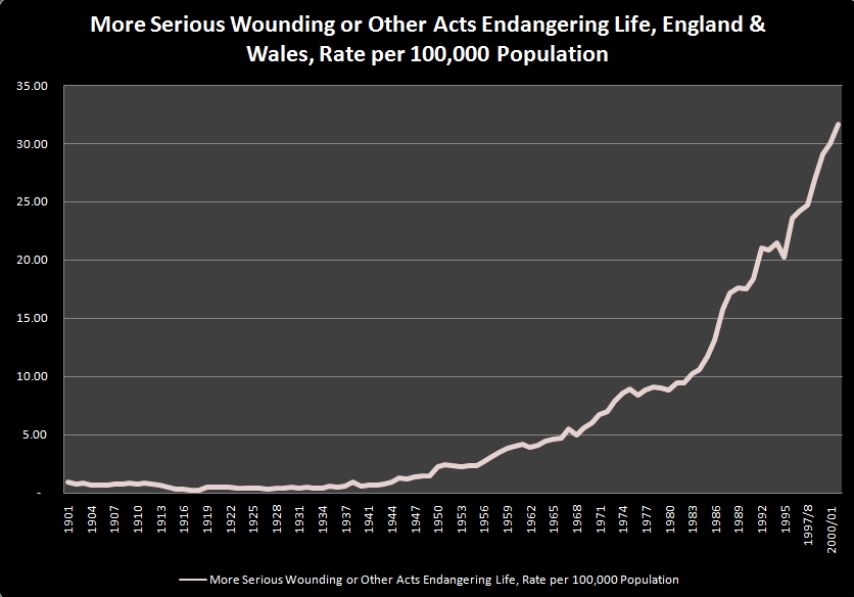
And that doesn’t really matter, because the statistics I pointed you to were exclusively for your nation. Let’s look at “More serious wounding or other acts endangering life” for example.

1950: 1,078 incidents
1960: 1,847
1970: 2,956
1980: 4,390
1990: 8,920

Your population didn’t grow that much over that period (about 45 million in 1950, about 50 million in 1990). So the rate of this specific violent crime increased from about 2.4/100,000 population in 1950 to 17.84/100,000 in 1990. That’s over a 700% increase in 40 years, and the numbers nearly doubled again by the end of the century.

You are not safer than you were in 1960.

“But if you look at gun-related crime … the US leaves everyone else in the dust.”

Only if you cherry-pick the nations you compare us to. Internationally the heavily-armed U.S. ranks about 100th for homicide. Think about that. What disqualified those other 99 nations from your consideration? And why do you concentrate on gun violence? The U.S. has a higher homicide rate committed without guns than England and Wales has by all methods. I will stipulate to our violent tendencies. What I won’t do is attributed those tendencies to the widespread ownership of firearms. I can riff on this subject for a few thousand words, but I’ll pass at this time.

“Take a look here for more up to date and detailed figures than you provided:”

Again, so stipulated. But I wasn’t comparing our rates to yours. I was comparing your rates over history to our rates over the same period. That says that England & Wales has gotten more dangerous over time (going from incredibly safe to notably less so) and the U.S. has gotten safer (from notably unsafe to considerably safer). Your nation has banned the tools of self-defense and made self-defense legally risky by imposing a “proportional response” requirement. Over that same period my nation has loosened the laws on self defense and the restrictions on the ability to have weapons suitable for it.

These two data points seem to contradict the gun control narrative.

“To your point regarding historical crime stats, the key time points you miss are the tightening of the rules after the Hungerford and Dunblane massacres, where automatic weapons and handguns (respectively) were outlawed and other guns began to be properly controlled.”

I’m going to skip quoting the rest of that paragraph and ask again, why the exclusive focus on gun crime? Is it somehow worse than knife crime (the latest focus of your law enforcement attention)? On physical assault with other weapons or bare hands? Because those numbers, as far as we can tell, are not improving. We can’t really tell because apparently they’re not being properly recorded.

'Fifth of all crimes' go unrecorded Pullquote: “The problem is greatest for victims of violent crime, with a third going unrecorded. Of sexual offences, 26% are not recorded.”

And if you can link to The Guardian, so can I: Violent crime in England and Wales is up 24%, police figures show

Makes one wonder why the numbers aren’t being recorded, doesn’t it?

“ ‘Yeah, we keep hearing that one - “More guns = more crime” - except it hasn’t happened.’ Look at US gun crime figures compared to everywhere else on the planet.”

I have. Again, why do you ignore those countries that don’t conform to your worldview?

“Why is not obvious that if you have guns you have gun crime and without guns you don’t?”

Oh, it is. This is known as a tautology. Again, why the emphasis on guns versus violence? Here is a good place to give you a quote from the conclusion of a gun control meta-study performed here in the early 1980’s at the behest of the Carter administration that addresses this question directly:
“The progressive's indictment of American firearms policy is well known and is one that both the senior authors of this study once shared. This indictment includes the following particulars: (1) Guns are involved in an astonishing number of crimes in this country. (2) In other countries with stricter firearms laws and fewer guns in private hands, gun crime is rare. (3) Most of the firearms involved in crime are cheap Saturday Night Specials, for which no legitimate use or need exists. (4) Many families acquire such a gun because they feel the need to protect themselves; eventually they end up shooting one another. (5) If there were fewer guns around, there would obviously be less crime. (6) Most of the public also believes this and has favored stricter gun control laws for as long as anyone has asked the question. (7) Only the gun lobby prevents us from embarking on the road to a safer and more civilized society.

“The more deeply we have explored the empirical implications of this indictment, the less plausible it has become. We wonder, first, given the number of firearms presently available in the United States, whether the time to ‘do something’ about them has not long since passed. If we take the highest plausible value for the total number of gun incidents in any given year - 1,000,000 - and the lowest plausible value for the total number of firearms now in private hands - 100,000,000 - we see rather quickly that the guns now owned exceed the annual incident count by a factor of at least 100. This means that the existing stock is adequate to supply all conceivable criminal purposes for at least the entire next century, even if the worldwide manufacture of new guns were halted today and if each presently owned firearm were used criminally once and only once. Short of an outright house-to-house search and seizure mission, just how are we going to achieve some significant reduction in the number of firearms available?

“Even if we were somehow able to remove all firearms from civilian possession, it is not at all clear that a substantial reduction in interpersonal violence would follow. Certainly, the violence that results from hard-core and predatory criminality would not abate very much. Even the most ardent proponents of stricter gun laws no longer expect such laws to solve the hard-core crime problem, or even to make much of a dent in it. There is also reason to doubt whether the ‘soft-core’ violence, the so-called crimes of passion, would decline by very much. Stated simply, these crimes occur because some people have come to hate others, and they will continue to occur in one form or another as long as hatred persists. It is possible, to be sure, that many of these incidents would involve different consequences if no firearms were available, but it is also possible that the consequences would be exactly the same. The existing empirical literature provides no firm basis for choosing one of these possibilities over the other. Restating the point, if we could solve the problem of interpersonal hatred, it may not matter very much what we did about guns, and unless we solve the problem of interpersonal hatred, it may not matter much what we do about guns. There are simply too many other objects that can serve the purpose of inflicting harm on another human being."
The estimate of 100,000,000 firearms in the early 80’s was almost definitely low. The current estimate of 300,000,000 is also probably low. But it means the problem of gun elimination hasn’t gotten any smaller. But gun violence has.

“German gun ownership is almost as high per capita as the US, but their gun crime is ridiculously low, and dropping, because they positively vet people that apply to have guns … and only sane people are allowed them. That’s probably how it should be done. Can we agree that only sane people should have guns?”

In an ideal world, yes. I’m not going to get into a lengthy discussion on the topic of American vs. European views of government authority in this thread. Suffice it to say, what you are noting as a victory of “common sense gun regulation” is more an example of a quite homogeneous culture. If I recall my history correctly, those famously law-abiding people managed to kill tens of millions of other Europeans during the 20th Century, did they not? I don’t think I’d point to them as the gun-control ideal, myself.

“Regarding ‘close your eyes and think of England’ :) The calculation is: in the incredibly rare case where someone actually breaks into my house armed, I will find a way to come out of it unscathed, either by bargaining, or self defence, or running, because the alternative, everybody up-gunned and shooting to kill, is worse.”

This is an argument that I hear repeatedly. Since you admitted to missing the alternative to a police state reference in my early comment, I’ll point you to that same excerpt once again:

“So long as a sufficient number of us are, the rest of society will enjoy the benefit of our protection. When there are too few of us, or when those of us who are willing to resist are restricted by law from doing so…”

EVERYBODY doesn’t need to be armed. In fact it takes just a small percentage of the population armed and willing to benefit the rest of society. You say “I will find a way to come out of it unscathed…” You may. What about a single woman, or an elderly man?

I’ve seen this argument before too. A previous discussion yielded this bit of “wisdom” that seems to represent your position:
Consider two scenarios:
1. Attacker has a gun. Defender does not.
2. Attacker does not have a gun. Defender doesn't either.
Self defence is possible in the second scenario while it isn't in the first one. Is that clear now?
No. How about this instead:

If the law disarms citizens, then it can make self defense impossible where it would have been possible if the citizen was armed.

Take these incidents from 2004, for example: Vulnerable pensioners need the self-defence law changed Pullquote:
“Two women in their eighties have been brutally beaten in their own homes by burglars in the past few days….

“Annie Hendrick, an 89-year-old grandmother, was in a critical condition in a London hospital yesterday after being beaten almost beyond recognition 11 days ago.

“Sally Skidmore was attacked on her 81st birthday a week ago yesterday, as she sat in an armchair watching television at home. She was punched repeatedly in the face and was left with two black eyes, a swollen jaw and a bleeding nose.”
Let’s ignore the Telegraph’s call for allowing women like these to possess at least pepper spray to defend themselves with. I doubt seriously that the perpetrators of these crimes began their criminal careers with the assaults on Ms. Hendrick and Ms. Skidmore. More likely they’ve been doing similar crimes, perhaps without the assault and battery, for some time. Had they met someone armed and willing to shoot, might that not have ended their careers before either lady had the misfortune to meet them? How many other crimes might have been prevented? We literally can’t know. But what we do know in the Oklahoma incident is that the three perpetrators of that home invasion will not be recidivists.

“Most people here find a baseball bat or a kitchen knife a sufficiently comforting deterrent.”

A kitchen knife did not work out so well for Mr. Brett Osborne: Five years in prison for acting in self-defence Pullquote:
’The law,’ explains Harry Potter, the barrister who, with Charles Bott, would defend Osborn, ‘does not require the intention to kill for a prosecution for murder to succeed. All that is required is an intention to cause serious bodily harm. That intention can be fleeting and momentary. But if it is there in any form at all for just a second - that is, if the blow you struck was deliberate rather than accidental - you can be guilty of murder and spend the rest of your life in prison.

‘Moreover,’ Mr Potter continues, ‘while self-defence is a complete defence to a charge of murder, the Court of Appeal has ruled that if the force you use is not judged to have been reasonable - if a jury, that is, decides it was disproportionate - then you are guilty of murder. A conviction for murder automatically triggers the mandatory life sentence. There are no exceptions.’
Pour encourager les autres, as the Froggies put it?

“I don’t think you’ll find most people in this country would sit around and do nothing if their home is invaded, we are not pacifists :)!”

When defending oneself or others can get you jailed, then sitting around and doing nothing might be an option.

“But having a gun makes it too easy to end up with everybody dead.”

Despite the fact that I can give you link after link to incidents were ether the perpetrator ended up captured (wounded or unwounded), driven off, or killed, while the defenders suffered little to no injury. What do you say to those people? They shouldn’t have had a gun?

“I suppose you could say criminals do benefit, because they don’t end up dead.”

Or wounded. Or captured. Or driven off to consider a safer career path. No, they get to keep on victimizing others. And society loses.
Damn, but I do enjoy these.

UPDATE 4/14:  And another round:
As I say, we will not agree. Of course you can cherry pick stories in the UK news where a person comes to grief who would have been better off armed, and the daily mail and telegraph are great places to start looking. And of course there are cases where the tabloids can make out that the victim is unfairly punished for defending himself - I assure you that if you look into the case it will not be quite as simple as you suggest, the legal system is quite sane here in general. And for every article you cite where there is a positive outcome where an armed victim saved themselves, I’ll cite one where a child kills themselves or someone else with a gun sitting on a table at home, or a school massacre, or some other ghastly avoidable gun accident or crime occurs.

Is our system perfect? Of course not! But we think it’s OBVIOUSLY miles better than your alternative.

Regarding countries not on the list: who do you want to include? From that guardian article:


If you want to include Honduras, Venezuela, Swaziland, Guatemala, Jamaica, El Salvador, Columbia, I have no problem with that, but I’m not sure it helps your cause to compare the US to countries like that. Isn’t it more useful to consider countries that are a bit less chaotic? I note also that the top 2 Euro countries in the list, Finland and Switzerland the vast majority of gun killings are suicides! But that’s a separate problem. Source here: List of countries by firearm-related death rate - Wikipedia

Regarding historic data - I see where you are coming from, and I agree that the long term is generally the best we to look at trends, but the key point you are missing is that during the majority of the 20th century, in the UK you could own a semi-automatic weapon, rifle, handgun or shotgun, with a little bit of paperwork and a clean criminal record. We have only really been doing proper gun control since legislation following the Dunblane massacre in 1996, finally enacted after massive public pressure in 2003. Here’s Uk gun crime chart from 1990 to the present:

I have no idea why the number increased so markedly up to 2002 or so, but since then the trend has been pretty clear, do you agree? But before 2003, the Uk did not have effective gun control, so am not sure that you can read anything useful into the prior data.

I understand you feel that having guns around overall reduces all crime. That may be so or it may not be (my gut feeling after scanning a lot of data is that the US and the UK are in the same ball park where it comes to non-violent crime, so gun ownership has little effect overall on non-gun crime, but I could well be wrong), but in this country we are more than happy to accept the consequences of NOT having every home invasion turning into the equivalent of the St Valentines day massacre, even if it means a slightly higher level of other types of crime. Yes. We feel it’s better to sacrifice a few unlucky people rather than suffer the consequences of everyone being armed to the teeth, because (sorry) we don’t want to end up like the US, having to justify the craziness of more or less anyone being allowed to own a device specifically designed to kill other human beings as efficiently as possible, by saying it makes everyone safer.
"As I say, we will not agree."

No, we won’t, but for me the purpose of discussions like this isn’t to change your mind, it’s to put both sides of the argument up for those undecided to see and consider. Thanks for doing your part.

“I assure you that if you look into the case it will not be quite as simple as you suggest, the legal system is quite sane here in general.”

From this side of the pond, it appears that your legal system is - at best- schizophrenic when it comes to self-defense, and as a result the apparently real risk of prosecution in the event of a self-defense situation has what one person on your side grudgingly called a “chilling effect” on such actions.

“And for every article you cite where there is a positive outcome where an armed victim saved themselves, I’ll cite one where a child kills themselves or someone else with a gun sitting on a table at home, or a school massacre, or some other ghastly avoidable gun accident or crime occurs.”

I’d be happy to take up that challenge - to the point that I would be willing to bet I could give you at least three “positive outcome” stories for each “bad outcome” story you could find, but this isn’t the place for that. Nor is it the point. The question for me is, “Who gets to decide?” Who gets to decide how I choose to defend myself and my loved ones? Me? Or an entity that isn’t responsible for providing the protection that they deny to me (but still reserve to themselves)? You’ve made your choice. I’m fine with that. But I won’t live under those rules.

“If you want to include Honduras, Venezuela, Swaziland, Guatemala, Jamaica, El Salvador, Columbia, I have no problem with that, but I’m not sure it helps your cause to compare the US to countries like that. Isn’t it more useful to consider countries that are a bit less chaotic?”

But many of those nations are - judging by their laws - gun control paradises! Honduras - 6.2 (legally owned) guns per 100 population (GB has 6.6, the U.S. 112.6 according to Wikipedia), yet it is the undisputed champion of homicide worldwide. Does this not suggest to you that guns aren’t the issue as much as culture? British law has treated firearms as deodands, and now they’re doing the same to knives.

“We have only really been doing proper gun control since legislation following the Dunblane massacre in 1996, finally enacted after massive public pressure in 2003.”

Where “proper gun control” is defined as “banning and confiscating all legally-owned handguns”? What law was passed in 2003 that magically fixed everything?

The British government has been incrementally passing gun control laws since 1920 in order to reach the point in 1996 where they could pass, and more importantly implement, the handgun ban. In 1920 the Firearms Act implemented registration of handguns and rifles and restricted possession to people who could prove “good reason” to have them. At that time “self defense” was accepted as a good reason. The law was passed as a crime control measure, but when the seal on the discussions of that legislation expired in 1981 the real reason behind it came to light - fear of armed revolt by communists (read: unions) as had occurred in Russia just a few years previously.

Though Britain didn’t have Prohibition and the associated problem with Tommy-gun toting mobsters, in 1937 the machine guns that had been brought back after WWI and had been legally registered under the 1920 Firearms Act were - you guessed it - banned, along with short-barreled shotguns. American pundit Charles Krauthammer writing about our 1994 “Assault Weapons Ban” (that wasn’t) said: “It might be 50 years before the United States gets to where Britain is today. Passing a law like the assault weapons ban is a symbolic -- purely symbolic -- move in that direction. Its only real justification is not to reduce crime but to desensitize the public to the regulation of weapons in preparation for their ultimate confiscation.” You started in 1937. Sixty years later you had banned all but a handful of firearms after first requiring that they all be registered and after making acquisition, storage and use of them onerous and expensive. You said you owned shotguns - how many people there are willing to jump through the regulatory hoops necessary to do so?

And you were told that each and every law that was passed would make you safer. The previously mentioned Prevention of Crime Act of 1953 took away “self defense” as a legitimate reason to own a firearm or to carry any “offensive weapon” including things like pepper spray.

To make you safer.

The Criminal Justice Act of 1967 (later consolidated into the Firearms Act of 1968) required registration of all shotguns, previously considered merely “sporting arms” and gave the police the power to refuse registrations if they believed the registrant would “endanger public safety.”

To make you safer.

The 1988 Firearm Act (passed after the Hungerford massacre) had been sitting on a desk in Parliament since 1973 as a White Paper, just awaiting the proper crisis to be implemented. (As Winston Churchill - later quoted by current Chicago Mayor Rahm Emanuel - said, “Never let a serious crisis go to waste. Crisis provides the opportunity to do things you couldn’t do before.”) That one banned all semi-automatic and pump-action centerfire rifles and changed shotguns that could hold more than two shells into “firearms” that required the more stringent license required for rifles and handguns.

To make you safer.

Then after Dunblane all centerfire handguns were banned effective October 1997. All other handguns were banned effective February 1998.

To make you safer. Home secretary Alun Michael said after passage of the handgun ban: “This is an important step towards improving the safety of the public after the terrible events of Dunblane. Britain now has some of the toughest gun laws in the world. We recognize that only the strictest control of firearms will protect the public.”

But only after 2003 did you get truly effective gun control? Again, what was the magical change? And did it make you safer? Again, check your statistics. Historical crime data indicates not. Using the data there for “Total Violence Against the Person” minus “Violence without injury” for the period of 1990 - 2014/15 this is the graph I get:


What happened after 2001 to cause that massive spike? It wasn’t just gun crimes that increased. What law was passed after 2003 that caused it to drop? And why were there still over double the number of incidents in 2015 than in 1990? Your population hasn’t grown that much over 25 years. Based on a fixed population of 55 million, the rate in 1990 would be about 327/100,000. In 2014/15 about 650/100,000.
We don’t keep track of statistics the same way, but Aggravated Assault here generally involves a weapon or injury of some sort, so it’s at least comparative. In 1990 our aggravated assault rate was 424.1/100,000. In 2015 it was 237.8.
With our lax gun laws.

So, are you safer? You’ve traditionally never killed each other very often, so you get what I call “OMGWTFBBQ?!?” headlines like Murder rate in England and Wales rises 11%. Yeah, 573 dead. So an 11% increase is an extra 63 deaths, or two guys driving lorries through crowds of holiday shoppers. But you’re beating, stabbing and bludgeoning each other at two and a half times the rate we are.

Are you safer? Safer than you were in 1990? Safer than you were in 1960? Because we’re just about as safe now as we were in the 1960’s and we have a lot more guns than we had then, and much more leeway in their use in self-defense.

My argument isn’t that guns necessarily make us safer, it’s that disarming the public DOESN’T. And the numbers appear to back me up, because I’m not fixated on the tools of violence, but the ACT.
I get the feeling this one's petering out.

UPDATE: Jim is still in it!
Hi Kevin - I think we could go on at this forever :) Two things though really:

First, Honduras, Columbia, Guatemala etc. I honestly don’t think there’s much point in arguing that gun control there is properly enforced, do you? Are you seriously going to suggest we compare the real situation of how many people actually have guns legally/illegally between the UK, Japan, Australia, other euro countries, etc etc to these very out-there countries? I don’t think to do so does your argument much good. ‘Look - we’re miles better than Columbia’ … I should jolly well hope so!

Second: comparative numbers. There are a lot of articles out there saying that the Uk is 5 times more violent than the US. Most of these seem to link back to a survey carried out by Civitas for the Tory party in the Uk from a few years ago, designed to discredit the law and order policies of the Labour government … and it fails to take into account the different definitions for violence between the US an the UK - I believe I mentioned this in an earlier post. I have spent a little time trying to find a rigorous analysis where an honest effort is made to compare apples and apples, and I can only find one, here: Dispelling The Myth - a response to the Civitas report I refer to above. The guy links to his data sources and describes his methodology. He only uses published results, though he does point out that in similar surveys in the UK and the US, UK violent crime is under-reported by about 2x and in the US by about 4x, but that is not taken into account in the calculation. The headline results (sorted from worse in the UK to worse in the US):

You are 1.27x (58.3 / 45.8) more likely to be knifed in the UK than in the US

You are 1.1x (135.7 / 113.7) more likely to suffer robbery in the UK than in the US.

You are 1.02x (26.7 / 26) more likely to be raped as a female in the US than in the UK

You are 1.29x (229.5 / 176.9) more likely to suffer theft of a vehicle in the US than in the UK

You are 1.52x (702.1 / 460.1) more likely to suffer burglary in the US than in the UK.

You are 4.03x (4.6 / 1.14) more likely to be murdered in the US than in the UK.

You are 6.9x (241.05 / 34.7) more likely to suffer aggravated assault in the US than in the UK.

You are 35.2x (3.17 / 0.09) more likely to be shot dead in the US than in the UK.

These are absolute numbers, like compared to like as far as possible, from snapshots taken in 2013. Building a narrative based on whether crime rates go up or down year on year is not much use when comparing the UK and the US if you don’t take into account the initial starting points. Here’s at least one initial starting point and in my opinion it doesn’t make the US look good, guns or no guns, and there is no argument here at all that the UK is bludgeoning its citizens to death 3 times more than the US. That would come under either murder or aggravated assault in the figures above.

I am not making this stuff up. By all means check this guy’s sources … I have spot checked a couple of calculations (rape and knife crime) and I can’t find any errors. If you can, let me know.

If you do take into account this guys assertion that crime is underreported in the US 2x as much in the US as the UK, the situation in the US looks even bleaker.

If you can find an alternative analysis of like for like crimes between the US and the UK, please cite it.

As to why crime of any sort increases or decreases, I would say that there’s a lot more that goes into it than gun control, eg poverty, alienation, the gap between rich and poor, policing, sentencing, social security, healthcare, education etc etc. Generally the poorer and more alienated people feel, the more they commit crime. There comes a point I suspect when for some people any risk is worth taking.

Frankly the best way it seems to live in a country with low crime is to live in a country with a strong social conscience, where the disadvantaged are looked after. Not everyone’s cup of tea I know.

Out of curiosity - do you think we are the only people on the planet reading this conversation?? :-D
I've got to dig through that link and see what's in it, but Jim is holding up his end of the argument with skill and enthusiasm.

UPDATE 4/18:  OK, there's been another exchange.  I put up my response this evening, but copying everything over here isn't a simple cut-and-paste exercise.  Maybe tomorrow.

UPDATE 4/19: OK, here's my latest response to Jim:
OK, I’ve read your link and explored the authors methodology, and honestly can find little to criticize except one thing - it compares one year’s data only.

Which completely avoids my point.

Going back to your opening paragraph:

“First, Honduras, Columbia, Guatemala etc. I honestly don’t think there’s much point in arguing that gun control there is properly enforced, do you? Are you seriously going to suggest we compare the real situation of how many people actually have guns legally/illegally between the UK, Japan, Australia, other euro countries, etc etc to these very out-there countries? I don’t think to do so does your argument much good. ‘Look - we’re miles better than Columbia’ … I should jolly well hope so!”

I have already stipulated to the US’s (much) greater tendency toward violence. You seem to attribute it to the presence of firearms, and I attribute it to culture. I understand we won’t reach any consensus on this, but I wanted to make the point clear. If you study world history prior to the invention of the (effective) firearm, you will note that violence was much more widespread, and the world much more lethal back then. I recommend you look at Long Term Historical Trends in Violent Crime (PDF) and The Better Angels of Our Nature.

What I was trying to get across to you was not the relative safety of the UK vs. the US, but rather the relative safety within each nation over time.

Going back to the link I provided before, Historical crime data let’s look at one data series - “More serious wounding or other acts endangering life” for the period 1898–2001/02 (all that data set is good for). Again, this data set is for “number of incidents” and per capita is more what we’re interested in, so I’ve looked up the census data and interpolated between those data points to give that measurement. As you noted, this data is restricted to the polity of England and Wales and does not include Scotland or Northern Ireland.

Here’s the graph I get:

 photo Serious_Wounding_England_Wales.jpg

Gun control in the UK began as I said in 1920 with the registration of firearms. Doesn’t appear that things were very violent there in 1920. In 1937 full-auto weapons and short-barreled weapons (excluding handguns) were banned. Still doesn’t look very violent. Post WWII violent crime began to inch up. The 1953 Prevention of Crime Act - passed to make you safer - removed self defense as a valid reason to carry any kind of weapon, and removed self defense as a valid reason to possess a firearm.

It apparently didn’t make you safer.

The Criminal Justice Act of 1967 and the Firearms Act of 1968 - again, passed to make England safer - didn’t.

The 1988 Firearms Act which banned semi-auto and pump-action rifles - again, to make you safer - again, didn’t.

The handgun ban of 1997? Ditto.

Now you assert that after 2003 these laws or some additional law you can’t seem to point to magically started working! Yet the current level of violent crime dwarfs what you had in the 1950s. It’s bad enough that police departments have been cooking the books to make it look better.

Met tried to silence PC whistleblower who exposed crime figures scandal

'Fifth of all crimes' go unrecorded - not because they aren’t reported, but because the police deliberately record them as less serious offenses or don’t record them at all.

Yes, we kill each other a lot over here, but then we always have. The UK used to be damned near idyllic. Now it’s just about average - again, excepting the fact that y’all just don’t kill each other very much. But regardless, you aren’t safer than you were.

Europeans (and others) wring their hands over our supposedly astronomical homicide rate and tell us we need to get with the 21st Century and get rid of our guns so we can be safer, just like you. I respond with this:

 photo homicides.jpg
We'll see if anything further develops.

Friday, March 17, 2017

Gun Content

So I've cut way back posting here, but I'm still occasionally answering stuff over at Quora.  Seems a waste to let this one vanish in their bit-buckets, so here's a question-n-answer with an associated comment thread I did recently.

The question was:
Why are guns a right in the US, meanwhile education and healthcare are not?
The question is not about whether or not the government will prevent you from having an education/healthcare. My question is about why education and healthcare aren’t considered in the constitution.
I stumbled onto it fairly early, so there weren't many answers, but most of them talked about how the Constitution conferred rights on citizens, etc. Here's my answer:
Oy vey. After reading the current answers (there are eight not downvoted enough to be hidden) it becomes blindingly obvious that our free “education” system has failed pretty dramatically. As one student stated "I Was Never Taught That Knowledge."

The fundamental question is “What is a ‘Right’?”

Several people here state that education is a right, or that healthcare is a right.

No, they’re not.

While I’m not an Objectivist, I think Ayn Rand was correct when she stated:
A 'right' is a moral principle defining and sanctioning a man's freedom of action in a social context. There is only one fundamental right (all others are its consequences or corollaries): a man's right to his own life.
As others have stated, “guns” aren’t a right, the right to self-defense - protection of one’s own life - is. The right to keep and bear arms is its corollary, for if denied the tools of that defense, the right is essentially stripped.

Education? You have the right to study anything you wish. What you don’t have is the right to make someone teach you. Health care? Same thing. You have the right to take care of yourself, but not force others to care for you.

Because forcing others violates their rights.

So why is the right to arms listed in the Bill of Rights, but education and healthcare are not? Because the Constitution is a legal document that establishes the limits of power of a governing body. If the Constitution were a document that said only what government could not do, it would be infinitely long. Instead, the body of the Constitution itself lists the powers that the Federal government has, and the mechanism under which those powers are established, maintained and exercised. The Bill of Rights is a (limited) list of things that government is warned explicitly not to trifle with, and a warning that there are other such rights not so listed.

The Tenth Amendment, too, is a limit that basically says “Only powers defined here belong to the Federal Government. Everything else is a power reserved to the States or The People. Hands off.”

So of course that’s the first one that got folded, spindled, mutilated and incinerated.

So what do we gather from this? That EDUCATION and HEALTHCARE are not in the purview of the FEDERAL GOVERNMENT. It’s not the job of the Federal Government to provide these things, subsidize these things, or regulate these things except as they affect interstate commerce. (A clause that has been stretched to obscene lengths ever since Wickard v. Filburn.)

It doesn’t matter if they seem to be good ideas. Those powers were not given to the Federal Government by the Constitution. They’re (as you observed) not mentioned in that document. They’re among the “powers not delegated to the United States by the Constitution.” And they’re not rights.

But they are most definitely powers.
I got a lot of positive responses, and the answer got spread around a lot (17.4k views so far), but this was the best comment thread I think:
Garry McConnell:
Successfully arguing that education and health care are not rights does not by extension prove that it isn’t a good idea for the federal government to invest in these areas. It might be that conditions have changed enough in 250 years that individual responsibility and hard work cannot alone pay for a child’s education or their uninsured cancer treatments, and that by extension a small class of people has an unfair advantage in the life, liberty and happiness department.

You also might consider that when the Founders spoke of defence, and the amenders referred to guns, they did so in the context of raising state militias, not foreseeing a $600 billion Pentagon, and that in the case of personal self defense they probably would have considered a 50 round semi-auto a tad excessive.
Me:

“Successfully arguing that education and health care are not rights does not by extension prove that it isn’t a good idea for the federal government to invest in these areas.”

That’s not the argument. The argument is - good idea or not - the Federal government wasn’t given those powers. You want to give the Federal government those powers? Article V spells out how to amend the Constitution. Have at it.

“It might be that conditions have changed enough in 250 years that individual responsibility and hard work cannot alone pay for a child’s education or their uninsured cancer treatments, and that by extension a small class of people has an unfair advantage in the life, liberty and happiness department.”

But why should it be the job of the FEDERAL GOVERNMENT to correct this iniquity? Why should it be granted the powers necessary to do this? Has history not shown what happens when governments accrue more and more power? (See your “$600 billion Pentagon” comment.)
Garry McConnell:
Well, my answer is because I don’t think the country can prosper without all citizens having reasonable access to health care and education, and costs in those fields have risen beyond the ability a hard working middle class family to afford. I feel it is wrong in civilized, wealthy country for a family to be ruined financially by a single medical bill. I think it is scandalous that a simple blood test costing $50 in Canada is billed at $5000 in one US state, and governments in other countries are able to drive down the cost of drugs and procedures by being the “single buyer”.

I’m aware of the constraints of the national debt, but I feel the country is in need of a reassessment of its budget priorities. We likely have different views on what has happened since the Depression; I do not believe the country would have survived without the government assuming a greater role in the economy, for example making education available to returning WW2 soldiers, and creating a viable middle class. I know that other democratic countries have offered public or hybrid health care systems that deliver equivalent quality at less than half the cost as a % of GDP. Finally, on a global scope I doubt the planet can survive another 100 years of growth-driven priorities and extreme concentration of wealth. And I don’t care if you label those views socialism, this is the only country where that’s an insult. I understand and respect your arguments, Jefferson is one of my favorite quotes, I just think the world can no longer afford the degree of economic freedom you prescribe.

I could be wrong, I’m not Einstein. I frequently fault liberal governments for spending on everything instead of setting clear priorities. Perhaps the country needs a new approach; the severe blue/red discord is not healthy.
Me:
“…and costs in those fields have risen beyond the ability a hard working middle class family to afford.”

And why is that? I don’t think it’s because of a lack of government regulation.

“… I feel the country is in need of a reassessment of its budget priorities.”

Here we agree on the generality. On the specifics I suspect not so much.

“I know that other democratic countries have offered public or hybrid health care systems that deliver equivalent quality at less than half the cost as a % of GDP.”

While depending on the U.S. to provide not only their security but the majority of new drugs, new medical procedures, and new medical technologies.

“Finally, on a global scope I doubt the planet can survive another 100 years of growth-driven priorities and extreme concentration of wealth.”

And how has this “extreme concentration of wealth” come about? Through government regulation. See Regulatory capture and Rent-seeking. So, hey! Let’s give the government some more power to decide who wins and who loses! Let’s give it control over another 1/6th of the total economy! What could go wrong?

“…I don’t care if you label those views socialism, this is the only country where that’s an insult.”

That’s because this is apparently the only remaining country that actually grasps what an abysmally bad idea it is.

“Jefferson is one of my favorite quotes, I just think the world can no longer afford the degree of economic freedom you prescribe.”

Perhaps you’ll like these quotes from Milton Friedman:


"I frequently fault liberal governments for spending on everything instead of setting clear priorities."

Friedman has one for that, too:


“Perhaps the country needs a new approach; the severe blue/red discord is not healthy.”

On that we also agree. But that divide is the result of 100+ years of public education pushing the idea that freedom is scary and dangerous, and we’d be much better off being told what we can and can’t do by our supposed betters.

I’ve concluded that it’s a little late to try and overcome that.
Garry McConnell:
Sorry, Friedman has always left me cold. I don’t believe freedom stands alone, it comes with responsibilities to our fellow man. And contrary to capitalism, every dollar isn’t equal. The dollar spent feeding a starving child is simply more valuable than the one going towards a trust baby’s second yacht. If economic freedom is creating too many yachts compared to starving children, it isn’t working. And I don’t believe that if government just got out of the way freedom would solve the world’s greatest problems. I think we would have more poverty, pollution, and corruption, and as class concentration increased, we would ironically have less freedom for most people.
Me:
“Sorry, Friedman has always left me cold.” Says the man who also stated: “I don’t care if you label those views socialism, this is the only country where that’s an insult.”

Quelle suprise.

“The dollar spent feeding a starving child is simply more valuable than the one going towards a trust baby’s second yacht.”

No, it’s a dollar. How you feel about it does not change its value.

“If economic freedom is creating too many yachts compared to starving children, it isn’t working.”

How many is “too many”? Who gets to decide? And, more importantly, who gives those people the power to restrict my economic freedom?

I don’t have these comment thread discussions in order to change the minds of the people I’m sparring with - I know that’s a waste of time - I do it so that interested third parties can look at both sides of the argument and see perhaps something they’ve not thought about before. So, even though he “leaves you cold,” here’s Milton Friedman on Donahue discussing “greed” and government, about which I’ll have more to say below:


“…I don’t believe that if government just got out of the way freedom would solve the world’s greatest problems.”

That’s the difference between us, then. Because freedom has lifted more people out of poverty than anything else humanity has tried, and as they rise out of poverty they prefer a cleaner environment (that now they can afford to have) and they oppose corruption as it tends to limit their freedom. Adam Smith’s “invisible hand” at work. (Would I be correct in assuming that Smith “leaves you cold” as well?) Friedrich von Hayek in his Road to Serfdom has this to say about Smith:

“Perhaps the best illustration of the current misconceptions of the individualism of Adam Smith and his group is the common belief that they have invented the bogey of the ‘economic man’ and that their conclusions are vitiated by their assumption of a strictly rational behavior or generally by a false rationalistic psychology. They were, of course, very far from assuming anything of the kind. It would be nearer the truth to say that in their view man was by nature lazy and indolent, improvident and wasteful, and that it was only by the force of circumstances that he could be made to behave economically or carefully to adjust his means to his ends. But even this would be unjust to the very complex and realistic view which these men took of human nature. Since it has become fashionable to deride Smith and his contemporaries for their supposedly erroneous psychology, I may perhaps venture the opinion that for all practical purposes we can still learn more about the behavior of men from the Wealth of Nations than from most of the more pretentious modern treatises on ‘social psychology.’

“However that may be, the main point about which there can be little doubt is that Smith's chief concern was not so much with what man might occasionally achieve when he was at his best but that he should have as little opportunity as possible to do harm when he was at his worst. It would scarcely be too much to claim that the main merit of the individualism which he and his contemporaries advocated is that it is a system under which bad men can do least harm. It is a social system which does not depend for its functioning on our finding good men for running it, or on all men becoming better than they now are, but which makes use of men in all their given variety and complexity, sometimes good and sometimes bad, sometimes intelligent and more often stupid. Their aim was a system under which it should be possible to grant freedom to all, instead of restricting it, as their French contemporaries wish, to 'the good and wise.'


(Bold my emphasis.) Government is the concentration of power into the hands of the few. Throughout history government has existed not to “solve the world’s greatest problems” but to protect and expand the power and privilege of the powerful and privileged. That power corrupts and attracts the already corrupt. It’s human nature. As Friedman asks in that clip, where are you going to find these angels who are going to organize society for us?

Thomas Paine had it right in Common Sense: “Society in every state is a blessing, but Government, even in its best state, is but a necessary evil….” A necessary evil - best kept small and watched closely. You want to feed starving children? Please, be my guest. Use your individual freedom. Start a GoFundMe page, Patreon, form a group like the Masons or Elks. Try to convince that trust fund baby to contribute. But don’t hand more power to the government in the belief that they are somehow better human beings - “the good and the wise” - just because they were elected to office or collect a government paycheck.

Ask the Venezuelans.
Garry McConnell:
You’re right, of course, we are going around in circles. Just one more point. People who claim they don’t want the government to interfere in the economy or peoples lives are sometimes inconsistent. Freidman, for example, thought the Fed should have printed its way out of the Depression, which can add significantly to the central bank’s balance sheet, expose the Treasury/taxpayer to risk, and in the worst case turn a deflation into a hyperinflation. It also, as we saw in 2008, can be a way to bail out Wall Street banks who should be allowed to fail if we are truly in a free economy.

I also find those preaching liberty are sometimes the same ones passing laws telling people how to lead their lives or supporting extreme government surveillance options. Or my favourite: turning the Constitution’s guarantee of freedom of religion on its head and insisting on “religious freedom”, which often is held up as the right to discriminate without regard to the law.

Anyhow, thanks for being civil. Cheers.
Me:
We’re not really going around in circles, but we do differ on first principles, so there cannot be any real agreement reached. Regardless, the discussion serves to expose readers to two vastly different worldviews, and at that it was useful. Thanks to you for the civility as well.

Inconsistency is found on both sides of the aisle - human nature, again. “Liberal” used to mean “in favor of maximizing individual liberty.” Now, subsumed into the “progressive” bandwagon (and like Vizzini’s “inconceivable!”) “Liberal” means something entirely different. Like the “liberals” being for the right to choose except when it comes to where you send your kids to school, what size soda you should be allowed to purchase, how much salt you can put on your food, what size car you should be allowed to drive, whether you can opt out of purchasing health care insurance, what you can say in public, what you can believe with respect to climate change, who you can associate with (as long as you’re not a member of a protected class), which flags you can fly, what books you can burn, who should be banned from speaking on college campuses, etc. etc. etc.

You illustrate “religious freedom” being “turned on its head” because (for example) a Christian baker didn’t want to make a cake for a gay wedding because homosexuality is a sin for Christians. But apparently it’s perfectly OK to deny service to Trump voters because they believe the wrong things.

Pot? Kettle.

I think any business should be able to deny service to anyone for any reason they wish. If they’re assholes, it’s easier for me to avoid them if they wear their “(_*_)” tattoo on their foreheads for all to see. But that’s just me.

WRT Friedman, nobody’s right all the time. As of this moment our nation is $19.9 trillion in debt, up $8 trillion in just the last eight years. I’m wondering why we don’t have hyperinflation right now, and the only reason I can come up with is that the Dollar is the world’s reserve currency.

To close, here’s an interesting Venn diagram I ran across a few years ago for you to think on:


I would place myself on that diagram somewhere between Minarchism and Paleo-Conservatism, shading a lot closer to Minarchism.

I imagine the idea of a Federal government that small frightens you.
Garry McConnell:
Interesting, thanks.

Modern Liberal
Me:
Again, quelle suprise! ;-)
I kind of enjoyed that and thought I'd share.

Wednesday, December 28, 2016

Another Quora Thread

No, not that thread, a different one.  If you're among the tl;dr crowd, just skip down to the last comment.  It's in gold.

Here's the question that was asked last December:

Questions that Contain Assumptions:  How do extreme gun rights advocates defend the fact that the shooter in San Bernadino was able to legally buy AR-15 assault rifles with 1400 rounds of bulletproof vest-piercing ammunition?

Here's my answer and the comment thread that followed:
You're obviously not familiar with California's gun laws. If, in fact, the San Bernadino shooters were armed with fully-functional AR-15 rifles, they did not acquire them legally. Those are verboten in California, as are pipe bombs.

You are also obviously not familiar with "bulletproof" vests. Vests are classified by what power levels they are rated to stop. The classes are:

Level I - rated to stop up to .38 Special, a rather mild handgun round.
Level IIA - rated to stop up to 9x19mm and some .357 Magnum handgun rounds.
Level II - rated to stop high-velocity .357 Magnum.
Level IIIA - rated to stop most .44 Magnum handgun rounds.

You'll note that none of these are rated to stop any rifle cartridge. The Level IIIA vest is the heaviest vest normally worn by police officers in the performance of their everyday duties, because as the level of protection goes up, the vests get thicker, heavier, stiffer, hotter, and more uncomfortable. A Level IIIA vest or lighter won't stop a .30-30 Winchester round (traditional deer rifle cartridge) from one of these:

 photo win94.jpg

The lightest rated vest that can stop a 5.56NATO round (the round fired by the standard AR-15 rifle) is Level III, and it includes plates made of steel or ceramic. Level IV vests are the only vests literally described as being able to stop "armor piercing" ammunition fired from rifles, and 5.56NATO ammunition does not meet the definition of "armor piercing."

As far as having 1,400 rounds, that's less than a case and a half of ammunition - otherwise known as "a good weekend" in a lot of places in America.
Edwin Blake Waddell
We can quibble over specifics. My only point here is that it bothers me (and many others) that these shooters were able to get assault-style rifles (or weapons, whatever semantics you prefer) legally. My point was never that the weapons were obtained illegally. That's the whole problem! Some laws need to change. I question how thorough these "background" checks are. The F.B.I. found evidence that Farook was in touch with people domestically and abroad who have Islamist extremist views, according to officials. Sounds like a red flag to me. We can argue about whether they had "rifles" or "weapons" and how many rounds of ammo they had, and what kind of bullets they were but the bottom line is: another day in America, another mass shooting and it is becoming the "new normal." Whether they are terrorists or mentally ill or normal people who "snap", I'll say it again: It's too damn easy to get a gun (especially multiple assault guns) in this country! Something needs to change. Background checks need to be expanded. Maybe a mental health evaluation needs to be passed before purchasing a gun. I think I am hearing from "good guys" who want to "keep their guns." NO PROBLEM! I don't want to take away guns from good guys. They may save my live some day. But strengthening a few regulations might, just might, keep some "bad guys" from getting guns. I would think responsible, safe gun owners would welcome tighter regulations. You guys would PASS a tighter background check. The Farooks of world (mostly) would not. I know: "bad guys still find a way of getting weapons." Well some, yes. But if tighter regulations kept just a few mass shootings from happening, it is worth it!
Except the weapons were acquired illegally, and apparently modified illegally, and combined with illegal explosives.

And your response is that you want to make it MORE illegal. Illegaler!

I think you need to do some research. How about reading this report (PDF, 18 pages):

Enforcement of the Brady Act, 2010

If that's too long for you, here's the TL;DR version:

In 2010, about 76,000 background checks resulted in denial of sales, some 47.4% of which (34,459) were for "a record of a felony indictment or conviction." How many people ended up in jail for signing their names to a falsified Form 4473 - which carries a 5-year prison sentence? Well, 62 people were "referred for prosecution." That's 0.18%.

Of those 62, thirteen plead guilty or were found guilty - down from 73 in 2006.

Or how about this:

 photo federalprosecutions.jpg

It doesn't appear that more laws are needed, but possibly the will to use the ones we've got already. I have to ask - if we aren't using those laws, then what are they for? And why should we add MORE?
EBW
Ok, I'm fine with using the ones we have if they will really bring down gun related deaths. I just think that access to guns is part, not all, of the problem. I'm not satisfied with the ways things are in America related to gun deaths. The rate of prosecutions are not keeping up with the rate of gun deaths. Look at the stats in this article especially in contrast to other countries:http://www.vox.com/2015/10/3/9444417/gun-violence-united-states-america
Gun related deaths are down. Are YOU aware of this?

Gun Homicide Rate Down 49% Since 1993 Peak; Public Unaware

 photo homicides.jpg

The guns are already out there. They're not going to go away. Making it more difficult for people to buy guns from gun shops will have NO EFFECT on firearm accessibility to people who are willing to commit murder, which (as it happens) is also illegal.

Here's one of my favorite excerpts from the gun control meta-study commissioned by the Carter Administration and published in 1982 as Under the Gun: Weapons, Crime and Violence in America:

"The progressive's indictment of American firearms policy is well known and is one that both the senior authors of this study once shared. This indictment includes the following particulars:

(1) Guns are involved in an astonishing number of crimes in this country.

(2) In other countries with stricter firearms laws and fewer guns in private hands, gun crime is rare.

(3) Most of the firearms involved in crime are cheap Saturday Night Specials, for which no legitimate use or need exists.

(4) Many families acquire such a gun because they feel the need to protect themselves; eventually they end up shooting one another.

(5) If there were fewer guns around, there would obviously be less crime.

(6) Most of the public also believes this and has favored stricter gun control laws for as long as anyone has asked the question.

(7) Only the gun lobby prevents us from embarking on the road to a safer and more civilized society.

"The more deeply we have explored the empirical implications of this indictment, the less plausible it has become. We wonder, first, given the number of firearms presently available in the United States, whether the time to "do something" about them has not long since passed. If we take the highest plausible value for the total number of gun incidents in any given year - 1,000,000 - and the lowest plausible value for the total number of firearms now in private hands - 100,000,000 - we see rather quickly that the guns now owned exceed the annual incident count by a factor of at least 100. This means that the existing stock is adequate to supply all conceivable criminal purposes for at least the entire next century, even if the worldwide manufacture of new guns were halted today and if each presently owned firearm were used criminally once and only once. Short of an outright house-to-house search and seizure mission, just how are we going to achieve some significant reduction in the number of firearms available?" (pp. 319-20)

--

"Even if we were somehow able to remove all firearms from civilian possession, it is not at all clear that a substantial reduction in interpersonal violence would follow. Certainly, the violence that results from hard-core and predatory criminality would not abate very much. Even the most ardent proponents of stricter gun laws no longer expect such laws to solve the hard-core crime problem, or even to make much of a dent in it. There is also reason to doubt whether the "soft-core" violence, the so-called crimes of passion, would decline by very much. Stated simply, these crimes occur because some people have come to hate others, and they will continue to occur in one form or another as long as hatred persists. It is possible, to be sure, that many of these incidents would involve different consequences if no firearms were available, but it is also possible that the consequences would be exactly the same. The existing empirical literature provides no firm basis for choosing one of these possibilities over the other. Restating the point, if we could solve the problem of interpersonal hatred, it may not matter very much what we did about guns, and unless we solve the problem of interpersonal hatred, it may not matter much what we do about guns. There are simply too many other objects that can serve the purpose of inflicting harm on another human being." (pp. 321-22)


Here we are 33 years on, with probably 200 million more firearms in private hands. Homicide rates are at levels last seen in the 1960's, but nobody told the public, and the constant drumbeat of "GUN CONTROL!" is increasing in tempo.

I wonder why that is?
EBW
I'm sure we could trade "definitive" articles all night to support our views (my turn) but 'crazy me' still thinks that the more guns there are, the more gun deaths there are. http://thinkprogress.org/justice/2013/09/13/2617131/largest-gun-study-guns-murder/
AKA: "I reject your reality and substitute my own."
EBW
Yep. We both have our own versions of reality.
The question is: Which of our two respective realities is the one that doesn't go away when you stop believing in it?
And the pièce de résistance, posted tonight, more than a year after this thread originated:
Sekaye Knutson

I was leaning towards increased gun control until I saw this beautifully thorough thread.
And THIS is why I write there.