Monday, May 05, 2008
It's Official. I Like It!
Over the last weekend and this evening I loaded 500 rounds of .223 and 100 rounds of .308. For every one I used my (relatively) new RCBS Chargemaster 1500 that I bought last May. I've reported on it before, but (now that I've actually, you know, read the instructions and made use of some of the neater features) I thought I'd report in again.
Worth every penny.
However: "Throw a measured charge ±0.1 grain, in about 20 seconds?" HAH!
All my loading over the last few days has been with Varget, which is a short-cut extruded powder. The Chargemaster handles it fine, but each charge takes closer to 30-35 seconds. Plus, it never throws a charge light. It either hits the mark or goes 1-3 tenths over. One tenth I will live with. Two or more, no.
This is a function of how the powder stacks up in the trickler tube, mostly. Tonight, for example, I threw twenty charges each of 42.0, 42.2, 42.4, 42.6 and 42.8 grains. On average I probably had to throw 22-24 charges to get twenty at the programed weight (within 0.1 grain). Interestingly, at 42.6, the Chargemaster threw 19 precisely at the programmed weight and one at 42.7, but when I programmed it for 42.8, I had to throw 25 charges because it kept trickling up to 43.0-43.1.
Still, it's faster than I used to be using an RCBS powder measure and a Wheeler Engineering trickler over a PACT electronic scale, so I'm not going to complain.
Previously I used the Chargemaster to throw some 2400 loads for .45LC. 2400 is a tiny ball powder, and it measured a bit more accurately. Plus, the lighter charges measured out a tiny bit quicker. The individual granules of 2400 don't weigh as much as the cut granules of Varget, so consequently it takes a few more of them to make up 0.2 grain.
Like I said - worth every penny. If you're loading for accuracy, this is a very nice setup.
UPDATE: Original JS-Kit/Echo comment thread available here, thanks to reader John Hardin.


This is a Test
This is a Test
This is only a test.
I'm trying out Blogger's "Title" feature to see if it A) works, and B) if I like it.
This is only a test.
I'm trying out Blogger's "Title" feature to see if it A) works, and B) if I like it.
Quote of the Day.
Damned straight ammo is expensive.
h/t: Say Uncle
Gun owners, men and women alike, have been very therapeutic for me. They are an incredibly encouraging and generous lot, letting a newcomer borrow their pistols, try a variety of guns and use up their ammunition. With the price of metal so high, sharing bullets is right up there with putting gas in my tank.This weekend I loaded 200 rounds of .45ACP (all I had brass for - more is on order), and 500 rounds of .223. I also prepped the 50 .308 cases I fired last weekend, and some time this week I'll be loading 200 rounds of .308, and later this week I should be receiving 1,000 .45ACP cases and 1,000 200 grain Rainier hollowpoints, but I doubt I'll get a chance to load many of those before I leave for the NRA convention next week.
- Julia Zaher, Columnist's NRA gun instruction continues, MLive.com
Damned straight ammo is expensive.
h/t: Say Uncle
Sunday, May 04, 2008
Vote Early & Often.
Patti Patton-Bader is someone special. Please vote for her tomorrow - early and often.
h/t to Instapundit, who got the email from NZBear.
As you'll note, Soldier's Angels is at the top of my left sidebar, and directly under it is a subset of that group, Project Valour IT.Patti Patton-Bader, founder of Soldiers’ Angels, is one of the fifteen semi-finalists in NBC's "America's Favorite Mom" contest. There are five categories, and she is nominated with two other mom's in the "military mom's" category. The winner receives a $250,000 cash prize, and Patti has said she’d like to use the money to build a ranch for soldiers and their families to vacation at with assistance from Angel families.
Tomorrow, Patti will be featured in the morning on NBC's Today Show, and all day tomorrow (but ONLY tomorrow) folks will have the opportunity to vote for her at http://www.nbc.com/Americas_Favorite_Mom/. Allegedly everyone can vote up to ten times per email address, so I’m hoping folks will vote early and often!
Patti Patton-Bader is someone special. Please vote for her tomorrow - early and often.
h/t to Instapundit, who got the email from NZBear.
I Don't Care, This One Wins!.
From Cowboy Blob's caption contest:
From Cowboy Blob's caption contest:
"Elementary schools in rural American have discovered bitterness starts early." - Maggie Mama

Quote of the Day.
Sales of the IBMeraphim open on July 7. My order's going out FedEx.
No matter what you get, you're going to get a piece of American history. Just think of it as a little bit of Americana..... with a bayonet lug.Hell yeah!
- "Barney" from a comment at Bad Dogs and Such on CMP rifles.
Sales of the IBMeraphim open on July 7. My order's going out FedEx.
Saturday, May 03, 2008
Iron Man ROCKS!.
My wife and I just got back from seeing Iron Man. I also just read Kyle Smith's review of the film at Pajamas Media.
Oh, please. Enough with the "Hollywood hates America" paranoia. Look, we all know that a bunch of people in Hollywood do, but not every film coming out of Tinsel Town has anti-Americanism undertones. (It's not paranoia when they really are out to get you, but it is paranoia where you see them where they ain't.)
First: The special effects in this film enhance - make it possible, in fact - but do not overwhelm the film.
Second: Robert Downey Jr. is outstanding, and the rest of the supporting cast ain't bad, either. Gwyneth Paltrow has never looked better. Somebody needs a Oscar nomination for casting.
Third: It's PG-13. Really. Unless you don't mind your small children watching Robert Downey Jr. rolling around in bed with a hot blonde (who gets up the next morning and wanders around his palatial house in nothing but one of his shirts), leave them at home.
I'm not going to write a review full of spoilers, but I take exception to this line from Smith's review:
I won't comment on the final fight scene - I didn't see Transformers, so I don't know how that film played out. I will say I thought it was terrific and I'd like to see it again.
The whole film (with the exception of the initial battle scene) was a lot of fun. I strongly recommend this film to anyone who likes the genre.
My wife and I just got back from seeing Iron Man. I also just read Kyle Smith's review of the film at Pajamas Media.
Oh, please. Enough with the "Hollywood hates America" paranoia. Look, we all know that a bunch of people in Hollywood do, but not every film coming out of Tinsel Town has anti-Americanism undertones. (It's not paranoia when they really are out to get you, but it is paranoia where you see them where they ain't.)
First: The special effects in this film enhance - make it possible, in fact - but do not overwhelm the film.
Second: Robert Downey Jr. is outstanding, and the rest of the supporting cast ain't bad, either. Gwyneth Paltrow has never looked better. Somebody needs a Oscar nomination for casting.
Third: It's PG-13. Really. Unless you don't mind your small children watching Robert Downey Jr. rolling around in bed with a hot blonde (who gets up the next morning and wanders around his palatial house in nothing but one of his shirts), leave them at home.
I'm not going to write a review full of spoilers, but I take exception to this line from Smith's review:
You come to Iron Man to see a bullet-proof one-man flying tank, not hear a Ralph Nader lecture on how American industry is responsible for all the wars in the world.Excuse me? Did we see the same film? Downey's character had witnessed a bunch of American soldiers killed with weapons that had his company's name on them. He had a negative reaction to that, and it's understandable and well-played.
I won't comment on the final fight scene - I didn't see Transformers, so I don't know how that film played out. I will say I thought it was terrific and I'd like to see it again.
The whole film (with the exception of the initial battle scene) was a lot of fun. I strongly recommend this film to anyone who likes the genre.
Friday, May 02, 2008
Quote of the Day.
I meant to post this yesterday, but it will do just as well today. From American Digest, and there's an associated post you should read as well:Click on the image credit and read that post, too.
I meant to post this yesterday, but it will do just as well today. From American Digest, and there's an associated post you should read as well:Click on the image credit and read that post, too.

Thursday, May 01, 2008
Electrical Engineering Geekery!
Or: One Step Closer to Skynet!
OK, this is just cool. As most of you know I'm an electrical engineer, so I find this kind of thing fascinating.
We've found the fourth fundamental electrical component.
Up until recently we've had just three: The resistor, the capacitor, and the inductor. Each works with the forces of electricity - charge, current, voltage, and magnetic flux - differently, and each acts in a complimentary manner with the others to allow us to do interesting and useful things. Back in 1971 a UC Berkely engineer predicted that there should be a fourth component, just to fulfill the symmetry of the forces of electricity. He predicted the behavior of that fourth component based on the behaviors of the other three, and he even tried to make one by combining the other three and some transistors, but ended up giving up.
He did, however, name the component: the memristor.
The really interesting thing that he predicted about the memristor is what separates it from the other three fundamental components, and is the source of its name - the memristor has a memory that is fundamental to its existence. It would "remember" what happened to it last. None of the other three components can do that.
Enter the nano-scale world of microcircuitry.
Suddenly the "memristor effect" turns up, and it screws up things for people who don't know about it, or understand what they're seeing.
As the famous saying goes: It isn't when someone shouts "EUREKA!" that great scientific discoveries occur, it's when you mumble quietly to yourself, "That's odd..."
A memristor is a device that changes its resistance based on the direction in which current flows through it. In one direction, the resistance goes down. In the other, the resistance goes up. Turn off the current flow, the resistance stops changing - and stays right where it's at.
Memory.
From the article:
(IEEE Fellow and nonlinear-circuit-theory pioneer Leon) Chua calls the HP work a paradigm shift; he likens the addition of the memristor to the circuit design arsenal to adding a new element to the periodic table: for one thing, “now all the EE textbooks need to be changed,” he says.Chua is the engineer who postulated the existence of the memristor. I think he's right.
And I think it will get him a Nobel Prize.
The memristor's memory has consequences: the reason computers have to be rebooted every time they are turned on is that their logic circuits are incapable of holding their bits after the power is shut off. But because a memristor can remember voltages, a memristor-driven computer would arguably never need a reboot. "You could leave all your Word files and spreadsheets open, turn off your computer, and go get a cup of coffee or go on vacation for two weeks," says Williams. "When you come back, you turn on your computer and everything is instantly on the screen exactly the way you left it."The ultimate in non-volatile RAM.
But here's the part that really got my attention:
(HP senior fellow Stanley) Williams is in talks with several neuroscience/engineering labs that are pursuing the goal of building devices that emulate neural systems. Chua says that synapses, the connections between neurons, have some memristive behavior. Therefore, a memristor would be the ideal electronic device to emulate a synapse.See? Skynet!
By redesigning certain types of circuits to include memristors, Williams expects to obtain the same function with fewer components, making the circuit itself less expensive and significantly decreasing its power consumption. In fact, he hopes to combine memristors with traditional circuit-design elements to produce a device that does computation in a non-Boolean fashion. "We won't claim that we're going to build a brain, but we want something that will compute like a brain," Williams says. They think they can abstract "the whole synapse idea" to do essentially analog computation in an efficient manner. "Some things that would take a digital computer forever to do, an analog computer would just breeze through," he says.
The HP group is also looking at developing a memristor-based nonvolatile memory. "A memory based on memristors could be 1000 times faster than magnetic disks and use much less power," Williams says, sounding like a kid in a candy store.
Now, think about that in conjunction with this piece Instapundit pointed to earlier today: Where Are They? Why I hope the search for extraterrestrial life finds nothing.
In that piece, author Nick Bostrom postulates that the reason SETI and its ancestors have never found evidence of another intelligent species in the universe is because there aren't any - and that's a good thing - because if there were, they would have already overrun us in their expansion. That we haven't seen anyone is indicative of the rarity of intelligent life due to what he calls the "Great Filter":
We have every reason to believe that the observable universe contains vast numbers of solar systems, including many with planets that are Earth-like, at least in the sense of having masses and temperatures similar to those of our own orb. We also know that many of these solar systems are older than ours.He's betting on "in our past," because, he says:
From these two facts it follows that the evolutionary path to life-forms capable of space colonization leads through a "Great Filter," which can be thought of as a probability barrier. (I borrow this term from Robin Hanson, an economist at George Mason University.) The filter consists of one or more evolutionary transitions or steps that must be traversed at great odds in order for an Earth-like planet to produce a civilization capable of exploring distant solar systems. You start with billions and billions of potential germination points for life, and you end up with a sum total of zero extraterrestrial civilizations that we can observe. The Great Filter must therefore be sufficiently powerful--which is to say, passing the critical points must be sufficiently improbable--that even with many billions of rolls of the dice, one ends up with nothing: no aliens, no spacecraft, no signals. At least, none that we can detect in our neck of the woods.
Now, just where might this Great Filter be located? There are two possibilities: It might be behind us, somewhere in our distant past. Or it might be ahead of us, somewhere in the decades, centuries, or millennia to come.
If the Great Filter is indeed behind us, meaning that the rise of intelligent life on any one planet is extremely improbable, then it follows that we are most likely the only technologically advanced civilization in our galaxy, or even in the entire observable universe. (The observable universe contains approximately 1022 stars. The universe might well extend infinitely far beyond the part that is observable by us, and it may contain infinitely many stars. If so, then it is virtually certain that an infinite number of intelligent extraterrestrial species exist, no matter how improbable their evolution on any given planet. However, cosmological theory implies that because the universe is expanding, any living creatures outside the observable universe are and will forever remain causally disconnected from us: they can never visit us, communicate with us, or be seen by us or our descendants.)This was the fascinating idea behind a not very well written science-fiction novel from the late 1980's, The Toolmaker Koan. A koan is a buddhist thought-puzzle. In this case the puzzle is "why do all intelligent species rise to the level of toolmaker, then make tools that wipe themselves out?"
The other possibility is that the Great Filter is still ahead of us. This would mean that some great improbability prevents almost all civilizations at our current stage of technological development from progressing to the point where they engage in large-scale space colonization. For example, it might be that any sufficiently advanced civilization discovers some technology--perhaps some very powerful weapons technology--that causes its extinction.
I thought the juxtaposition of these two pieces today was quite interesting. Perhaps we have just discovered the seeds for real "artificial intelligence" that can pass the Turing Test.
And possibly the seeds of our own "Great Filter"?

Your Government at Work.
A piece by my favorite Pulitzer prize-winning political cartoonist, Mike Ramirez:
Now, read this. Excerpt:
A piece by my favorite Pulitzer prize-winning political cartoonist, Mike Ramirez:

Now, read this. Excerpt:
Members of Congress complain loudly about high oil profits ($40.6 billion for Exxon Mobil last year) but frustrate those companies' desire to use those profits to explore and produce in the United States. Getting access to oil elsewhere is increasingly difficult. Governments own three-quarters or more of proven reserves. Perversely, higher prices discourage other countries from approving new projects. Flush with oil revenue, countries have less need to expand production. Undersupply and high prices then feed on each other.
Wednesday, April 30, 2008
Quote of the Day.
For generations our primary vision of a dystopian future has been that of Orwell's 1984. This was a fundamentally "masculine" nightmare of fascist brutality. But with the demise of the Soviet Union and the vanishing memory of the great twentieth-century fascist and communist dictatorships, the nightmare vision of 1984 is slowly fading away. In its place, Aldous Huxley's Brave New World is emerging as the more prophetic book. As we unravel the human genome and master the ability to make people happy with televised entertainment and psychoactive drugs, politics is increasingly a vehicle for delivering prepackaged joy. America's political system used to be about the pursuit of happiness. Now more and more of us want to stop chasing it and have it delivered.Couldn't let that one pass unquoted.
Jonah Goldberg, Liberal Fascism, p. 20
Tuesday, April 29, 2008
On the Next Überpost.
Yes, I know I've been promising it for a while, but so far it's gone through three iterations and I still don't have it hammered out to a conclusion I can live with. This one's very complex, and complicated by the fact that I'm currently reading Liberal Fascism which plays directly on the topic I'm writing about.
So I'm going to shelve it (again) until I can complete Liberal Fascism and get all my metaphorical ducks in a row. It seems like every day I find some new news article or old archived post by someone that I bookmark and stick in the file for this piece.
I think this one's going to be long, even for me.
The current working title, if you're interested, is "The George Orwell Daycare Center," and it's a much reworked and very extended takeoff from an earlier post, Philosophy melded with a more recent one, Human Reconstruction, the Healing of Souls, and the Remaking of Society, with a lot of other stuff mixed in, and a little RCOB thrown in for spice.
In the mean time, short filler posts. Sorry.
Yes, Exactly
From the Toronto Star - "A look beyond the handgun ban":
David Kennedy, an anthropologist at the John Jay College of Criminal Justice at the City University of New York, is the godfather of this approach. In 1996, when he was a professor at Harvard, Kennedy launched the Boston Gun Project, the first intervention of its kind. It reduced gun crime in the city by 60 per cent. Since then, it has blossomed to a number of cities across the U.nited States.(Emphasis mine.) Precisely what I've been saying since I started this blog. In America, and I assume pretty much worldwide, the vast majority of violent crime is committed by a tiny percentage of the population, almost all of whom have prior criminal records. As I have noted here in the past, American homicide rates are heavily skewed by the fact that young, black, urban males - who make up less than 13% of America's population - commit and are the victims of well over half the homicides America suffers each year. And on top of that, the young, black, urban males that actually commit the murders are a tiny fraction of that 13%.
Kennedy views bans, like the one Miller is pushing for, as a symptom of the problem, not a cure. "For people desperately searching for a solution, it seems like it makes sense," says Kennedy. "What they don't understand is that there are better tools that don't require law to implement, and are practically cookbook and off-the-shelf."
Chicago's Project Safe Neighbourhoods is close to Kennedy's prescription (he helped advise on the project); Cincinnati's Initiative to Reduce Violence is its full manifestation. In Cincinnati, gun-related homicides spiked in 2006 to 89, more than double the annual average, since 1991, of 43.
Kennedy's research team unpacked what he calls typical trends: They identified 69 distinct street groups, comprising about 1,000 people. Of the 89 homicides, these 1,000 people – less than half a per cent of the city's population – were connected to more than 75 per cent of them.
Identifying the problem makes the solution relatively simple, Kennedy says. "If we change the behaviour of these people, we solve the problem."
But the political response to this is "gun control"?
As SayUncle says, "Gun control is what you do instead of something."
But the philosophy says the number of guns is the problem, not the behavior of a tiny, identifiable group of people, and since the philosophy cannot be wrong, the consistent failure of the "solution" - gun control - cannot be because the wrong path is being pursued. No, no! The failure must be due to improper implementation! The only response must be to do it again, only HARDER!.
(h/t: Say Uncle)
UPDATE and correction: Chris Byrne in comments notes:
Actually, blacks as a whole are about 14% of the population.He's right, and I knew that. According to the CDC's data:
Young, male, urban blacks, are about 3% of the population.
Of those, 24% have a felony criminal record.
It's not about race, it's just demographics.
2005 - Total population 296,507,061
Black males 10-34 years old 7,763,680, or 2.62% of the population.
Homicides (all) - 10,438
Black males 10-34 - 5,181,
2.62% of the population, 49.6% of the victims.
One-gun-a-month laws, closing the "gun show loophole," licensing, registration, "assault weapon" bans, and handgun bans will somehow make this all go away because "the number of guns" in America is the problem.
No it's not.
Identifying the problem makes the solution relatively simple, Kennedy says. "If we change the behaviour of these people, we solve the problem."Yes indeed.
Quote of the Day.
And McCain? His only saving grace is he's not promising you your own personal physician. Like I said, he's the leastobjectionable repulsive Democrat in the race.
Both campaigns are showing how green they are by filling mailboxes with metric tons of ads printed on the pulped carcasses of dead trees. The airwaves are jammed with promises that Barack will heal the sick and the blind, Hillary will get you a gold house and a rocket car, and both of them are promising they'll not only slash gas prices and punish rich fat cats, but they'll also get you a great-paying job and your own personal physician to live at your house and fix what ails you for free, Free, FREE!Read the whole thing, because she's bang-on about what the job of President is supposed to be limited to.
Tam, from Misunderstanding the concept
And McCain? His only saving grace is he's not promising you your own personal physician. Like I said, he's the least
Monday, April 28, 2008
Quote of the Day.
Obama wants me to believe that a candidate who: (1) was utterly supine and silent for 20 years in his own church as racial hate was propagated by the pastor; (2) who refuses to condemn a prominent supporter and fundraiser for whom bombing American sites is still seen as a good thing, and (3) who has said not a single word on the campaign trail as his party heavyweights removed post-Abramoff earmark reforms... is a candidate who will stand up to Washington interests and change the way business is done. While helping get America past its racial issues, and healing its political divides. That a candidate talking up charter schools as part of the solution, who has received positive ratings from teachers unions for blocking them, is to be taken at face value.RTWT.
50 bucks for that whole bridge, you say?
Joe Katzman, Straining Belief: The Obama Campaign & Michelle's UCLA Speech
Sunday, April 27, 2008
Shooting Steel.
I shot my second Pima Pistol Club Steelworker's match today, and did fairly well. They haven't got the scores posted to the web yet (don't know if they will, either) but I finished third in the Stock pistol class - and I was shooting my single-stack Kimber Classic with 8-round magazines. My total time for the five stages was a tick over 175 seconds, which was a good distance behind second place, but that guy was shooting a Browning Hi-Power, using Europellets and magazines with capacities as high as 17 rounds. He didn't change mags much!
Overall, I'm pretty happy with my performance today, though I really, really need to work on my speed at controlled pairs.
UPDATE - 4/28: Will has some constructive criticism.
Saturday, April 26, 2008
Range Report:
Back from the Elsy Pearson rifle range outside of Casa Grande. First, I want to say something about the range itself. The city of Casa Grande has done a very nice job improving the range; raising the berms, providing covered shooting positions on the shorter bays, adding benches on the 50 yard range, and putting up fencing around the facility. My only complaint is that the fencing prevents vehicles from driving down the long (250 yard) bay. This makes toting out my 32-lb. 9"x12"x1" steel AR-500 plates a no-go anymore. Needless to say, they didn't make the trip this time.
The range is (currently) unattended - there are no rangemasters, so shooters are on their own recognizance. This is a mixed blessing because as we all know sometimes shooters are our own worst enemies. Rangemasters can sometimes resemble Eric "RESPECT MAH AUTHORITAH!" Cartman, or other shooters on the range can sometimes be unsafe. (Yes, we admit it.) But today (as has been my past experience there) everyone was polite and safe.
The other downside of the range, since it's unattended, is that it has no target stands and no restroom facilities other than "I'm going to step around this berm here..." The latter wasn't much of an issue today, but I don't have an actual target stand. I bought one of those cheap-ass "stick it in the ground" cardboard supports, but apparently the designer of this wonder of engineering has never heard of caliche. I had a little trouble setting up suitable target for a bit.
After getting unpacked and setting up the chronograph, I fired five rounds, cleaned, fired five more and cleaned again. Then I fired ten rounds through the chrono. While I was doing this I was getting the scope on target by aiming at rocks. This rifle is heavy enough that even shooting 175 grain rounds I could generally see the bullet impact downrange. Not always, but more often than not. Because the scope base has 20 MOA built into it, I had the elevation of the scope cranked all the way down. Good thing, too. I only brought it up about 1-½ turns to get it close at 200 yards. Windage was very close out of the box, so the scope mount is true to the bore.
The chronograph, a Chrony Beta Master, did not retain the information for my load which was 43.5 grains of Varget under the Sierra 175 grain MatchKing in a Lapua case touched off by a CCI BR-2 Large Rifle Benchrest primer. (Use at your own risk - I'm not responsible if this load blows up your gun!) To the best of my memory, the average velocity was about 2660 fps with an extreme spread of 75fps and a standard deviation of about 25fps, which is at best fair for a long-range load. I need to get the standard deviation down into the low teens or better.
Still, how'd it shoot?
Well, here are two sample groups from when I was getting the scope onto paper:

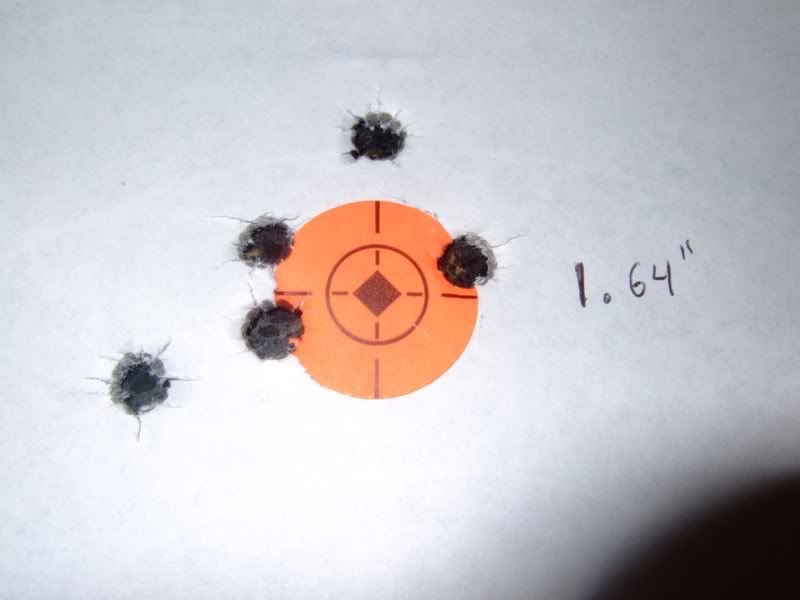
That's at 200 yards. Winds were light, but occasionally gusty. I won't blame any of those shots on wind. (Dammit.)
The interesting thing about the Leupold Tactical Milling Reticle in this scope is that at 14X there is an exactly ½ mill space in the center of the crosshairs. The orange target dots are 1" in diameter, so they subtend ½ mill at 200 yards (or close enough not to be able to tell the difference.) I tried my damnedest to keep that tiny orange dot in the dead center of the reticle. Seems to work!
I spent the rest of my 50 rounds busting rocks and then plinking the steel targets located up on the side of the mountain that is the ultimate backstop at the Casa Grande range. I need to get a laser rangefinder next, because I estimate the plates I was shooting at were at about 600 yards. I hit 'em a few times, too! (I will blame wind - and range estimation - for the misses there.)
I had to remount the scope when I got home. Unfortunately at 14X the eye relief was too short for me to shoot comfortably, so I loosened the mount screws and shifted it back two notches on the base. That ought to work much better now, but I'm going to have to re-zero the scope. (*Damn!* Work, work, work, that's all this hobby is!)
Next up on the agenda is to load another 50 of the 175SMKs over a bit lighter powder charge, and 50 of the Lapua 155 grain Scenar hollowpoints that are just as long as the SMKs. The primers on the first fifty flattened a tiny bit, but there was significant primer cup flow into the firing pin hole of bolt face. I think that load is just a bit hot for this rifle.
I also ran 100 rounds of my new .45ACP load through my Kimber Classic and Eclipse. I'm using the Ranier Ballistics 200 grain hollowpoint over 7.0 grains of Unique touched off with WLP primers. (Same warning - use this load data at your own risk!) The cases are mostly WCC once-fired match brass. Feed, function, and accuracy were on par with the (much more expensive) Speer 200 grain Gold Dot, so this is going to be my match ammo from now on. Now I need to load a couple hundred of them so I can shoot in the Pima Pistol Steelworker's match tomorrow morning.
Finally, I still have to scrub the Remington barrel squeaky clean and treat it with Ultra Bore Coat before my next outing. I'm not much of a believer in "breaking in" a barrel, but I did want to get some rounds out of the rifle before treating it. Right now it's definitely a sub-MOA gun. I want it to stay that way.
UPDATE: Here's a shot of fired vs. unfired primers.

Pressure, no?
Subscribe to:
Posts (Atom)