Liberty is an inherently offensive lifestyle. Living in a free society guarantees that each one of us will see our most cherished principles and beliefs questioned and in some cases mocked. That psychic discomfort is the price we pay for basic civic peace. It's worth it. It's a pragmatic principle. Defend everyone else's rights, because if you don't there is no one to defend yours. -- MaxedOutMama

I don't just want gun rights... I want individual liberty, a culture of self-reliance....I want the whole bloody thing. -- Kim du Toit

The most glaring example of the cognitive dissonance on the left is the concept that human beings are inherently good, yet at the same time cannot be trusted with any kind of weapon, unless the magic fairy dust of government authority gets sprinkled upon them.-- Moshe Ben-David

The cult of the left believes that it is engaged in a great apocalyptic battle with corporations and industrialists for the ownership of the unthinking masses. Its acolytes see themselves as the individuals who have been "liberated" to think for themselves. They make choices. You however are just a member of the unthinking masses. You are not really a person, but only respond to the agendas of your corporate overlords. If you eat too much, it's because corporations make you eat. If you kill, it's because corporations encourage you to buy guns. You are not an individual. You are a social problem. -- Sultan Knish

All politics in this country now is just dress rehearsal for civil war. -- Billy Beck

Showing posts with label Education. Show all posts

Sunday, January 24, 2021

Quora question: "Why is the United States so messed up right now in 2021?"

My answer:

100+ years of “public education” has produced the electorate we have today. Too many people can’t reason, have no coherent philosophy, have no knowledge of actual history (only “social justice” history), have been taught that Western Civilization is the root of all evil in the world, etc.

It started in the very early 1900’s, driven by the wealthy industrialists to set up a system that would produce a two-tiered output - the actually educated sons & daughters of the elite who would be managers, and the people who would be working in their factories and buying the resultant products. All the “Progressives” were in favor of it. They wanted obedient, unquestioning workers who could read, write, and do math, but not think for themselves.

Shortly afterward the “Progressives” suborned the system to create ever-greater numbers of “Social Justice Warriors,” culminating in what we have today. After more than five generations the population consists of essentially four groups - those that despite being in the public system still managed to get an education, those who were privately educated, those who the education system didn’t radicalize but instead made numb, and the radicals. (Note: a lot of the radicalized went back into the education system as teachers and administrators in a positive feedback loop.)

The private system has always been oriented towards the elites. The majority of the nation, I think, are the numb. Those who educated themselves are a minority and the radicals are too, but they - being radical - have influence far beyond their mere numbers.

"Human history becomes more and more a race between education and catastrophe." - H.G. Wells, 1920

--

"Give me a child for his first seven years and I'll give you the man." - Quote attributed to the Jesuits

--

"All who have meditated on the art of governing mankind have been convinced that the fate of empires depends on the education of youth." - Aristotle

--

"A recently reprinted memoir by Frederick Douglass (1818-1895) has footnotes explaining what words like 'arraigned,' 'curried' and 'exculpate' meant, and explaining who Job was. In other words, this man who was born a slave and never went to school educated himself to the point where his words now have to be explained to today's expensively under-educated generation.

"There is really nothing very mysterious about why our public schools are failures. When you select the poorest quality college students to be public school teachers, give them iron-clad tenure, a captive audience, and pay them according to seniority rather than performance, why should the results be surprising?

"Ours may become the first civilization destroyed, not by the power of our enemies, but by the ignorance of our teachers and the dangerous nonsense they are teaching our children. In an age of artificial intelligence, they are creating artificial stupidity.

"In a democracy, we have always had to worry about the ignorance of the uneducated. Today we have to worry about the ignorance of people with college degrees." - Thomas Sowell

--

"It is only from a special point of view that 'education' is a failure. As to its own purposes, it is an unqualified success. One of its purposes is to serve as a massive tax-supported jobs program for legions of not especially able or talented people. As social programs go, it’s a good one. The pay isn’t high, but the risk is low, the standards are lenient, entry is easy, and job security is pretty good...in fact, the system is perfect, except for one little detail. We must find a way to get the children out of it.”—Richard Mitchell, the Underground Grammarian.

Sunday, January 17, 2021

Quote of the Day - Seen @ Facebook

You’ll love this.

I’m in my masters class for education (already know where this is going) and Paulo Freire and Myles Horton are mainstays for this class with their book “We make the Road by Walking.” Here is a quote by Freire “Education is not neutral and that by claiming to be neutral, we are technically siding with the powerful.” 
Paulo Friere is best known for his book "Pedagogy of the Oppressed" and is the spiritual founder of "Critical Pedagogy," which is to education what "critical race theory" is to racial healing.  Miles Horton is known for his textbook "Education for Social Change."  As opposed to "education to learn how to read, write, do math, understand science, and think for yourself."

Sunday, November 01, 2020

Don't #WalkAway.

A recent piece at The American Conservative by Rod Dreher, Joe Rogan World vs. NPR World contains these two quotes:

...NPR sounds like Vatican Radio from the Church of Secular Progressivism, ...The New York Times reads like L’Osservatore Romano of the same pseudo-religion.

Do read the whole thing.  This is not surprising to me, but it is beautifully expressed.

Back in 2008 I wrote The Church of the MSM and the New Reformation, a review of media bias as seen through the lens of Professor of Communication Brian Anse Patrick's (PBUH) book The National Rifle Association and the Media:  The Motivating Force of Negative Coverage.  That the media has a bias is undeniable.  Both sides of the current political conflict believe that.  But what Professor Patrick exposed was that the bias is both Left and Right (one more than the other), but it is exclusively about control:

That elite media may be biased for or against a particular issue or topic is interesting, and this knowledge may help an interest group rally indignation or manage its public relations; however it tells little about the overall functioning of media in society. This latter concern is the broader and more important idea, with larger implications.

The larger concept that lies behind the consistent ranking is a broad cultural level phenomenon that I will label an administrative control bias. It has profound implications. Administrative control in this usage means rational, scientific, objective social management by elite, symbol-manipulating classes, and subclasses, i.e., professionalized administrators or bureaucratic functionaries. The thing administered is often democracy itself, or a version of it at least. Here and throughout this chapter terms such as "rational," "objective," "professional," and "scientific" should be read in the sense of the belief systems that they represent, i.e. rationalism, objectivism, professionalism, and scientism. Scientism is not the same as being scientific; the first is a matter of faith and ritualistic observance, the other is difficult creative work. William James made a similar distinction between institutional religion and being religious, the first being a smug and thoughtless undertaking on the part of most people, the second, a difficult undertaking affecting every aspect of a life. The term scientistic administration would pertain here. Note that we move here well beyond the notion of mere gun control and into the realm of general social control, management and regulation.

He explained that people who migrate into journalism believe that problems should be solved by the people already exercising the power.  That journalists see themselves as the clergy of the Church of State, acting as intermediaries between the High Church of government - Federal, state and local -  and the laypeople who make up the rest of the nation.  Which is why I found Mr. Dreher's description of NPR and the NYT to be so poetic.

As the political divide comes to a crashing head in this country on Tuesday, November 3, I thought I'd try to pull together the various threads that have been gathering in my head and try to weave together something coherent before (maybe) this whole thing gets ripped apart.

Why are we at this point?  I have pointed at public education as the great enabler, but it goes deeper than that.  John Taylor Gatto illustrated convincingly that the public education system was initially established by the Great Industrialists (aka "Robber Barons") of the 19th Century to create a two-tiered system: A lower tier for the workers who would labor, do what they're told without question, and buy the products they themselves manufactured, and an upper tier for the children of the Great Men and any who showed exceptional promise.  It was, after all, only natural - "Social Darwinism" was the phrase associated with it, except that philosophy quite easily slides into racism and eugenics (which it did.)  

No, a kinder, gentler philosophy was needed, and that was Marxism - the promise that all men (they were sexists in the late 19th century) would eventually be equal, would suffer no privation, would have all they needed, but never any more or less than their neighbors.  It was a beautiful dream, but Marx insisted that it was an historical inevitability!  So a lot of people adopted that dream and began working towards achieving it, hopefully in their lifetime.

These people were better than the average Joe or Jane.  They cared more.  They took jobs in government, in education, in media, because Utopia could not be consummated with the average prole!  Regular people cared only about themselves and a few people in their close circles.  For Marxism to work, people had to care about everyone else, and that required that they be trained, (nudged in the modern vernacular) into becoming a human being that can care more for a stranger than they do for themselves.  

I believe my readers can see the flaw here.

Instead of schools churning out capitalists, they started churning out sort-of-Socialists, and among them the Scientistic Administrators referred to by Prof. Patrick.  Part of that change was the secularization of the Western world, but the human mind seems to require some sort of spirituality.  There appears to be a portion of the brain pre-wired for a belief in some higher power.  In the face of a growing secularism, that inherent need for "spirituality" still needs to be filled.

Socialism, its accompanying Scientism and the promise of Marx's utopian vision seems to do so nicely, and generation after generation has been infected and affected by exposure to that horribly flawed idea.

From a now-banned 2017 Reddit essay:

Blue Team Progressivism is a church, offering you moral superiority and a path to spiritual enlightenment. As a church it's got a lot going for it. It runs religious programming on television, all day every day. Every modern primetime program is like a left-wing Andy Griffith show, reinforcing lessons of inclusion, tolerance, feminism, and anti-racism.

Watching a 90-pound Sci-Fi heroine beat up a room full of giant evil men is as satisfying to the left as John Wayne westerns were for the right.

The Blue Church controls the HR department, so even if you don't go to church, you have to act like a loyal churchgoer in every way that matters while you're on the clock. And off the clock, on any kind of public social media platform.

Jon Stewart and John Oliver are basically TV preachers. Watching them gives the same sense of quiet superiority your grandma gets from watching The 700 Club. The messages are constantly reinforced, providing that lovely dopamine hit, like an angel's voice whispering, "You're right, you're better, you're winning."

Hollywood award shows are like church talent shows - the skits and jokes aren't really funny, but it's fun to look at the pretty girls, and you're all on the same team.
If you oppose the ideas of the Left, as I have said in this forum repeatedly, you aren't merely wrong, misinformed, misled, ignorant or in error, you're evil.  As Eric Hoffer explained in his 1951 book The True Believer:  Thoughts on the Nature of Mass Movements:
Hatred is the most accessible and comprehensive of all unifying agents. It pulls and whirls the individual away from his own self, makes him oblivious of his weal and future, frees him of jealosies and self-seeking. He becomes an anonymous particle quivering with a craving to fuse and coalesce with his like into one flaming mass. (Heinrich) Heine suggests that what Christian love cannot do is effected by a common hatred.

Mass movements can rise and spread without belief in a God, but never without belief in a devil. Usually the strength of a mass movement is proportionate to the vividness and tangibility of its devil. When Hitler was asked whether he thought the Jew must be destroyed, he answered: "No.... We should have then to invent him. It is essential to have a tangible enemy, not merely an abstract one." F.A. Voigt tells of a Japanese mission that arrived in Berlin in 1932 to study the National Socialist movement. Voigt asked a member of the mission what he thought of the movement. He replied: "It is magnificent. I wish we could have something like it in Japan, only we can't, because we haven't got any Jews."
But we have had Ronald Reagan, George Bush, and now Donald Trump, each one inspiring greater and greater derangement to the point where it's actually been called that - [fill in the blank] Derangement Syndrome, each new mutation more virulent than the last. 

Of course, we've still got Jews, too

Those Presidents, and the people who voted for them, have been called deplorables, bitter clingers, racists, sexists, misogynists, homophobes, Islamophobes,  pretty much every -ist and -phobe you can think of.  But what they're really saying is "heretic."  Note how viciously they go after the apostates - the former members of the Left who #WalkAway.   They know better.  They're better educated, better informed, more intelligent, and therefore should be in charge of everything.  As the quote on the masthead of this blog from Sultan Knish explains:
The cult of the left believes that it is engaged in a great apocalyptic battle with corporations and industrialists for the ownership of the unthinking masses. Its acolytes see themselves as the individuals who have been "liberated" to think for themselves. They make choices. You however are just a member of the unthinking masses. You are not really a person, but only respond to the agendas of your corporate overlords. If you eat too much, it's because corporations make you eat. If you kill, it's because corporations encourage you to buy guns. You are not an individual. You are a social problem.

Hoffer, in a 1967 television interview with Eric Sevareid, was asked about the Intellectuals - our "betters" in society and (most importantly today) government.  He responded:

Hoffer:  I talk of a specific type of person when I talk about an intellectual. [...] To me an intellectual is a man of some education who considers himself a member of the educated elite, who thinks he has a God-given right to direct affairs. To me an intellectual doesn't even have to be intelligent in order to be an intellectual. He looked down upon the masses as if they were dirt.

Sevareid: It's their attitude toward ordinary people that is the dividing line in your mind?

Hoffer: That's right.

--

Hoffer: In this country the intellectuals aren't in power. Mass movement hasn't a chance for the simple reason that they aren't started by the masses. They're started by intellectuals.

In America the intellectual has neither status, nor prestige, nor influence. We, the common people, are not impressed by intellectuals. We have a disdain for pencil-pushers. We actually define efficiency by the small number of pencil-pushers. If you asked me what I consider an efficient society I'd say the ratio between the office personnel and the producing personnel.

The smaller the amount of supervision the better, the healthier, the more vigorous a society. The highest supervisory personnel is where the intellectuals are in power - in Communist countries. There half the population is supervising the other half. The intellectuals have a tremendous contempt for the masses. Intellectuals can't operate unless they're convinced that the masses are lazy, incompetent, dishonest; that you have to breathe down their necks, and you have to watch them all the time. We in America are sitting pretty because the masses perform only if we leave them alone. That's where we are at our best.

--

Eric Sevareid: You seem to have a fear about the rise of intellectuals in political life and power. Why are you so frightened of them?

Eric Hoffer: First of all, I ought to tell you that I have no grievance against intellectuals. All that I know about them is what I read in history books and what I've observed in our time. I'm convinced that the intellectuals as a type, as a group, are more corrupted by power than any other human type. It's disconcerting to realize that businessmen, generals, soldiers, men of action are less corrupted by power than intellectuals.

In my new book I elaborate on this and I offer an explanation why. You take a conventional man of action, and he's satisfied if you obey, eh? But not the intellectual. He doesn't want you just to obey. He wants you to get down on your knees and praise the one who makes you love what you hate and hate what you love. In other words, whenever the intellectuals are in power, there's soul-raping going on.

And here we are, 53 years later with a society full of three more generations of college-educated intellectuals.  We have a mass movement started by those intellectuals on college campuses where they teach and are taught to loathe their nation and their fellow citizens.  We're in not a civil war over control of the government, but a RELIGIOUS war over the control of our souls.  

57 genders. Free speech is violence, but violence is speech, but silence is violence.  There should be an equal number of female Fortune 500 CEOs but not an equal number of female brick layers, roofers, plumbers, or auto mechanics.  Tear down all the statues.  Rename all the streets, schools and other public buildings.  Burn down Federal buildings, preferably with Federal agents inside.  Raise your hand and say "Black Lives Matter" or we'll beat you.  Defund the police, but call the highway patrol when a Joe Biden campaign bus is surrounded by Trump supporters in pickup trucks, and on, and on, and on.

And so far we deplorables have acquiesced, gone along, kept our mouths shut and tried to stay out of it.

That choice is not going to be viable much longer.  The Left is like the Terminator - it doesn't sleep, doesn't eat, and absolutely will not stop unless it is stopped.  It's time to stop them.  This election is only the first step.  If we don't take it, we may not get another.  It's time to #StandUpandFaceThem, and damn the backlash.


Friday, July 24, 2020

Quote of the Day - Stephen Kruiser Edition

From his daily Morning Briefing, titled:  Defund the Public Education Leftist Indoctrination Mills
While I have never been one to view anything as an existential crisis, I’ve more and more come to believe that the upcoming presidential election will be a watershed moment for the United States. If Joe Biden wins, it will be the complete triumph of decades of public education indoctrination. The drift of so many young Americans towards socialism and anti-American sentiment is the direct result not being taught real American history, but being fed a leftist line that seeks to rewrite and/or whitewash much of what made this country great.
Do read the whole thing, but seriously, Stephen?  Now?  You're a pundit.  I'm just the average guy, and I figured that out a few years ago.  Defunding public education isn't enough.  We need to nuke the site from orbit until the rubble bounces, and salt the Trinitite.  Public education isn't "fixable."  The problem isn't the schools, its the people who run them.  We have to get them away from the children.

And for those of you who ask "Well, what do we replace them with?" please read Education, Societal Division and a Proposal


Wednesday, July 08, 2020

Endgame


This blog has been, for me, a seventeen-year exploration of other people's ideas.  If you've been here long, you'll know that I use short quotes and long excerpts from other people's writings to make the points I write about.  Like most people, I am not an "original thinker."  I try to expose myself to as much as I can, and weigh it against my experience and reason to determine truth.  Then I put it down in pixels to help me get my head around it.

Over these past seventeen years (hell, over the last 25), I have slowly come to some conclusions that I'm not happy about.

Remember that last nearly 10,000-word überpost?  I told you that so I could tell you this.  Hopefully I won't be as long-winded this time.


Tuesday, May 05, 2020

This is What the Education Bureaucracy is Afraid Of

AITA for showing my 13 year old daughter footage of WW2 concentration camps? Excerpt:
Schools are shut, we’re in lockdown and I’m playing teacher. My daughter is 13 and doing a project on world war 2. It’s basically a critical thinking piece about why it is important to remember the atrocities with also room to argue that we should be able to forget about it and move on.

I feel incredibly strongly about remembering WW2, for a variety of logical reasons I won’t get into, but also I’m quite an emotional person who wants to remember. However for the purpose of this project I tried to stay unbiased.

My daughter who is generally a clever and kind person just wasn’t getting it. I looked at the reading material and it was all very... I don’t know. Dull I guess? Watered down? Far removed?

Later on she was in a video call with some school friends saying learning about ww2 was a waste of time. Essentially the gist was it’s boring, it’s in the past and we don’t have to deal with these sort of things nowadays. I heard one of her friends say “I don’t think it’s even as bad as the text books made it out to be”

In that moment I guess I decided to take a more hands on teaching approach.
RTWT.

Monday, April 20, 2020

The Eduocracy is Worried?


Harvard Magazine warns of the damage homeschooling can do to children.  Note that they used the Bible as one of the books, and that the cartoonist cannot (apparently) spell "Arithmetic" correctly.  Note that more than one critic of compulsory government schooling has pointed out that one tenet of the architects of "Public Education" was reducing the influence of parents on their own children to better condition them as good cogs for the social machine.

Wednesday, April 08, 2020

Education Quote of the Day

Seen at Instapundit by Robert E. Wright of the American Institute for Economic Research:
As I recently argued elsewhere, America’s educational system has not prepared us for the government power grab because it does not create enough Emersonian independent thinkers or, frankly, even adult thinkers. Due to the extreme Left bias of higher education, many of America’s college graduates remain intellectually infantilized to the point that they can do little more than Tweet ignorant hate at any idea that does not accord with Progressive mantras.
 Analysis:  True. Read the piece in that second link.

Tuesday, March 31, 2020

Our Collapsing Schools, Part 6.02x10²³

How Low Can Higher Education Go? by John Ellis from "Minding the Campus."  Highly recommended.  Just a taste:
One study after another has found that (recent college graduates) write badly, can’t reason, can’t read any reasonably complex material, have alarming gaps in their knowledge of the history and institutions of the society in which they live, and are in general poorly prepared for the workplace.
RECENT.  COLLEGEGRADUATES.  The ones who DIDN'T drop out.

Brought to you by Brawndo® The Thirst Mutilator™!  It's got what plants crave!

RTWT, where you will find this:  "The goal of schooling is not considered to be instructional, let alone intellectual, but political."  And weep.

Sunday, December 01, 2019

Wednesday, July 24, 2019

Civil War


America will never be destroyed from the outside.  If we falter and lose our freedoms, it will be because we destroyed ourselves. - Abraham Lincoln

--

Peace - the word evokes the simplest and most cherished dream of humanity.  Peace is, and has always been, the ultimate human aspiration.  And yet our history overwhelmingly shows that while we speak incessantly of peace, our actions tell a very different story. - Javier Perez de Cuellar

--

Conflict, like poverty, is the normal condition of Man.  Instead of seeking the causes of conflict, one would be better off studying the causes of peace and the prosperity it makes possible. - Anonymous

--

We have war when at least one of the parties to a conflict wants something more than it wants peace. - Jeane Kirkpatrick

--

Revolution, n. - In politics, an abrupt change in the form of misgovernment. - Ambrose Bierce
A recent Pew poll indicates that a majority of the population believes that political violence is imminent.  A February 2019 column from the BBC asked Are We On the Road to Civilization Collapse? Sara Hoyt wrote in March a piece entitled We Are Dancing on a Powder Keg.

These are not isolated examples, oh no:

It’s Time For Conservatives To Choose: Fight Back Or Surrender

The Battle Isn't Right vs. Left. It’s Statism vs. Individualism


Georgetown University poll: Nation at edge ‘of civil war,’ but voters reject compromise

The Civil War

America's Second Civil War Has Already Begun

Which way to the revolution

Democrat Congresswoman To Conservative Teen: “You’re Right To Be Afraid Of Us”

America’s Cold Civil War

Eric Holder: Democrats Should Consider Packing SCOTUS

America Is Over, But I Won’t See It Go Without An Epic Fight

That's an even dozen, and I didn't have to work hard to compile them.

The concept of the "meme" was coined by anti-theist Richard Dawkins in his 1976 book The Selfish Gene. It's not just those humorous images that make up a significant portion of Facebook postings, though they're an exhibit of the general concept. Merriam Webster defines a meme as "an idea, behavior, style, or usage that spreads from person to person within a culture." Dawkins himself said:
Memes (discrete units of knowledge, gossip, jokes and so on) are to culture what genes are to life. Just as biological evolution is driven by the survival of the fittest genes in the gene pool, cultural evolution may be driven by the most successful memes.
This is a mega-überpost, but if this interests you (or frightens you) get a snack and a beverage, get comfortable then please click below and continue. 

Saturday, July 20, 2019

"We Have Met the Enemy, and He is Us."

The immortal words of the comic-strip character Pogo.

(Perusing my blog, I noticed that I had a half-dozen started essays that I'd never completed and published.  This is one of them from back in early 2016.  I thought I'd dust it off and hit "Publish."  Comments?)

Here we are in the early stages of the Run for the Presidency, 2016, and the most likely candidates at the moment are a lying, incompetent carpetbagger from Arkansas and a blowhard billionaire whose only principles seems to be "make money" and "promote myself."  The Vermont Socialist could still pull it out if he could get the Democrat Superdelegates on his side, but that seems unlikely at this point.  The Republican elite is shitting itself over the possibility that The Donald® might win the nomination, and the only other candidate with a chance is Ted "No Compromise" Cruz.  They could defeat The Donald® if they united behind Cruz, but as Rush Limbaugh keeps repeating, they hate The Donald®, they FEAR Cruz.

How the fuck did we get to this point?

Political commentator Henry Louis Mencken, an early 20th Century Cassandra wrote in 1920:
The larger the mob, the harder the test. In small areas, before small electorates, a first-rate man occasionally fights his way through, carrying even the mob with him by force of his personality. But when the field is nationwide, and the fight must be waged chiefly at second and third hand, and the force of personality cannot so readily make itself felt, then all the odds are on the man who is, intrinsically, the most devious and mediocre — the man who can most easily adeptly disperse the notion that his mind is a virtual vacuum.

The Presidency tends, year by year, to go to such men. As democracy is perfected, the office represents, more and more closely, the inner soul of the people. We move toward a lofty ideal. On some great and glorious day the plain folks of the land will reach their heart's desire at last, and the White House will be adorned by a downright moron.
So a low opinion of politicians and the electorate both is nothing really all that new, but I wonder if Mencken really believed what he was saying, or was he instead writing a warning?  Doesn't really matter now, though, because instead of electing a moron, we're looking at electing an entirely different kind of disaster.

In 2006 I pulled a Quote of the Week from an Orson Scott Card book I was reading:
(America) was a nation created out of nothing - nothing but a set of ideals that they never measured up to. Now and then they had great leaders, but usually nothing but political hacks, and I mean right from the start. Washington was great, but Adams was paranoid and lazy, and Jefferson was as vile a scheming politician as a nation has ever been cursed with.
...
America shaped itself with institutions so strong that it could survive corruption, stupidity, vanity, ambition, recklessness, and even insanity in its chief executive.
A couple of years later, I pulled that quote again for my post Restoring the Lost Constitution, and asked the question:

But can it survive enmity?

I don't have an answer to that question yet, but it may be coming sooner than anyone would like.

Friday, February 22, 2019

Quote of the Day - Education Edition

Victor Davis Hanson from his recent speech Two States of California (worth your time BTW):
When I went in (to the California State University system) in 1984 as a professor of Classics, the remediation rate - that was a fancy term for those who are admitted into the CUS system, the largest university system in the world, well over a quarter-million students - was 32%, and the graduation rate in four years was 51%. When I left 23 years later the remediation rate was 55% and the average for SIX years graduation was 49%.

How did California solve that problem? They just got rid of the word last year called "remediation." So rather than saying 60% of the students who entered the CSU system cannot take a college class because they don't qualify to be there in the first place and therefore you have remediated class - we used to call them "Bonehead English" and "Bonehead Math" - and you don't get college credit for it, we don't call it remediation anymore and they solved the problem. There's zero remediation now.

But believe me, if we're going to build a high-speed rail, who is going to pilot it? Who is going to engineer it? Somebody who is remediated?

So after saying that, to emphasisze this idea of schizophrenia, I go over to the coast and I'm at Stanford University. Last year the London Times Higher Education supplement - and was confirmed by the University of Tokyo - rated the greatest universities supposedly in the world. You'd think they'd all be Japanese and British since they were doing the surveys. Number one - CalTech. Number two - Stanford. Number four - Berkeley. Number ten - UCLA. Number fifteen - USC. FIVE of them were from California. California had more top universities than any other NATION except the United States, and yet it has a public school system where just 60% of people can't read or write. It's the same state, believe me.
See also this post from December of 2004.

Friday, February 15, 2019

Arguing With a Leftist

The writing bug is starting to bite again, so you may see some new content here, including (eventually) a mega-überpost I started back in October of last year, but for now just this little piece.

A few days ago someone at Quora tagged me with the question:
If both conservatives and liberals love USA, why there are such hostility and lack of trust towards each others?
I left an answer, but someone else left this one:
As a former Right turned Left, I assure you all there are smart and well educated people on each side. The difference is largely in an assumption or two.

The Right assumes people deserve and have a right to whatever assets they have, whether earned or given by prior generations. And this includes land, food, natural resources, water, etc.

The Left believes luck plays a big part in how wealth is currently distributed. They believe every human deserves some minimal share of water, food, clean air, and resources required to live. They point out that every business owes some of its success to the hard and soft infrastructure provided by governments.

I think I am being fair to both my former and current views here. All differences in political philosophy derive from the above.

I changed because I figured out I am a Liberal. Imagine a game of Monopoly where one player is given a pile of money, properties, houses and hotels by his father, along with some good game advice. The other players start with a few bucks and don't know what the rules are when they start out. Liberals don't think this is fair, Conservatives do.
I left this comment with the (forlorn) hope that it might generate a debate:
“Liberals don't think this is fair, Conservatives do.”

I disagree. We both agree it’s not fair. The difference is that Conservatives understand that the world is not fair.

“(Liberals) believe every human deserves some minimal share of water, food, clean air, and resources required to live.”

Conservatives know that the world owes us nothing. Liberals think they can make the world fair. All they need is the power to make it so.

Conservatives understand that the kind of power needed to “make the world fair” always ends badly.

Always.
Result? Crickets.  But I'd like to go ahead and unpack this - fairly accurate, I think - definition of the modern-day "liberal," née "Progressive."

The progressive complains that the world is not fair. They're absolutely right - it isn't. They believe that the Right thinks it is fair - we don't, but we understand that all the wishing in the world won't make it fair. Because they think the unfairness can be corrected, and the Right is opposed to making this correction, we're evil. That's where we part company. (There's more to it than that, but this I think is the fundamental disagreement.)  There's a disconnect at the very foundation of the ideological split between the two philosophies, and it goes back decades if not centuries.  After all, Kipling's The Gods of the Copybook Headings was published in 1919, just shortly after the Russian Revolution.

The fundamental split is that one side thinks that - given sufficient power (in the right hands, of course) - the world can be made fair.  That there doesn't need to be winners and losers. (Thus "participation trophies" and sports "games" where no one keeps score.) That it is the job of "society" to make everyone absolutely equal.  The other side believes that the world is fundamentally unfair and it's up to the individual to overcome that inherent unfairness.

Let's look a the literature throughout history.  Kipling in 1919.  Kurt Vonnegut's Harrison Bergeron from 1961.  George Orwell's Animal Farm (1945) and 1984 (1949).  The Greek fable of the Procrustean Bed from ancient history.  They're all warnings about trying to build Utopia.  What does the Left have?  So far as I can tell, Star Trek from 1966 where they don't use money, everyone has their needs met, and anyone can pursue whatever they like or do nothing at all.  Exactly what Karl Marx promised would be the outcome of Communism in The Communist Manifesto (1848) and Das Kapital (1867) - two other fantasies.   We saw this most recently in Alexandria Ocasio-Cortez's (AOC) "Green New Deal" where she promised "Economic security to all who are unable or unwilling to work." (My emphasis.)

Remember Kipling?
And that after this is accomplished, and the brave new world begins
When all men are paid for existing and no man must pay for his sins,
As surely as Water will wet us, as surely as Fire will burn,
The Gods of the Copybook Headings with terror and slaughter return.

Let's return to our new Leftist's assertion:
The Left believes luck plays a big part in how wealth is currently distributed. They believe every human deserves some minimal share of water, food, clean air, and resources required to live. They point out that every business owes some of its success to the hard and soft infrastructure provided by governments.
And:
The Right assumes people deserve and have a right to whatever assets they have, whether earned or given by prior generations. And this includes land, food, natural resources, water, etc.
What are you to assume from this? That the "hard and soft infrastructure provided by governments" unfairly benefits some, no? And therefore those beneficiaries then owe some of their unfairly gained wealth to those not so fortunate. Am I misunderstanding the "logic" here?

As economist Walter Williams has asked, how much of someone else's property is "your fair share"?  Who decides?  As others have asked, why is robbing someone at gunpoint illegal, but threatening someone with arrest by an armed agent of the government if they don't cough up money not?

This goes back to my constant harping on education.  I ran across this cartoon Facebook today:


Between 100 and 200 million, in point of fact.

Like they teach that these days.

Hell, they don't even teach about the Holocaust these days.  Why would they teach about socialism's other lethal failures?  Instead the schools indoctrinate students in Leftism and the result is that a majority of young people today view socialism favorably.  WaPo columnist E.J. Dionne Jr. recently wrote "Trump's War on Socialism Will Fail."  Of course it will.  The Long March Through the Institutions has worked out wildly better than either Rudi Dutschke, Antonio Gramsci or any of the members of the Frankfurt School could have imagined. (Two people and one organization that the Millenials don't know anything about, either.)

And we're paying for it now.

Many years ago Chris Byrne wrote "There can be no useful debate between two people with different first principles, except on those principles themselves." As illustrated above, our first principles are completely divergent, and there is no debate - useful or otherwise - anymore. Charles Krauthammer's observation that the Right thinks the Left is stupid, but the Left thinks the Right is evil was correct when he made it back in the 1990's, but today the Right is beginning to wake up to the fact that what the Left wants to accomplish - and is willing to use violence to achieve - is evil. When both sides "other" their opponents, can open warfare be far behind?


Wednesday, September 12, 2018

Education, Societal Division and a Proposal

Überpost alert!  It is something I've been studying and thinking about since 1993, and writing about here for 15 years, so there will be a lot of internal links, external links, links to stuff that only exists because of the Internet Wayback Machine, etc. and a lot of stuff you've seen here before if you've been here very long. It's about a lot more than education but it all starts there.

Lets get on with it, shall we?

"All who have meditated on the art of governing mankind have been convinced that the fate of empires depends on the education of youth." - Aristotle

If you've read this blog for any extended period, you know one of my personal hobby-horses is public education. Specifically, its general failure to educate. That failure is hardly a new thing. Let me remind you:

Quote of the Day, July 13, 2012

Quote of the Day, July 14, 2009

Those are John Taylor Gatto quotes not necessary to requote in full here, thus the links. Here are a couple of other significant quotes:
The aim of public education is not to spread enlightenment at all; it is simply to reduce as many individuals as possible to the same safe level, to breed and train a standardized citizenry, to put down dissent and originality. That is its aim in the United States, whatever the pretensions of politicians, pedagogues, and other such mountebanks, and that is its aim everywhere else.

--

And what is a good citizen? Simply one who never says, does or thinks anything that is unusual. Schools are maintained in order to bring this uniformity up to the highest possible point. A school is a hopper into which children are heaved while they are still young and tender; therein they are pressed into certain standard shapes and covered from head to heels with official rubber-stamps.

Henry Louis Mencken, 1924
Even Noam Chomsky concurs:
I quoted the Trilateral Commission view of the educational system, namely that it's a system of indoctrination of the young, and I think that's correct. It's a system of indoctrination of the young. That's the way the liberal elites regarded it and they're more or less accurate. So the educational system is supposed to train people to be obedient, conformist, not think too much, do what you're told, stay passive, don't raise any crises of democracy, don't raise any questions. That's basically what the system is about.
Watch the whole clip. It's about five minutes long.

I've written about indoctrination before, but my objection has been to what indoctrination is going on, not why:
...I am ambivalent on the topic of "indoctrination." My problem is with what that indoctrination entails. (Leo) Rosten objects to the failure of the educational system to indoctrinate moral values. I'd say it still does. It just doesn't indoctrinate goodness, kindness, and decency anymore. It indoctrinates "multicuturalism," "tolerance," "sensitivity," "fairness," "socialism," and "self-esteem." It fails to instruct in history, civics, ethics, mathematics, English, or for that matter, job skills. The education system receives "young skulls full of mush" and processes them right on through, sending them into the world with what Ayn Rand described as "a junk heap of unwarranted conclusions, false generalizations, undefined contradictions, undigested slogans, unidentified wishes, doubts and fears."

The reasons for this are myriad. Diane Ravitch puts part of the blame (convincingly) on the textbook companies who are loath to put anything in a text that someone, anyone, might find offensive. I put a large part of the blame on the influx of socialist True Believers into the ranks of educators since the time of John Dewey. As far as public schools are concerned, we've abandoned the idea that education can liberate the human mind or human spirit. Schools are now warehouses, run by administrators terrified of lawsuits and too many teachers who are literally tyrannized by their charges and their parents. Indoctrination still goes on, though. Read this lovely little op-ed by Mark Bradley, a history teacher from Sacramento. I bet his classes are popular!

It would seem that if you want some good indoctrination, your only choices are homeschooling or private - often ecumenical - schools.

Indoctrination of children is not necessarily a bad thing, but somewhere along the line we stopped paying attention to what was and what wasn't getting poured into their heads, and it started long before 1975.
In 2008 I wrote another überpost, The George Orwell Daycare Center, specifically illustrating the kind of indoctrination I'm objecting to, followed by an observation by historian, profound thinker and university professor Victor Davis Hanson. I believe that it is still possible to get a decent education out of many, possibly most school systems in this country - if you want one.  This is due to those teachers who really do know their subjects and how to teach them, and students willing to do the work necessary to learn them. I think both still exist, however I graduated High School in 1980 so this may no longer be as true as it once was. It does appear that the ratio of such teachers and students to the general population is getting continually smaller. That question is "Why?"
Our once unchallenged preeminence in commerce, industry, science, and technological innovation is being overtaken by competitors throughout the world. This report is concerned with only one of the many causes and dimensions of the problem, but it is the one that undergirds American prosperity, security, and civility. We report to the American people that while we can take justifiable pride in what our schools and colleges have historically accomplished and contributed to the United States and the well-being of its people, the educational foundations of our society are presently being eroded by a rising tide of mediocrity that threatens our very future as a Nation and a people. What was unimaginable a generation ago has begun to occur--others are matching and surpassing our educational attainments.

If an unfriendly foreign power had attempted to impose on America the mediocre educational performance that exists today, we might well have viewed it as an act of war.
That last one is from the introduction to the 1983 report of the National Commission on Excellence in Education entitled A Nation at Risk: the Imperative for Educational Reform.

It was an act of war. Guerilla war. But the battleground had been carefully prepared, like the Maginot Line, for an entirely different war.
In the first decades of the twentieth century, a small group of soon-to-be-famous academics, symbolically led by John Dewey and Edward Thorndike of Columbia Teachers College, Ellwood P. Cubberley of Stanford, G. Stanley Hall of Clark, and an ambitious handful of others, energized and financed by major corporate and financial allies like Morgan, Astor, Whitney, Carnegie, and Rockefeller, decided to bend government schooling to the service of business and the political state—as it had been done a century before in Prussia.

Cubberley delicately voiced what was happening this way: "The nature of the national need must determine the character of the education provided." National need, of course, depends upon point of view. The NEA in 1930 sharpened our understanding by specifying in a resolution of its Department of Superintendence that what school served was an "effective use of capital" through which our "unprecedented wealth-producing power has been gained." When you look beyond the rhetoric of Left and Right, pronouncements like this mark the degree to which the organs of schooling had been transplanted into the corporate body of the new economy.

It’s important to keep in mind that no harm was meant by any designers or managers of this great project. It was only the law of nature as they perceived it, working progressively as capitalism itself did for the ultimate good of all. The real force behind school effort came from true believers of many persuasions, linked together mainly by their belief that family and church were retrograde institutions standing in the way of progress. Far beyond the myriad practical details and economic considerations there existed a kind of grail-quest, an idea capable of catching the imagination of dreamers and firing the blood of zealots.

-- John Taylor Gatto, The Underground History of American Education
...between 1967 and 1974, teacher training in the United States was covertly revamped through coordinated efforts of a small number of private foundations, select universities, global corporations, think tanks, and government agencies, all coordinated through the U.S. Office of Education and through key state education departments like those in California, Texas, Michigan, Pennsylvania, and New York.

Important milestones of the transformation were: 1) an extensive government exercise in futurology called Designing Education for the Future, 2) the Behavioral Science Teacher Education Project, and 3) Benjamin Bloom's multivolume Taxonomy of Educational Objectives, an enormous manual of over a thousand pages which, in time, impacted every school in America. While other documents exist, these three are appropriate touchstones of the whole, serving to make clear the nature of the project underway.

Take them one by one and savor each. Designing Education, produced by the Education Department, redefined the term "education" after the Prussian fashion as "a means to achieve important economic and social goals of a national character." State education agencies would henceforth act as on-site federal enforcers, ensuring the compliance of local schools with central directives. Each state education department was assigned the task of becoming "an agent of change" and advised to "lose its independent identity as well as its authority," in order to "form a partnership with the federal government."

The second document, the gigantic Behavioral Science Teacher Education Project, outlined teaching reforms to be forced on the country after 1967. If you ever want to hunt this thing down, it bears the U.S. Office of Education Contract Number OEC-0-9-320424-4042 (B10). The document sets out clearly the intentions of its creators — nothing less than "impersonal manipulation" through schooling of a future America in which "few will be able to maintain control over their opinions," an America in which "each individual receives at birth a multi-purpose identification number" which enables employers and other controllers to keep track of underlings and to expose them to direct or subliminal influence when necessary. Readers learned that "chemical experimentation" on minors would be normal procedure in this post-1967 world, a pointed foreshadowing of the massive Ritalin interventions which now accompany the practice of forced schooling.

The Behavioral Science Teacher Education Project identified the future as one "in which a small elite" will control all important matters, one where participatory democracy will largely disappear. Children are made to see, through school experiences, that their classmates are so cruel and irresponsible, so inadequate to the task of self-discipline, and so ignorant they need to be controlled and regulated for society's good. Under such a logical regime, school terror can only be regarded as good advertising. It is sobering to think of mass schooling as a vast demonstration project of human inadequacy, but that is at least one of its functions.
That was also Gatto.

Our education system, as Gatto has noted, is largely based on the Prussian system established by the great industrialists of their era in order to produce a two-tiered output - the workers and the owners and managers. However, it was rapidly suborned instead to destroy Western culture:
Translated into practical terms and updated from its early-20th-century Italian cultural setting, (Antonio) Gramsci's thesis is understood by the modern Left to mean:
Socialist revolution will never happen in a nation if its culture continually reaffirms and enshrines middle-class capitalist values. Thus, in order to pave the way for the arrival of a communist state, radicals must first insinuate themselves into and/or influence the media and educational system, and from these positions of influence change public attitudes about the status quo. To achieve political hegemony, you must first achieve cultural hegemony.
This was a significant change from Marx's and Lenin's original ideas about communist revolution, which basically involved simply seizing power, public opinion be damned, and afterward propagandizing the masses to accept the new order. Gramsci realized that Marx had it reversed, and that the propaganda and indoctrination must happen first, in order to make the populace open to the idea of revolution; otherwise, rendered complacent by middle-class values and comforts, the populace would never consent to the upheaval of a revolution.

The media and public schools were correctly identified by Gramsci as the most influential cultural institutions, and it was therefore those that the left realized must be targeted.

It is this sophisticated Gramscian plan, and not the more brutish Marxist idea of simply seizing power by force, which has guided leftist thought in America since WWII. And it is why the media and education have, over time, been slowly turned into engines of leftist propaganda. Gramscianism matured into "critical pedagogy" which is the real-world application of his educational theories, and countless left-leaning young adults have for decades been nudged toward careers in education and the media. Some time ago, we crossed a threshold in which the Gramscian infiltrators no longer had to ply their trade surreptitiously, but became the majority in the media and in education, and after that point the process accelerated rapidly as they took over both fields and turned them into ideological weapons.
Sugatra Mitra, Indian solid state physicist and now Professor of Educational Technology at the School of Education, Communication and Language Sciences at Newcastle University, England, was among the forefront of people who had to learn how to write software, and ended up doing more teaching of that than physics. This piqued his interest in primary education. Though his interest was specific to the British system, he came to a similar conclusion:
I tried to look at where did the the kind of learning we do in schools, where did it come from? And you know you can look far back into the past, but if you look at present-day schooling the way it is, it's quite easy to figure out where it came from. It came from about 300 years ago, and it came from the last and the biggest empire on the planet. Imagine trying to run the entire planet without computers, without telephones, with data handwritten on slips of paper and traveling by ships. But the Victorians actually did it. What they did was amazing. They created a global computer made up of people. It's still with us today, it's called the "bureaucratic administrative machine."

In order to have that machine running, you need lots and lots of people. They made another machine to produce those people - the school. The schools would produce the people who would then become parts of the bureaucratic administrative machine. They must be identical to each other. They must know three things: they must have good handwriting because the data is handwritten, they must be able to read, and they must be able to do multiplication, division, addition and subtraction in their head. They must be so identical that you could pick one up from New Zealand and ship them to Canada and he would be instantly functional.

The Victorians were great engineers. They engineered a system that was so robust that it is still with us today, continuously producing identical people for a machine that no longer exists.
I will come back to this later when I delve deeper into the education portion of this post.

So the purpose of "public education" isn't so much educating, it's building dependable uniform cogs for a machine run by elites. As I have noted in the past, despite the inspirational rhetoric of Jefferson in the Declaration of Independence and President Lincoln in the Gettysburg Address, the purpose of governments has always been, until the American Revolution, to protect and expand the power and privilege of the powerful and privileged, not the protection of the individual rights of the cogs, not to be "of the people, by the people, for the people." Referring back to that first Gatto link, you'll note that our Founders were, as they pretty much had to be, self-taught. That has changed since the late 18th century, at first slowly, but exponentially.

Angelo Codevilla, Professor Emeritus of International Relations at Boston University, calls this "elite" our Ruling Class.
Our ruling class's agenda is power for itself. While it stakes its claim through intellectual-moral pretense, it holds power by one of the oldest and most prosaic of means: patronage and promises thereof. Like left-wing parties always and everywhere, it is a "machine," that is, based on providing tangible rewards to its members. Such parties often provide rank-and-file activists with modest livelihoods and enhance mightily the upper levels' wealth. Because this is so, whatever else such parties might accomplish, they must feed the machine by transferring money or jobs or privileges -- civic as well as economic -- to the party's clients, directly or indirectly. This, incidentally, is close to Aristotle's view of democracy. Hence our ruling class's standard approach to any and all matters, its solution to any and all problems, is to increase the power of the government -- meaning of those who run it, meaning themselves, to profit those who pay with political support for privileged jobs, contracts, etc. Hence more power for the ruling class has been our ruling class's solution not just for economic downturns and social ills but also for hurricanes and tornadoes, global cooling and global warming. A priori, one might wonder whether enriching and empowering individuals of a certain kind can make Americans kinder and gentler, much less control the weather. But there can be no doubt that such power and money makes Americans ever more dependent on those who wield it.

Laws and regulations nowadays are longer than ever because length is needed to specify how people will be treated unequally.
--
(The party) is composed of two tiers. The lower tier produces many outspoken members who make their demands known to the upper tier. The lower tier is derived from the inner-city population that serves as the base of the party. The lower tier's members are generally educated in public school systems and if they aspire to advanced training, they are educated in facilities provided by the state. This wing constitutes the majority of (the party's) membership, but contributes little or nothing to party theory or platform. It votes the party line and is rewarded with cash payments, subsidized housing, subsidized education, and occasional preferential employment in government positions. The lower tier provides only a handful of clearly token individuals allowed to serve in high offices.

The upper tier, which includes most of the party's management, virtually all the appointed and elected government officials, and all of the party's decision-makers, is drawn exclusively from suburban areas where wealth is a fundamental criterion for admittance as a resident. These party members are generally educated at private schools and attend private colleges. They are not affected by food-rationing schemes, income caps or taxation laws, as the legislation drafted and passed by members of their social group inevitably contains loopholes that effectively shelter their income and render them immune from unpleasant statues that restrict the lives of lower-tier party members and all nonparty citizens.

(The party) leadership recognizes that in return for supporting a seemingly populist agenda, they can obtain all the votes they require to remain in power. Even the most cursory analysis of their actions and attitudes, however, indicates that they are not populists but, in fact, are strong antipopulists who actively despise their voting base. This....is proven by their efforts to reduce public educational systems to a level most grade-school children (in other countries) have surpassed, with the excuse that this curriculum is all that the students can handle. They have made the inner-city population base totally dependent on the government, which they control. -- John Ringo from the novel The Road to Damascus
I'm by no means a fan of Pat Buchanan, but I think he was absolutely correct when he said:
Our two parties have become nothing but two wings of the same bird of prey.
So our system of Public Education has been largely turned into not only a system to crank out identical cogs, it also serves as a place for political indoctrination, and a place to ensure that a love of learning is beaten out of those cogs.

The political Left, once referred to as "the loyal opposition," has been suborned by Marxists in order to pursue their holy quest for the Utopia promised by Marx. Marxism promised the birth of the "New Soviet Man" as a spontaneous outcome of a Communist society, but that has never occurred. Of course, the counter argument is that none of the societies that call themselves Communist actually have been. "True communism has never been tried!" But the supporters of Marxist philosophy eventually concluded that Gramsci was right, those men are required in order to achieve "True Communism" instead of them spontaneously springing up after "the Revolution." The New Soviet Man had to be made, and the public education system has been the primary tool, along with the entertainment and information media, to pursue this goal.

To some tiny extent it has been successful.
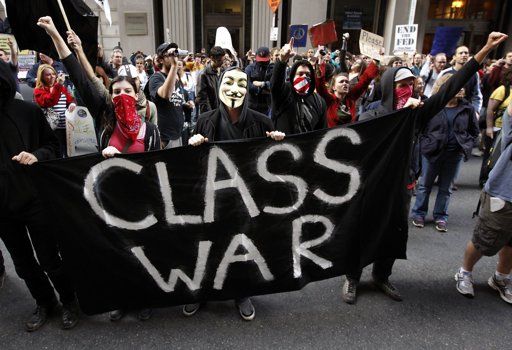


In other significant ways it has spectacularly failed.

Thomas Sowell, economist and philosopher and the best thinker in my opinion of the last 70 years, wrote in what I consider to be his magnum opus A Conflict of Visions: Ideological Origins of Political Struggles that human beings philosophically break down, crudely but sufficiently descriptively, into two fundamentally opposed worldviews that they are effectively born with, not that they reach through reason:
 Sowell calls one worldview the "constrained vision." It sees human nature as flawed or fallen, seeking to make the best of the possibilities that exist within that constraint. The competing worldview, which Sowell terms the "unconstrained vision," instead sees human nature as capable of continual improvement.

You can trace the constrained vision back to Aristotle; the unconstrained vision to Plato. But the neatest illustration of the two visions occurred during the great upheavals of the 18th century, the American and French revolutions.

The American Revolution embodied the constrained vision. "In the United States," Sowell says, "it was assumed from the outset that what you needed to do above all was minimize [the damage that could be done by] the flaws in human nature." The founders did so by composing a constitution of checks and balances. More than two centuries later, their work remains in place.

The French Revolution, by contrast, embodied the unconstrained vision. "In France," Sowell says, "the idea was that if you put the right people in charge--if you had a political Messiah--then problems would just go away." The result? The Terror, Napoleon and so many decades of instability that France finally sorted itself out only when Charles de Gaulle declared the Fifth Republic.
I would argue that France hasn't exactly sorted itself out, but it is for the moment stable enough. (Editor's note:  This essay was written before the French Yellow Vest Movement.  I may have been overly optimistic.) My point here is that those born with the "unconstrained" worldview are the ones that can be, and often enthusiastically are, receptive to the Utopian promise of Marxism.  The problem is that those born with the "constrained" worldview aren't, and they don't understand that. As a result, as Charles Krauthammer put it:
To understand the workings of American politics, you have to understand this fundamental law: Conservatives think liberals are stupid. Liberals think conservatives are evil.
So President Trump got elected to the shock of almost everyone, everywhere. No one in the political establishment, entertainment or information media could understand it.  He was, despite his wealth and education, not part of the Ruling Class, but he was President and a danger to the status quo so everyone who is part or imagines themselves part or wants to be part of the Ruling Class has agreed that he won illegitimately and must be gotten rid of regardless the cost. All those people who voted for him? Moronic knuckle-draggers, Christian fanatics clinging to their faith, evil gun owners clinging to their pseudo-penises, evil greedy capitalists clinging to their ill-gotten gains, white supremacists longing to bring back slavery, etc, etc, etc. In short, the non-human enemy that cannot be reached so it must be wiped out.  You know, like Hitler and the Nazis. 

The irony, it burns!

The American Left is most strongly concentrated in urban and suburban areas. As previously noted, they control the information and entertainment media and the entire education system from Kindergarten to post-graduate. They therefore think that almost everyone thinks like they do. They swim in waters that they don't ever think about. But the people who elected Trump exist in large quantities nationwide. The Left doesn't consider that number. It's their blind spot. These people live in "flyover country."

When Trump appointed Betsy DeVos as Secretary of Education in 2017, the Left came further unhinged. DeVos, we were told, was unqualified, unprepared, "fundamentally incompetent," a zealot, and - to the Teacher's unions - apparently Gozer the Gozerian because she is enthusiastically in favor of education vouchers and school choice. Something the teachers unions vociferously oppose. You'll notice that our "Ruling Class" already practices "school choice." Their offspring attend private schools.
It is only from a special point of view that 'education' is a failure. As to its own purposes, it is an unqualified success. One of its purposes is to serve as a massive tax-supported jobs program for legions of not especially able or talented people. As social programs go, it’s a good one. The pay isn’t high, but the risk is low, the standards are lenient, entry is easy, and job security is pretty good...in fact, the system is perfect, except for one little detail. We must find a way to get the children out of it. -- Richard Mitchell, The Underground Grammarian
School choice is not enough. We need to nuke the whole thing from orbit, and make the rubble bounce.

Sugatra Mitra, as previously noted, was among the forefront of people who had to learn how to write software, and ended up doing more teaching of that skill than physics. When the generic PC hit the market, his colleagues were astounded to find that their young children could learn to operate these complex, expensive machine without instruction. He decided to investigate this phenomenon:
I used to teach people how to write computer programs in New Delhi, 14 years ago (1999) , and right next to where I worked there was a slum. I used to think how on earth are those kids ever going to learn to write computer programs? Or should they not? At the same time we had lots of parents, rich people who had computers, and who used to tell me "You know, my son, I think he's gifted, because he does wonderful things with computers. Oh and my daughter - surely she is extra intelligent." and so on. So I suddenly figured that how come all the rich people are having these extraordinarily gifted children? What did the poor do wrong?

I made a hole in the boundary wall of the slum next to my office, and stuck a computer inside just to see what would happen if I gave a computer to children who never would have one, didn't know any English, didn't know what the Internet was. The children came running in. It was three feet off the ground, and they said "What is this?" And I said "Yeah, it's, I don't know." They said "Why did you put it there?" I said "Just like that." And they said "Can we touch it?" And I said "If you wish to." And I went away.

About eight hours later, we found them browsing, and teaching each other how to browse. So I said "That's impossible, because- You know how is it possible? They don't know anything." My colleagues said "no it's a simple solution. One of your students must have been passing by and showed them how to use the mouse." So I said "Yeah, that's possible." So I repeated the experiment. I went 300 miles out of Delhi into a really remote village where the chances of a passing software development engineer was very little. I repeated the experiment there. There was no place to stay, so I stuck my computer in, I went away. I came back after a couple of months, found kids playing games on it. When they saw me they said "We want a faster processor and a better mouse." So I said "How on Earth do you know all this?" And they said something very interesting to me. In an irritated voice they said "You've given us a machine that works only in English, so we had to teach ourselves English in order to use it." That's the first time as a teacher I've heard the words "teach ourselves" said so casually.
Please watch the entire 22 minute video. It's important for your understanding of the rest of this essay. If you've not seen it before, it'll knock your socks off. If you're unfamiliar with the man, watch several more of his presentations. But Self Organized Learning Environments and the School in the Cloud answering "big questions" are also not enough. Human beings need to be able to do simple math in their heads, to at least understand algebra, to read with comprehension and for enjoyment, to understand history, both Western and worldwide, to understand how different governments work (or don't), and much more. In addition they need to be able to apply their knowledge to reach logical rather than emotional hypotheses and test them. They need to learn skills that have been, as Mike Rowe observes, abandoned in the pursuit of mostly useless, incredibly expensive college degrees with the specious promise that a piece of paper guarantees a well-paying career, thus leaving society with a disdain for jobs that require physical labor as somehow inferior and degrading. And they need to be taught a work ethic. I like Mike's take on it.

As R.A. Heinlein put it:
A human being should be able to change a diaper, plan an invasion, butcher a hog, conn a ship, design a building, write a sonnet, balance accounts, build a wall, set a bone, comfort the dying, take orders, give orders, cooperate, act alone, solve equations, analyze a new problem, pitch manure, program a computer, cook a tasty meal, fight efficiently, die gallantly. Specialization is for insects.
While there are autodidacts (I'm one when it comes to American history, education and Constitutional law), I don't think many people are. Those people who aren't need some direction, some pressure to learn. Generally it's pursuit of better employment opportunities, but those are adults. We're talking here about primary education. Again the Internet has become the place to go for everything from mathematics to chemistry to ancient history, to just about anything you can imagine, but someone has to provide that content and point kids at it with interest in learning it.

As far as content creation is concerned, there is multiple-degreed former hedge-fund manager and now The Most Influential Person in Education Technology, Salman Kahn, who in 2004 was tutoring his niece in mathematics long-distance using YouTube, Yahoo Doodle, a $900 desktop from Best Buy with a $200 microphone, and a closet as an office. Sound familiar?

Kahn established his non-profit Kahn Academy in 2008, beginning with a mathematics curricula, but with outside funding he's been able to hire staff and expand to many, many other subjects. His major concern, however, is mastery of the subject. That requires keeping track of each student's progress, and not allowing them to move on until they demonstrate that mastery:
I grew up with plenty of smart people. They would beat me at chess, they could solve brain teasers before I could, but then they would struggle in algebra. These were incredibly smart people who simply did not have the foundation in math that I had. I saw the same thing with my cousin, Nadia. She had actually gotten “A”s and “B”s in every math class. Despite that, she had some serious gaps in her knowledge that became more significant as the content became more difficult.
These gaps are due to the Prussian system - all students arrive in the classroom at the same time, are lectured by a teacher who has little to no time for individual attention but must finish the lecture before the next bell rings and then gives homework to the students to be turned in the next day. As he has said many times, would you construct a building this way? His example is that a contractor is hired to build that building, with a rigid time schedule. The contractor has X number of days to pour the foundation, regardless of weather or anything else. When the inspector shows up, he says "Well the concrete isn't quite dry here, and there's a crack there. I'd give it an 80%." Well, 80% is a "B" and that's good enough, right? So the contractor proceeds. But when they get to the 4th floor, the entire structure collapses. Who's at fault?

The education system.

With the Kahn Academy the lectures are viewed at home where you can back them up or simply repeat them until you've got the idea. Only then are you given problems to work, which can be done in the classroom in collaborative effort with five or six other students helping explain anything the struggling student still doesn't quite grasp, just as Dr. Mitra's SOLEs are set up. Software keeps track of the student's performance by providing those questions to solve, and once the student gives a sufficient number of correct answers in a row it determines that the student has shown mastery of the idea and allows moving ahead to the next concept. Each child learns at a different pace, with some progressing rapidly and others needing more time. The Kahn Academy model is the very definition of "No child left behind." The critical thing is, short of a mental disability your kid isn't necessarily more brilliant than other kids but they're all a lot brighter than we give them credit for. It's just that our "education" system forces them to not learn.

Back when I started this post literally years ago Kahn was working with a public school and concentrating on mathematics with this reverse system. I found an article about it which I can't find now, but I do remember that the class he was working with was something like sixth-graders. One student really grasped math. She had advanced to Calculus in a very short period - a class I had to work hard to get into my Senior year of High School in the Prussian system. There were nine of us in that class out of about 200 Seniors. She was maybe 12 years old. But what struck me was a comment by one of her teachers: "How do we slow them down?"

We shouldn't, but that "teacher" should be fired. I refer you back to that quote from the Underground Grammarian.

Kids learn, as Dr. Mitra has found, when they are intellectually challenged.  They learn at different rates, as Salman Khan has exhaustively documented. And they generally learn best when allowed to collaborate in small groups, receive enthusiastic reinforcement from adults, and are otherwise left alone to teach themselves.  No wonder the teachers unions are afraid. They're pretty much not needed, and are instead an anchor slowing if not preventing not "education" but learning. The money thrown at "education" has no effect, but the education establishment constantly blames a lack of sufficient funding as the root cause of the failure of the education system, so more and more money gets poured down that particular rat-hole.


And where does that money go? Not into infrastructure, not into the classroom, certainly not into the pockets of teachers, no matter how good or bad they are, but into the pockets of an ever-expanding army of bureaucrats that "administrate" or monitor students for things like political correctness and diversity and tolerance. Like all government programs, failure means "throw more money at it."

In addition children need to be challenged and allowed to work with both their brains and their hands to learn useful skills.  That opportunity could come from access to "Maker Labs" now springing up, albeit slowly, around the country. Hopefully the growth of these learning centers will also be exponential. The problem here though is that such labs are expensive to establish, to stock and to maintain.  That money has to come from somewhere, and the Ruling Class has no incentive to provide that funding, given that it does not produce the dependable, uniform cogs they depend on.

So we have the opportunity to switch to a system that allows the maximum possible development of every individual, rather than producing those uniform, unthinking cogs our current system relies on, but who wants that? Instead the Ruling Class wants to perpetuate this forever: