I'd Like to Thank My Loyal Readers...
All sixteen of you.
According to Google Analytics, between Jan. 23 and the time of this post, TSM has received 23,129 site visits by 9,461 absolutely unique visitors. Of which 9,445 have visited exactly one time.
Which means, (carry the one...) I have sixteen visitors who have visited more than once in the last month.
And one of them is Markadelphia.
Boy, do I feel special! ;-)
UPDATE: It would appear that not only is Google evil, but it is capable of error. I feel like Nomad at the end of The Changeling!
Saturday, February 23, 2008
Friday, February 22, 2008
Human Reconstruction, the Healing of Souls, and the Remaking of Society
From Hugh Hewitt's seventy minute interview with Jonah Goldberg discussing his new book Liberal Fascism: the Secret History of the American Left from Mussolini to the Politics of Meaning:
Hugh Hewitt: Jonah, at the risk of doing something that will have program directors across the United States screaming at me, I want to talk about Rousseau. This may in fact be the first time...I emphasized those bits because I believe they are at the heart of the difference between the Left and the Right in this country and the world. Hugh Hewitt is accurate in his assessment that Rousseau believed that man was inherently good, and that society - more accurately "civilization" - was at fault for the corruption of Man's nature. You see it most explicitly in the mythos of primitive tribal cultures being "at one with nature" (as opposed to modern civilizations "rape" of it,) and so on. It is the belief that if Man was just restored to his inherent goodness, we would all live in a fair and free society where each would give according to his abilities and would receive in accordance to his needs.
Jonah Goldberg: (laughing)
HH: ...ever on talk radio that Rousseau has been brought up. But I don't know how you get to fascism unless you cover Rousseau to the French Revolution, and then on to the branches in Europe and America. And basically, it's Rousseau's radicalism which unleashed the whirlwind on the West.
JG: Right, I mean, and there are two ways to talk about this. There's the intellectual history, which I think is what you're getting at, where basically it goes French Revolution... the French Revolution, I argue, is the first fascist revolution. It merges nationalism with populism. It tries to replace God with the state. You have these intellectual revolutionaries who use terror and violence to remake society and start over at year zero. They create a secular religion out of politics, where they change the traditional Christian holidays to state holidays. And all of this gets replayed in Nazi Germany, and fascist Italy, and in the Soviet Union. But I think there's an important point to be made, which is that this, it's not necessarily that the fascists of Nazi Germany were inspired by Rousseau, it's that the same thing was happening again, that they were following the same sort of Rousseauian path. And Rousseau, as a philosopher, he basically gives word to a desire that beats in every human heart, to create a tribe out of society, to create, to impose this notion of the general will, where anybody who deviates from what the collective thinks he should do is a heretic or a traitor, to sanctify politics. And that's what inspired the French revolutionaries. That's what they took from Rousseau. And in many ways, that's what people like Mussolini and Hitler took from the French Revolution, is this same sort of burning desire to create a religion of the state. And we see the same thing that happened in the French Revolution replay itself in Germany, and to a lesser extent, replay itself in fascist Italy.
HH: And you know, it's the same temptation over and over again, and it's one abroad in the land right now, which is why I want to pause on this, which is Rousseau believed that man was good, you know, that the state came along, or that society came along and screwed things up, but that actually, that men were innately good. And that's simply not a conservative view, Jonah Goldberg. It's anti-conservative. It's also anti-theology in most senses.
JG: Right. I mean, I think the fundamental difference, the difference that defines the difference between American, Anglo-American conservatives and European welfare states, leftists or liberals, is Locke versus Rousseau. Every philosophical argument boils down to John Locke versus Jacques Rousseau.
HH: Yup.
JG: Rousseau says the government is there, that our rights come from the government, that (they) come from the collective. Locke says our rights come from God, and that we only create a government to protect our interests. The Rousseauian says you can make a religion out of society and politics, and the Lockean says no, religion is a separate sphere from politics. And that is the defining distinction between the two, and I think that distinction also runs through the human heart, that we all have a Rousseauian temptation in us. And it's the job of conservatives to remind people that the Lockean in us needs to win.
But as Tony Woodlief once put it (I paraphrase), anyone who espouses a belief in the inherent Goodness of Man has never stood between a toddler and the last cookie.
Jonah mentions that Hillary Rodham in her commencement address at Wellesly in 1969 said this:
What does it mean to hear that 13.3% of the people in this country are below the poverty line? That's a percentage. We're not interested in social reconstruction; it's human reconstruction.She didn't want to fix society, she wanted to fix humanity. Michele Obama tells us:
We have lost the understanding that in a democracy, we have a mutual obligation to one another, that we cannot measure our greatness in this society by the strongest and richest of us, but we have to measure out greatness by the least of these, that we have to compromise and sacrifice for one another in order to get things done. That is why I'm here, because Barack Obama is the only person in this race who understands that, that before we can work on the problems, we have to fix our souls. Our souls are broken in this nation.Yes, you see, society has altered us from our inherent goodness, and if we could just...
If we can't see ourselves in one another, we will never make those sacrifices. So I am here right now, because I am married to the only person in this race who has a chance of healing this nation.I guess "fixing our souls" is a form of "human reconstruction." Michele Obama believes that her husband has that power, the ability to "heal the nation" by "fixing our souls" and returning us to our inherent goodness. She continues:
We say we're ready for change, but see, change is hard. Change will always be hard. And it doesn't happen from the top down. We do not get universal health care, we don't get better schools because somebody else is in the White House. We get change because folks from the grass roots up decide they are sick and tired of other people telling them how their lives will be, when they decide to roll up their sleeves and work. And Barack Obama will require you to work. He is going to demand that you shed your cynicism, that you put down your division, that you come out of your isolation, that you move out of your comfort zones, that you push yourselves to be better, and that you engage. Barack will never allow you to go back to your lives as usual, uninvolved, uninformed.What hubris.
But it is Rousseauian. As Donald Sensing put it, both parties now lurching Leftward
have a foundational philosophy that is the same:Slightly altering that sentiment, Americans are a problem to be fixed, and America is a society to be managed.
America is a problem to be fixed, and Americans are a people to be managed.
Neither side has chosen a Lockean candidate for the office of President. John McCain has stated that he believes that rights are essentially creations of government. On the question of free speech, he said on Don Imus's radio program:
I would rather have a clean government than one where quote First Amendment rights are being respected, that has become corrupt. If I had my choice, I'd rather have the clean government."Quote 'First Amendment rights.'" He says this as a Senator who must swear this oath upon assuming office:
I do solemnly swear (or affirm) that I will support and defend the Constitution of the United States against all enemies, foreign and domestic; that I will bear true faith and allegiance to the same; that I take this obligation freely, without any mental reservation or purpose of evasion; and that I will well and faithfully discharge the duties of the office on which I am about to enter: So help me God.But the First Amendment apparently doesn't count - which makes one wonder which other parts of the Constitution he's willing to put "scare quotes" around.
Still, McCain doesn't seem interested in fixing humanity, just legislating for our better behavior. It is Hillary and Obama that worry me the most, as they are uncomfortably close to the levers of power, and their philosophical counterparts may hold sway in both houses of Congress after the next election.
Donald Sensing continued in his piece:
A friend of mine emigrated here from Romania after Ceaucescu’s regime fell. He told me the other day that Americans are over-regulated. Think about that; a man coming from a communist country believes that Americans are over-regulated. It chills.As Tam put it yesterday, things have gotten worse:
A long time ago Steven Den Beste observed in an essay, "The job of bureaucrats is to regulate, and left to themselves, they will regulate everything they can." Celebrated author Robert Heinlein wrote, "In any advanced society, ‘civil servant’ is a euphemism for ‘civil master.’" Both quotes are not exact, but they’re pretty close. And they’re both exactly right. Big government is itself apolitical. It cares not whose party is in power. It simply continues to grow. Its nourishment is that the people’s money. Its excrement is more and more regulations and laws. Like the Terminator, "that’s what it does, that’s all it does."
I do not believe Bush’s domestic policies are in the best interests of our long-term freedom. I do not think that Bush’s domestic legacy will, in the long run, be good for the country.
Hence I cannot urge anyone to vote for Bush in 2004.
Which is not to say that I endorse any of the Democrats running for president; they are more strident big-government activists than Bush, and won’t protect us from terrorism to boot. So I feel caught between the devil and the deep blue sea.
I predict that the Bush administration will be seen by freedom-wishing Americans a generation or two hence as the hinge on the cell door locking up our freedom. When my children are my age, they will not be free in any recognizably traditional American meaning of the word. I’d tell them to emigrate, but there’s nowhere left to go. I am left with nauseating near-conviction that I am a member of the last generation in the history of the world that is minimally truly free.
If you'll excuse the geeky metaphor, we've come to the Kobayashi Maru election scenario.The founding philosophical document of this nation, the Declaration of Independence, is absolutely Lockean. The founding legal document of this nation is Locke's philosophy made law.
And now we've abandoned Locke for either Rousseau or... I don't know what, but it isn't Locke. Jonah Goldberg concluded on the Locke/Rousseau topic:
(I)t is a natural human desire to want to recreate that sort of religious, spiritual tribal feeling. And we constantly are looking for it in our politics. The problem is it's fool's gold. You can never get it. And so we constantly are following these false prophets. And that's why in my view, all of these people who sell this stuff... Marxism was essentially selling this, that we're going to create a Heaven on Earth. Fascism was doing a thousand year Reich. All of these guys sell the same thing. That's why I think they're all reactionary, because they're all trying to recreate this feeling that we got when we lived in caves. And the only true radical, revolutionary, inspiring revolution of the last thousand years was the Enlightenment Revolution of Locke, Rousseau, the American founding, which said our rights come from God, and that government is our servant, not our master.But it will become our master, because we'll let it in our desire to chase false prophets who can heal our souls, reconstruct humanity, remake society and create Heaven on Earth.
UPDATE: Read this associated post by the Geek from Election Eve of 2006, too. (Link broken.)
For that matter, re-read my own Tough History Coming from November of 2005.


Quote of the Day.
That's funny right there. I don't care who you are.
Castro resigns, possible VP for ObamaBlog post title at Conservative Scalawag.
That's funny right there. I don't care who you are.
Thursday, February 21, 2008
CNN - The Most Busted Name in News.
Nothing like accuracy in journalism. Reader "homeboy" emailed me a link to a CNN report on YouTube designed to inspire PSH among the citizenry over "painted guns." Yes, the "Hello Kitty" AR-15 and various other firearms refinished in Gun Kote and other finishes. They even get a spokesman from Law Enforcement to inform the public about the dangers of pink guns. As SayUncle put it, "if you see a gun-shaped object then it is in your best interest to assume it is a gun and act accordingly."
But the point of this post is CNN's legendary accuracy. It's real, but it's NOT a Glock:
Hey, why not? CNN believed that a post-ban AK couldn't destroy cinderblocks, and pre-ban AK's were fully automatic.
There's not a single recreational shooter working at CNN, is there?
Nothing like accuracy in journalism. Reader "homeboy" emailed me a link to a CNN report on YouTube designed to inspire PSH among the citizenry over "painted guns." Yes, the "Hello Kitty" AR-15 and various other firearms refinished in Gun Kote and other finishes. They even get a spokesman from Law Enforcement to inform the public about the dangers of pink guns. As SayUncle put it, "if you see a gun-shaped object then it is in your best interest to assume it is a gun and act accordingly."
But the point of this post is CNN's legendary accuracy. It's real, but it's NOT a Glock:

Hey, why not? CNN believed that a post-ban AK couldn't destroy cinderblocks, and pre-ban AK's were fully automatic.
There's not a single recreational shooter working at CNN, is there?
Wednesday, February 20, 2008
"...as if it were something ominous."
Megan McArdle links to this CNN story that reports:
Steven Kazmierczak had been taking three drugs prescribed for him by his psychiatrist, the Northern Illinois University gunman's girlfriend told CNN.The first question I had upon hearing about the shooting was "I, for one, wonder if the shooter was on anti-depressants."
Jessica Baty said Tuesday that her boyfriend of two years had been taking Xanax, used to treat anxiety, and Ambien, a sleep agent, as well as the antidepressant Prozac.
Megan doesn't see it that way:
This is being reported as if it were something ominous, perhaps the cause of the tragedy. This seems a little much. It's not exactly shocking to find out that people who go on shooting sprees are often depressed, anxious types with difficulty sleeping.Megan seems to be missing the point. This kind of rampage murder/suicide was extremely rare. It has since become something that occurs two, three, or four times a year. Everybody asks "what changed?" Most seem to blame "the number of guns" or "gun availability," but the fact of the matter is that "gun availability" has never been the issue - guns have always been available. Some people blame violent video games, but there doesn't seem to be a correlation there.
The one thing that seems to be consistent is that the shooters are often on (or recently off of) medications like Prozac. According to this NY Times piece:
Over the years, the antidepressant Prozac and its cousins, including Paxil and Zoloft, have been linked to suicide and violence in hundreds of patients. Tens of millions of people have taken them, and doctors say it is almost impossible to tell whether the spasms of violence stem in part from drug reactions or the underlying illnesses.Tens of millions. Well, gee, how many "rampage shootings" did the U.S. (or the world, for that matter) see prior to the widespread use of these drugs, and how many do we see now? And if these drugs affect only 1/100 of 1% of people this way, that's 1,000 out of every 10,000,000.
So yes, Megan, many of us are wondering if Prozac wasn't a contributor to Kazmierczak's decision to murder a bunch of college students and then kill himself. The correlation seems to point in that direction.
Tuesday, February 19, 2008
Quote of the Day.
(Too busy with personal things to blog. This will have to do.)
I raised my eyebrow so violently it probably made a noise.From this Reason Online "Hit & Run" post.
(Too busy with personal things to blog. This will have to do.)
Monday, February 18, 2008
Quote of the Day
I'm enjoying this Democratic primary, as it seems to be causing our friends to the left to notice phenomena that they had previously pooh-poohed. - Instapundit on the Left's infighting over the Democratic primariesDon't worry, Professor. After it's all settled, they'll deny it all again. Like a Terminator, it's what they do. It's all they do. And they never, ever stop.
(Hey, I'm making a habit of the QotD thing!)
Sunday, February 17, 2008
Book Meme.
This one's been all over the web. Nobody tagged me with it (that I know of) but I like it, and I thought I'd respond to it:
This one's been all over the web. Nobody tagged me with it (that I know of) but I like it, and I thought I'd respond to it:
Which [type of] book do you irrationally cringe away from reading, despite seeing only positive reviews?
Anything on Oprah's list(s).
If you could bring three [fictional] characters to life for a social event (afternoon tea, a night of clubbing, perhaps a world cruise), who would they be and what would the event be?
Lois McMaster Bujold's Miles Vorkosigan in his position as Imperial Auditor; S.M. Stirling's Raj Ammenda Halgern Da Luis Whitehall; and R.A. Heinlein's Mycroft Holmes. Mike could come along by satellite relay, and we could plot and carry out the conquering of the planet!
You are told you can't die until you read the most boring novel on the planet. While this immortality is great for awhile, eventually you realize it's past time to die. Which book would you expect to get you a nice grave?
That was Samuel R. Delany's Dahlgren. I read it until I saw the bright light, and then I put it down.
Come on, we've all been there. Which book have you pretended, or at least hinted, that you've read, when in fact you’ve been nowhere near it?
None. If I haven't read it, I say so.
As an addition to the last question, has there been a book that you really thought you had read, only to realize when you read a review about it/go to 'reread' it that you haven't? Which book?
Nope.
You've been appointed Book Adviser to a VIP (who’s not a big reader). What's the first book you'd recommend and why? (if you feel like you’d have to know the person, go ahead of personalize the VIP).
Depends on the VIP. If it's a politician, Bill Whittle's Silent America. The "why" is self-explanatory.
A good fairy comes and grants you one wish: you will have perfect reading comprehension in the foreign language of your choice. Which language do you go with?
Oy. I don't have enough time to read the stuff I want to that's in English. I'd say Latin. There's a bunch of Roman-era stuff that would be interesting in the original, and French, Italian, and Spanish are all latin-based, which would make picking those languages up much simpler.
Alternately, Mandarin Chinese.A mischievous fairy comes and says that you must choose one book that you will reread once a year for the rest of your life (you can read other books as well). Which book would you pick?
Frank Herbert's Dune, if I'm going to read for pleasure. I reread it about every five years as it is.
I know that the book blogging community, and its various challenges, have pushed my reading borders. What's one bookish thing you 'discovered' from book blogging (maybe a new genre, or author, or new appreciation for cover art-anything)?
I read a huge amount of non-fiction now that I never would have read before, and it is spurred exclusively from me wanting to know more about the subjects that interest me that I've found through blogging.
That good fairy is back for one final visit. Now, she's granting you your dream library! Describe it. Is everything leather bound? Is it full of first edition hardcovers? Pristine trade paperbacks? Perhaps a few favorite authors have inscribed their works?
Realistically, I prefer paperbacks for their handiness and compactness. If I could have a "dream library, all my books would be paperback-sized printed on archival acid-free paper and archival bound.
Quote of the Day.
Compare and contrast that with this comment by Sarah, of the blog Carnaby Fudge:
Let me know when you stop regarding us religious types as ignorant, irrational subhumans.Francis Porretto, proprietor of Eternity Road (which I have listed on the sidebar under "True Excellence," BTW) from a comment to yesterday's QotD.
Compare and contrast that with this comment by Sarah, of the blog Carnaby Fudge:
"What has been your best blogging experience?"Things that make you go, "Hmmmmm....."
Arguing with Kevin from The Smallest Minority over religion and philosophy.
Saturday, February 16, 2008
Quote of the Day.
(A)t heart, most US citizens are libertarians by default - it is simply that most of them have "pet" projects they consider to be exceptions. Libertarianism is political atheism, and, to paraphrase Dawkins, everyone is a libertarian on most subjects, some just go one political project further."Adirian" in a comment to the post Really, It's Worse Than That.
Friday, February 15, 2008
Compare and Contrast.
A while back, City Journal ran a piece entitled The Myth of the Working Poor (which I highly recommend, BTW). Here's an excerpt:
After all, Shepard is a man.
Read the CSM interview. It's worth your time.
A while back, City Journal ran a piece entitled The Myth of the Working Poor (which I highly recommend, BTW). Here's an excerpt:
Books like Barbara Ehrenreich's Nickel and Dimed and David Shipler's The Working Poor tell us that the poor are doing exactly what America expects of them—finding jobs, rising early to get to work every day, chasing the American dream—but that our system of "carnivorous capitalism" is so heavily arrayed against them that they can't rise out of poverty or live a decent life. These new anthems of despair paint their subjects as forced off welfare by uncompassionate conservatives and trapped in low-wage jobs that lead nowhere. They claim, too, that the good life that the country's expanding middle class enjoys rests on the backs of these working poor and their inexpensive labor, so that prosperous Americans owe them more tax-funded help.And they're still using it today.
Though these books resolutely ignore four decades' worth of lessons about poverty, they have found a big audience. The commentariat loves them. Leftish professors have made them required course reading. And Democratic candidates have made their themes central to the 2004 elections.
Like communists who claim that communism didn't fail but instead was never really tried, Barbara Ehrenreich made her public debut with an attempt to brush aside the War on Poverty's obviously catastrophic results. The 46-year-old daughter of a Montana copper miner-turned-business executive, she joined Cloward and Piven to co-author a 1987 polemic, The Mean Season: The Attack on the Welfare State. The War on Poverty had failed so far, the book claimed, not because of its flawed premises but because the government hadn't done enough to redistribute the nation's wealth. America needed an even bigger War on Poverty that would turn the country into a European-style social welfare state. Pooh-poohing the work ethic and the dignity of labor, the authors derided calls for welfare reform that would require recipients to work, because that would be mortifying to the poor. "There is nothing ennobling about being forced to please an employer to feed one's children," the authors wrote, forgetting that virtually every worker and business owner must please someone, whether boss or customer, to earn a living. Welfare's true purpose, the book declared, should be to "permit certain groups to opt out of work." (The authors never explained why all of us shouldn't demand the right to "opt out.")What a surprise.
Her 1989 book, Fear of Falling: The Inner Life of the Middle Class, blamed poverty's continued existence in America partly on the Me Generation, which Tom Wolfe had so brilliantly made interesting to the nation. America's emerging professional middle class had started out hopefully in the 1960s, Ehrenreich claims, the inheritor of a liberating cultural revolution. But because that class depended on intellectual capital to make its living, rather than on income from property or investments, it felt a sharp economic insecurity, which by the late 1980s had made it "meaner, more selfish," and (worse still) "more hostile to the aspirations of the less fortunate," especially in its impatience with welfare.Aren't they always? Ehrenreich and her ilk would, of course, be the ones doing the taxing and redistributing, since they are The Anointed and know what's best for the rest of us.
The book vibrates with Ehrenreich's rage toward middle-class Americans. The middle class, she sneers, obsessively pursues wealth and is abjectly "sycophantic toward those who have it, impatient with those who do not." To Ehrenreich, "The nervous, uphill climb of the professional class accelerates the downward spiral of society as a whole: toward cruelly widening inequalities, toward heightened estrangement along class lines, and toward the moral anesthesia that estrangement requires." Ironically, Ehrenreich's economic prescription for a better America was for government to create one gigantic bourgeoisie: "Tax the rich and enrich the poor until both groups are absorbed into some broad and truly universal middle class. The details are subject to debate."
Ehrenreich's anger propelled her to write Nickel and Dimed. Beginning life as a piece of "undercover journalism" for Harper's, the 2001 book purports to reveal the truth about poverty in post-welfare reform America. "In particular," Ehrenreich asks in the introduction, how were "the roughly four million women about to be booted into the labor market by welfare reform . . . going to make it on $6 or $7 an hour?"Here's the point of this post - refutation of Ehrenreich's argument in the form of a similar experiment carried out by someone who intends to see it through honestly: Homeless: Can you build a life from $25? - an article in the Christian Science Monitor. Excerpt:
Nickel and Dimed doesn't fuss much with public-policy agendas, messy economic theories, or basic job numbers. Instead, it gives us Ehrenreich's first-person account of three brief sojourns into the world of the lowest of low-wage work: as a waitress for a low-priced family restaurant in Florida; as a maid for a housecleaning service in Maine; and as a women's-apparel clerk at a Minneapolis Wal-Mart. In her journeys, she meets a lively and sympathetic assortment of co-workers: Haitian busboys, a Czech dishwasher, a cook with a gambling problem, and assorted single working mothers. But the focus is mostly on Ehrenreich, not her colleagues.
The point that Nickel and Dimed wants to prove is that in today's economy, a woman coming off welfare into a low-wage job can't earn enough to pay for basic living expenses. Rent is a burden, Ehrenreich discovers. In Florida, she lands a $500-a-month efficiency apartment; in Maine, she spends $120 a week for a shared apartment in an old motel (she turns down a less expensive room elsewhere because it's on a noisy commercial street); in Minneapolis, she pays $255 a week for a moldy hotel room. These seem like reasonable enough rents, except perhaps for Minneapolis, judging from her description of the place. But with her entry-level wages—roughly the minimum wage (when tips are included) as a waitress, about $6 an hour as a maid, and $7 an hour to start at Wal-Mart—Ehrenreich quickly finds that she'll need a second job to support herself. This seems to startle her, as if holding down two jobs is something new to America. "In the new version of supply and demand," she writes, "jobs are so cheap—as measured by the pay—that a worker is encouraged to take on as many as she possibly can."
What's utterly misleading about Ehrenreich's exposé, though, is how she fixes the parameters of her experiment so that she inevitably gets the outcome that she wants—"proof" that the working poor can't make it.
Alone on a dark gritty street, Adam Shepard searched for a homeless shelter. He had a gym bag, $25, and little else. A former college athlete with a bachelor's degree, Mr. Shepard had left a comfortable life with supportive parents in Raleigh, N.C. Now he was an outsider on the wrong side of the tracks in Charleston, S.C.Rather different from Ms. Ehrenreich's experience.
But Shepard's descent into poverty in the summer of 2006 was no accident. Shortly after graduating from Merrimack College in North Andover, Mass., he intentionally left his parents' home to test the vivacity of the American Dream. His goal: to have a furnished apartment, a car, and $2,500 in savings within a year.
To make his quest even more challenging, he decided not to use any of his previous contacts or mention his education.
During his first 70 days in Charleston, Shepard lived in a shelter and received food stamps. He also made new friends, finding work as a day laborer, which led to a steady job with a moving company.
Ten months into the experiment, he decided to quit after learning of an illness in his family. But by then he had moved into an apartment, bought a pickup truck, and had saved close to $5,000.
The effort, he says, was inspired after reading "Nickel and Dimed," in which author Barbara Ehrenreich takes on a series of low-paying jobs. Unlike Ms. Ehrenreich, who chronicled the difficulty of advancing beyond the ranks of the working poor, Shepard found he was able to successfully climb out of his self-imposed poverty.Now there's a book that might be worth picking up. Of course, I'm sure Ms. Ehrenreich would claim his experiment didn't prove a thing.
He tells his story in "Scratch Beginnings: Me, $25, and the Search for the American Dream." The book, he says, is a testament to what ordinary Americans can achieve.
After all, Shepard is a man.
Read the CSM interview. It's worth your time.
Really,.It's Worse Than That
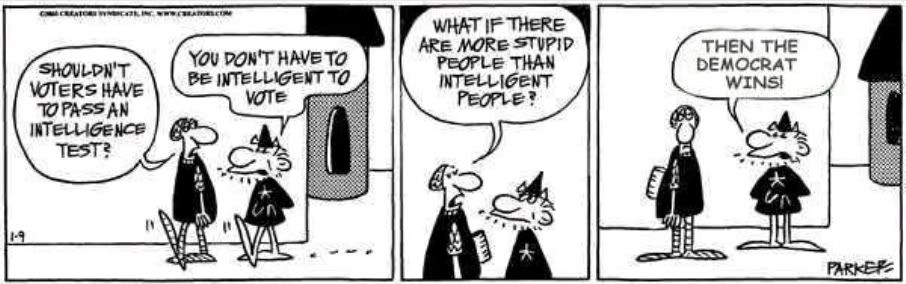
The stupid people vote in the primaries first.
Both side's primaries.
And, obviously, they outnumber the intelligent people now and have for a while. I blame the public education system, and have for a long while.
It's easier to lead stupid people around than intelligent, informed ones. Here's that Connie du Toit quote again:
And you may want to give a listen to some sound clips from a recent speech by Michele Obama. I'm fairly certain I don't want my government trying to fix my soul so that the Great Collective functions as she seems to believe it ought to.
(Click for full size)
The stupid people vote in the primaries first.
Both side's primaries.
And, obviously, they outnumber the intelligent people now and have for a while. I blame the public education system, and have for a long while.
It's easier to lead stupid people around than intelligent, informed ones. Here's that Connie du Toit quote again:
The other day our Carpenter’s helper heard me say something along the lines of, "it is difficult to conclude that incompetence is the reason why our public schools have deteriorated. There comes a point where you have to suspect sabotage, or a conspiracy."Amen.
He asked me if I really meant that. I gave him the five minute explanation of John Dewey’s known affiliation with communists, his frequent essays and articles about the wonders of the Soviet education system, and his quote, "You can’t make Socialists out of individualists. Children who know how to think for themselves spoil the harmony of the collective society which is coming where everyone is interdependent."
I then went on to tell him about how public schools changed at the turn of the last century. That there were others involved in turning Americans from free-thinking individualists to factory drones. I also added that many people probably went along with it because it seemed like a good idea, but there were certainly enough people behind the scenes, who knew that the goal posts had been moved. THAT is a conspiracy.
Yes. There does come that time when you are forced to don the tinfoil hat.
The incompetence excuse only works once. Incompetence this great is impossible to attribute to accident.
And you may want to give a listen to some sound clips from a recent speech by Michele Obama. I'm fairly certain I don't want my government trying to fix my soul so that the Great Collective functions as she seems to believe it ought to.
Quote of the Day.
You see, I can already predict how things would go if it were demonstrated that anti-depressants have a determinant role in sudden outbursts of homicidal-suicidal violence.What do you expect in a country where there's one lawyer for every 300 of us? Hey, they gotta eat!
Promotion of responsible use of these drugs? No way.
Pharma companies would be sued nearly out of existence and the use of anti-depressants strictly regulated (some of them may be banned altogether), all to the detriment of those people who'd actually benefit from them. - Fabio C. in a comment to Another Gun Free Zone.
Thursday, February 14, 2008
Hey!.I Just Realized...
...Bush signed the "economic stimulus package" - i.e. "giving us our money back because we know better how to spend it." I figure the check will arrive in May or June - just in time to pay off my trip to the 2nd Amendment Blog Bash.
I wondered how I was going to pay for that.
...Bush signed the "economic stimulus package" - i.e. "giving us our money back because we know better how to spend it." I figure the check will arrive in May or June - just in time to pay off my trip to the 2nd Amendment Blog Bash.
I wondered how I was going to pay for that.
Another Gun Free Zone Does its Job.
And once again a rampage shooting ends when the shooter decides he's done.
According to this story, there have been four fatalities in addition to the shooter, but this is the part that sticks with me:
I am reminded once again of Tam's declaration:
Expect there to be immediate blaming of the guns for this.
I, for one, wonder if the shooter was on anti-depressants.
UPDATE: From ABC News:
UPDATE II: According to the same report, the shooter purchased two of his four firearms last Saturday, from a licensed dealer in Champaign. According to this report, it was nine days ago.
Illinois has a 24 hour waiting period for long gun purchases, and a 72 hour waiting period for handguns. I'd assume he started the purchase nine days ago and picked them up on Saturday after the 72 hour waiting period for the handgun.
Boy, that waiting period really helped.
Gunman Opens Fire at Northern Illinois UniversityAccording to radio reports, "heavily armed" was a shotgun and a pistol.
A heavily armed man burst into a lecture hall at Northern Illinois University this afternoon and opened fire, wounding as many as 18 people, four of them critically, before taking his own life, authorities said.
The shooter, a thin white male dressed in black and wearing a stocking cap, went into Cole Hall on the university's campus in DeKalb, entered a science class through an emergency door and began shooting at students and a teacher, witnesses told a local radio station and a student newspaper.Well, at least we're back to the "angry white male" demographic.
There was conflicting information on fatalities. A hospital reported that there were none besides the gunman, but the Chicago Tribune quoted the campus police chief as saying four of the shooter's victims had died.Last I'd heard there were 17 victims, three critical, and the only dead was the shooter (not included in the 17.) However, those three were head wounds. I expect more fatalities.
NIU campus police chief Donald Grady told reporters that the gunman apparently had a shotgun and two handguns, including a Glock, but that only one of the handguns was immediately recovered. He said the shooter, who appeared to have been acting alone, had not expended all of his ammunition.Which matches the radio report with the exception of the extra handgun.
School officials said they knew of no motive for the shooting. The gunman does not appear to have been a student at the university but may have been a student somewhere else, they said. He emerged from behind a curtain near the stage and began firing, they said. The man has been identified, but his identity has not yet been released.Yes, when seconds count, the authorities are only minutes away.
"This is a tragedy, but from all indications we did everything we could when we found out," Peters said. "Our security people were there right away."
Grady said police officers were at the scene within two minutes of the shooting and that a campus-wide alert was issued within 15 minutes.As I said...
And once again a rampage shooting ends when the shooter decides he's done.
According to this story, there have been four fatalities in addition to the shooter, but this is the part that sticks with me:
Katie Wagner, a student who was inside the classroom, tells CBS 2 that there were 70 students inside room 101 at Cole Hall when the shooting happened. She said the gunman entered from a side door near the front of the lecture hall and started to fire shots.Waiting to die.
She described the gunman as white, tall, skinny and wearing a black tee shirt - and maybe something red.
She said she went to the ground immediately and just started staring at the floor.
I am reminded once again of Tam's declaration:
I ain't goin' out like that. Whether it's some Columbine wannabe who's heard the backward-masked messages on his Marilyn Manson discs, distressed daytrader off his Prozac, homegrown Hadji sympathetic with his oppressed brothers in Baghdad, or a bugnuts whackjob picking up Robert Frost quotes transmitted from Langley on the fillings in his molars, I am going to do my level best to smoke that goblin before my carcass goes on the pile. I am not going to go out curled into a fetal ball and praying for help that won't arrive in time.There doesn't seem to be much of that attitude in today's youth.
--
Even if the police are right there, it might not do me any good. Heck, I might not do me any good. But, dammit, I am going to try.
Expect there to be immediate blaming of the guns for this.
I, for one, wonder if the shooter was on anti-depressants.
UPDATE: From ABC News:
Stephen Kazmierczak, the 27-year-old who opened fire on a crowded Northern Illinois University lecture hall, killing five and then himself Thursday, was described as "fairly normal" and an "unstressed person" by NIU campus Police Chief Donald Grady.But in the last few weeks his behavior had become erratic, according to Grady, and it is believed the Kazmierczak had stopped taking his medication. The type of medication he was on is unknown.
UPDATE II: According to the same report, the shooter purchased two of his four firearms last Saturday, from a licensed dealer in Champaign. According to this report, it was nine days ago.
Illinois has a 24 hour waiting period for long gun purchases, and a 72 hour waiting period for handguns. I'd assume he started the purchase nine days ago and picked them up on Saturday after the 72 hour waiting period for the handgun.
Boy, that waiting period really helped.
Quote of the Day.
"There is something about a Republican that you can only stand him just so long; and on the other hand, there is something about a Democrat that you can't stand him quite that long." Will RogersFound at my boss's blog. (I didn't know he had one until today!)
Wednesday, February 13, 2008
Quote of the Day.
I don't have MDS (McCain Derangement Syndrome)...but I'm not dazzled by the image of McCain as President.From a comment by "Mumblix Grumph" at American Digest
It's not good when your candidate's slogans could be:
Meh, you could do worse.
or
Meh, he's not that bad, I guess.
While the Democrats with Obama are selling Hope and Change!!!, we're dealing in meh.
We are screwed.
Tuesday, February 12, 2008
Personally, I Think "Violence Policy Center" is a HELL of a Name
for a gun store!
They could use Jeff Cooper's quote on "violence policy" in their advertising:
for a gun store!
They could use Jeff Cooper's quote on "violence policy" in their advertising:
One bleeding-heart type asked me in a recent interview if I did not agree that "violence begets violence." I told him that it is my earnest endeavor to see that it does. I would like very much to ensure—and in some cases I have—that any man who offers violence to his fellow citizen begets a whole lot more in return than he can enjoy.
Subscribe to:
Posts (Atom)